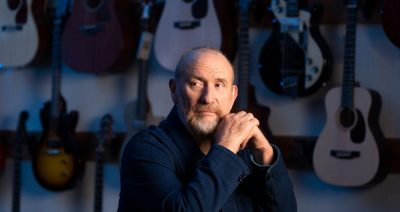
shot for ignition records – may 2013 press session
“Let me teach you how to write a song / The first line must be brief but strong / And the second line should rhyme with something in your baby’s heart / Something that they know but cannot name / And in that way every song’s the same.”
—From “Every Song’s The Same,” track two on Lower Reaches.
Though he exercises some artistic license in the opening line above, Justin Currie points out that he’s “as clueless as the next person” when it comes to the arcane art of songwriting. “It’s a process that will always remain a mystery to me”, he says. “When I wrote “Every Song’s The Same” I was aware that it could be misconstrued, but it was more, ‘Can somebody out there write something I can get excited about; something I can aim at?'”
After six albums with Del Amitri and three solo albums, what Currie has learned about songwriting is that you have to make yourself available to the muse. “Make sure you’re bored”, he says. “Make sure you’re alone.”
To that end, in 2012, the Glaswegian singer briefly extricated himself from city life. Renting a remote cottage, he hunkered down beneath The Cuillins, the mountain range that dominates the Hebridean island of Skye. Currie had no Internet and no mobile phone, just an acoustic guitar, a piano, and a ghetto-blaster on which to record his ideas.
“I suppose it was a bit like my Brill Building”, he smiles. “You’re being your own boss and putting yourself under pressure to write. I thought, ‘[If it doesn’t work out] at least I can go hillwalking…'”
It was songs rather than Skye’s famous munros that got bagged, however. Currie wrote fifteen of them in eleven days, something of a personal best in terms of rapid-fire delivery. The Lower Reaches songs “Falsetto,” “On A Roll,” “On My Conscience” and “Half Of Me” were all shaped on Skye, and in the end Currie came back two days early and repaired to the pub for a well-earned pint. His mate Aldo remarked that he’d never seen him looking so relaxed.
By now the singer had over 30 songs demoed for the album that would become Lower Reaches. He’d noticed that, broadly speaking, they addressed three subjects: love, mortality and music. Though his acclaimed solo debut What Is Love For (2007) and the follow-up The Great War (2010) had been self-produced, this time out Currie wanted an outside producer. He needed someone who could steer him on which songs to record, someone who would “take him out of the equation a bit.”
Having heard and rated Clear Heart Full Eyes, the debut solo album by The Hold Steady’s Craig Finn, Currie approached its producer, Mike McCarthy. McCarthy liked what he heard, and soon Currie was headed for the vintage analogue gear-festooned den that is McCarthy’s Austin, Texas-based studio. He packed a copy of Amexica:War Along The Borderline, Ed Vulliamy’s book about drug feuds down Mexico way, in his suitcase.
“The sessions were actually quite scary”, says Currie. “Mike just took over. The local musicians around Austin revere him because of his work on the …And You Will Know Us by the Trail of Dead records, so there was no question of me leading the musicians.
“I hadn’t met any of the guys he hired to play before I went out there, but even although some of them were half my age, they all had exquisite taste. I didn’t need to explain any references or worry about the palette.”
David Garza plays guitar and piano, and other musicians include members of White Denim, Phosphorescent and the Heartless Bastards. Together, they help Currie navigate a filler-less album that begins with a funeral and ends with a wedding. On the buoyant, almost Badfinger-esque “I Hate Myself For Loving You” and bijou, vintage beat-box propelled “Priscilla,” Currie’s highly-attuned pop sensibility is well to the fore. There are few if any songs on Lower Reaches that don’t have darker or more wistful undercurrents, however. Indeed, even “On My Conscience” – ostensibly a breezy, Byrds-go-Octopus’s Garden-like palette cleanser—drips lyrical bile.
“I hate those really romantic, ‘baby I’m going to take care of you’ type songs”, says Currie when quizzed about “Priscilla,” a song wherein the protagonist appears to accept culpability for damage to an ex-lover. “It doesn’t give me anything to get my teeth into, plus I think you can be quite nasty in a song while the subtext is genuinely romantic. Look at “I’m Not In Love” by 10CC – it works because the guy so obviously is in love.”
It’s on “Into A Pearl,” Lower Reaches’ remarkable piano ballad, that mortality raises its ugly head most movingly. Currie says he previously side-lined the song because “it was just too personal and emotive”, and because of certain stylistic similarities to material on his What Is Love For album. The moment when his unguarded vocal glides up into the falsetto is quite magical; one of this album’s draw-dropping moments.
Elsewhere, men – and perhaps women – of a certain age will identify with the conflicted protagonist of “Half Of Me,” a character torn between cordial-enough domesticity and the need to ‘Go out blazing trails in a haze of rock ‘n’ roll.’ We say protagonist, but we of course mean Currie, a man honest enough to admit that, even as he approaches 49, fifty-percent of him still wants to traverse America in a tour bus.
“Yeah, it’s embarrassing, but the desire doesn’t go away”, he laughs. “Me and my mates will go out to Nice ‘n’ Sleazy on Sauchiehall Street and they’ll be playing Cramps records [extremely] loud. Everyone else in there is 25 and doing Jaeger bombs, but they look great. You catch yourself in the mirror and wince, but then you think, ‘I’m not a golfer or an accountant – maybe this is okay.'”
In truth, Currie can hold his head high. And not least because he has just received props from the songwriter’s songwriter, Jimmy Webb. Together with the likes of Brian Wilson and Kris Kristofferson, Currie guests on Webb’s upcoming duets album, Still Within The Sound Of My Voice. In his self-penned sleeve-notes, Webb writes:
“Justin Currie is probably a revelation to some people in America. This is a voice you have heard somewhere and made a mental note to try and find out where those unique and seductive shivers originate. I thank you Justin for lending your great mastery and power to me.”
All of which means Justin Currie can die happy.
As he readies his fabulous third album, it only remains for us to ask him about the significance of its title.
“I liked the fact that the only time that phrase appears is when such and such a record troubles the lower reaches of The Charts,” he smiles. “I also liked that I travelled all the way to the lower reaches of the US to make a record. I didn’t find it easy to cede all responsibility to Mike McCarthy by any means, but it was ultimately a brilliant experience.”
Watch
Songwriting has always been a soul-baring exercise for British singer-songwriter Bobby Long. From the dark themes of his earliest work through to the thought-provoking subject matter he has traversed since then, his body of work is at its core captivating and emotionally raw. Whether mining the depths of despair and alienation or exploring spirituality, apathy and even more mundane topics like love and passion, his songs are word pictures that transfix and transport.
For his fourth album, Sultans, Long has chosen a somewhat different approach, from conceptualization through the recording process itself. Rather than working within the confines of a producer’s tight schedule, he chose to work with multi-instrumentalist and close friend Jack Dawson, with whom he had toured and collaborated on the 2012 EP The Backing Singer, and they took their time. “Usually with other producers I have worked with, we would meet just before recording. The relationship blossoms just as we record and work together, and by the end, we are really close. With this album, working with Jack especially, the friendship was already so deep, and there isn’t another musician I have played with as much as Jack, so everything was intertwined.”
As a result, Sultans as a whole is unlike Long’s three previous releases, A WINTER TALE (2011), WISHBONE (2013) and ODE TO THINKING (2015), beginning with the songwriting and preparation. “I started writing the songs a year before and did a lot more pre-production than usual,” he explains. “When I write, I usually just record my vocals and guitar, but this time I ended up using drum loops, played bass lines and spent a long time working on guitar parts and harmonies. I usually don’t go into too much detail because I would want whoever played bass or drums to come up with something naturally, but this time, I really wanted to work on the greater detail. When it came time to record, Jack (the producer) and Dave Lindsay (sound engineer) were incredibly respectful of the demos I had concocted. They honoured the originals and advanced them. Dave, who played drums on the album, actually liked some of the drum loops so much that he copied some of the fills. His drumming is a really important part of the album. It sets the tone and drives us forward.”
The trio recorded at Lindsay’s Country Club Studio in Brooklyn over a one year period. “We became a little band during the recording,” says Long. “I played guitar and sang, Dave played drums and Jack played bass. We basically recorded those parts as a band live. We would jam songs out and work things out. We then built the song up by adding parts and using other musicians/magicians to play different instruments. Having the record based around the natural feel of a live performance really added a human element to the album and set the earthy feel, which I really felt was important. As much as I wanted to experiment and feel the freedom to add anything and everything, we all felt it was incredibly important to stay true to our own playing and build from there. Just like the Beatles would have done.”
The Beatles actually loomed large in this project according to Long. “Me and Jack are massive Beatles fans and other bands like ELO and other psychedelic music really was a huge factor in our approach,” he explains. .”We would set up each day to do a new song, play it through a bunch, smoke, drink and then attack it. The results were always so varied and dynamic. It was a very liberating feeling. We made playlists and spoke about different techniques used on albums we loved from the 60s to present day. Nothing was off the table. No music was too weird or too un-cool.
“When you write a song, you always have the greater picture in your head. Your imagination runs over the tracks, and the songs take on all sorts of forms. The sounds of this record are the closest to my imaginings that I’ve ever come before, and this record is without doubt the closest I’ve come to matching what is in my head. Ironically, it came through working with a great friend of mine and feeling free to experiment because of our closeness before we went in the studio.”
Sultans takes its name from the first and last tracks on the album—essentially “Sultans Part 1” and “Sultans Part 2.” “It was a song that was originally just drums, ukulele and a sample that Jack gravitated towards,” Bobby explains. “I feel it sets the tone for the entire album and ends it quite nicely as well. We were obviously inspired by Sgt. Pepper when coming up with the idea of the same start and end point. It gives the album a concept, and although the songs are quite similar, there are differences in dynamics and playfulness.
“Also, vocally this album was different for me. I was really inspired by John Lennon’s vocals and the rawness he would get, especially on early Beatles records or his solo stuff. Letting emotion get in the way and kind of showing my true colours. I wanted to be brave, especially on the deeply personal songs so I just left it all out there.”
The songs that embody the album are varied in subject matter, some mining universal themes Long has touched on since the beginning like love and death, while other topics can be found on the 6PM news on a daily basis. “Some of the songs are from the standpoint of watching from the outside and putting myself in that situation,” he explains. “Being displaced and trying to understand others in certain situations creates patience and brotherhood not only in a song, but in real life. I think I wrote these songs with greater imagination. I was feeling a lot of frustration towards religion and religious establishments for one thing. I didn’t understand the depth of my frustration until I noticed the same issues arising again and again. My wife was expecting our first child during most of the making of the album, and my son was born pretty much right as we finished. Maybe that had something to do with certain frustrations—I don’t know. I do know that the lyrical content of the songs came from my experiences throughout my life, rather than just from the year before recording it like usual. I suppose my outlook has changed, but my writing is always in some sort of evolutionary stage. At the moment, I’m just harboring ideas. In the past, I’d write a song a day. I’m always changing it up.”
If you’re looking for some truth,
you’ve lost it,
get saved,
take the furthest thing that you can’t prove,
believe it,
you’re spared,
or try to make some sense of it all
from “Mazerati”
Bobby Long was born in Wigan, near Manchester in Northern England and moved with his family when he was two years old to the town of Calne in the countryside of southwest England known where he grew up. Dyslexic as a kid, his learning disability kept him from fully expressing the thoughts in his head until an observant teacher introduced him to the poetry of Dylan Thomas and suddenly the world of literature was his playground. His musical parents provided a constant flow of music in the house, from the Beatles to Bob Dylan to the blues, but he resisted the music bug until he was 16 when he was given a guitar and began writing songs.
At 18, he enrolled at London Metropolitan University where he studied sound and media for film (another passion) and became a regular on the local open mic circuit. Often playing five shows a week, he worked at developing his own unique guitar style and learned how to sing while showcasing his original songs. There he also fell in with a tightly-knit community of fellow musicians and actors who would become his close circle of friends. Among them was musician Marcus Foster, with whom he wrote a song called “Let Me Sign,” and soon-to-be movie star Robert Pattinson, who would sing their song in the 2008 blockbuster film Twilight.
The notoriety surrounding the film gave him the opportunity to come play his music in America, and he essentially never left, settling in New York City as home base for his life and career. Long headlines his own shows and has supported major artists, among them Steve Winwood, Iron & Wine, Rodrigo y Gabriela and Brett Dennen, as well as playing high profile festivals like Bonnaroo, Austin City Limits, the Dave Matthews Caravan, Bamboozle and England’s venerable Glastonbury Festival.
In between albums, he channels his writing skills into poetry and has now published two volumes of his work, Losing My Brotherhood (2012) and Losing My Misery (2016). For Losing My Misery he also created the original illustrations. “I feel like a better songwriter after I write poetry,” he says. As for another book, he says, “I have a few things I’m stuck with or half way through. Sometimes you’ve got to wait for a bit of inspiration or timing.”
Sultans represents Bobby Long’s continuation of his commitment to creating music that both challenges and entertains. “It’s about the whole body of work for me. It’s all part of the greater. I don’t think you can define anyone by one album. I certainly cannot. The good, bad, successful, underappreciated–it doesn’t matter. It’s about expressing yourself and feeling better for it. I want to do many more albums…no matter what.”
Watch
“The definitively Canadian duo has an ear for pop hooks, but writes songs that sound warm and comfortable.” —NPR
Dala, the award-winning duo of Amanda Walther and Sheila Carabine, are releasing their fifth studio record, Best Day this June on Compass Records. With lush intertwining harmonies, the duo underscores the folk-pop album’s “life is short” message with accompaniment from piano, guitar, ukulele and minimal drums. The title track of the album is available as a single exclusively on iTunes with an accompanying video.
Throughout their career the duo have toured tirelessly, building their following the old-fashioned way, turning first-time listeners into instant, die-hard fans, winning 5 Canadian Folk Music Awards and a Juno nomination. Dala has played all over North America and for the highest profile music festivals, among them New Orleans Jazz Fest, Philadelphia Folk Festival, Denver’s Swallow Hill, the Lowell Summer Concert Series, Strawberry Music Fest, Sisters Folk Festival the and 50th Anniversary of the Newport Folk Festival in 2009 – where Dala were the only Canadian act invited to play. Last summer Dala hosted a PBS special primetime concert entitled “Girls From The North Country” which aired all over North America with multiple plays in Los Angeles, Chicago, Philadelphia, Boston Portland, Austin, Cleveland, Charlotte and more.
Dala is grateful, but they tend to measure the success of their records according to more personal benchmarks, such as how well a given record reflects their friendship and how it might enable them connect more effectively with their diverse audience of both the young and young at heart. Best Day is no exception. “We really feel this album represents all of the aspects of our personalities, individually and together,” Carabine says. Walther and Carabine underline their message beautifully by bracketing Best Day with ‘Life on Earth’ and ‘Still Life’; two songs that encourage listeners to view their lives as masterpieces in the making, regardless of the materials they’re given to work with.
Lyrically, many of the songs on Best Day tread a fine line between uncertainty and hope, often finding Carabine and Walther asking questions both believe can never be answered completely. “They’re the things we’re always grappling with, regardless of life’s highs and lows,” Carabine says, “but that’s the thread that ties all our music together.”
Nowhere is that more evident than on Walther’s, ‘Father’ and Carabine’s, ‘Good as Gold’, both of which deal with the most complex, yet assuredly impermanent relationship – the relationship between parents and their children. But even playful tracks, like ‘First Love’ and ‘Lennon McCartney’, carry the kind of emotional weight that whether a listener is passing from the wooly comforts of childhood into adulthood or recalling memories long since buried, the songs will stop them in their tracks.
What drew Dala together initially was their shared love of the absurd – a quirky, irreverent and occasionally self-critical brand of humor that comes out as clearly in their music as it does their onstage banter. “We go to some emotional places in our music,” Walther says, “Humor serves as a relief from that, and a way to give the audience permission to laugh.” The more spontaneous the dialogue between songs, Carabine adds: “The better the performance and the more memorable the evening.”
That’s exactly the quality Dala hope to capture with every song they write and record – a high standard, perhaps, but one they credit producer, Mike Roth, for holding them in the studio. Roth shares many of their most treasured influences, The Beatles, Joni Mitchell and Bob Dylan among them. Additionally, having produced all of their records to date, he’s uniquely suited to help the duo capture their evolving vision as more recent influences, American folk singer, Eliza Gilkyson, Radiohead and Fleet Foxes, for example, come to bear on their music.
Watch
If you’ve seen David Mayfield perform with The Avett Brothers, Mumford & Sons, Jessica Lea Mayfield, or at Bonnaroo, you’ve caught the charisma, the heart, and the comedy, and it’s likely you’ll come back for more.
This singer-songwriter, band leader, and GRAMMY nominated producer stepped out of the sideman shadows with his 2011 album The David Mayfield Parade his follow-up Good Man Down was self released and funded with a surprising succesful Kickstarter campaign that more than doubled its initial goal of $18,000.
On the heels of that sucsess, Mayfield has partnered with Compass Records to release STRANGERS—a tour de force, stretching from the avant-garde to Mayfield’s musical roots, which are buried deep in the bluegrass tradition from a childhood of touring with his family’s band. Tracks range from the Celtic-inspired opener “Caution,” which features Mayfield’s deft ability in orchestrating complex instrumentation, to “The Man I’m Trying to Be,” a sharply honest song that is as dark and it is tender. Mayfield is truly a wordsmith, forging the mundane into the evocative in each track, most notably with “Ohio (It’s Fake),” whose innovative lyrics are propelled from acoustic beginnings into a pure pop finish, Mayfield’s trembling tenor rising above the grooving band. With the release of Strangers, David Mayfield is clearly going places, fueled by a deadly combination of infectious energy and songwriting chops that only come around once in a blue moon.
“Acoustic, beardy goodness.” —American Songwriter
“Anyone with a craving for rustic Americana—frayed edges and all—will find Mayfield and company effective practitioners.” —Blurt
“A massively skilled picker and singer with a knack for stagecraft.” —Nashville Scene
“…his songs are sturdy enough to work in any format, because his tunes are that lovely and his words that understated.”
—Washington Post
“…a dynamic combination of music and comedy worthy of a traveling vaudeville act” —The Boston Globe
“…the wild man of Americana!” —The Independent
“this abundantly bearded multi- instrumentalist/songwriter impresses with a sound on the cutting edge of indie folk- rock” —Spirit Magazine
David Mayfield grew up playing bass and touring with his family’s bluegrass band. As a teenager he established himself as a hot picker collecting national awards for his dexterity on guitar and mandolin. His knack for colorful performances was evident as a backing player in his sister Jessica Lea Mayfield’s band including their appearance on “The Late Show with David Letterman.” He oozed personality on stage – a trait that makes him a natural frontman. He took his skills and personality when he joined the bluegrass outfit Cadillac Sky, playing sold out shows with British folk revivalists Mumford and Sons. Around then Mayfield began writing songs after hearing artists like Randy Newman and Simon & Garfunkel. Encouraged by his sister Jessica, & friend Seth Avett, to record his original material, Mayfield did just that, to much acclaim. Since that time he has toured almost non-stop. Conscious of not just being a musician, but an entertainer – something his father instilled in him in the family band—he certainly makes an impression live. But it’s the strength of his songwriting and musicianship, combined with that charm and personality that keep audiences consistantly lining up to join the parade.
“…a voice as distinctive as a thumbprint…if only more songwriters—and more people—had his balance of wit and fortitude.” – Jim Farber, New York Daily News
“One of the best songwriters and record makers I’ve heard in a very long time.” – Randy Newman
“…aphoristic folk-rock songs packed with sly, joking wordplay. Keen social observation is tinged with a hipster’s sarcasm.” – Stephen Holden, The New York Times
“…appealing, unassuming acoustic pop colored with shades of folk, country, blues and jazz.” – Chuck Arnold, People
Richard Julian began releasing albums in 1997 on Billy Lehman’s (son of the infamous Wall Street trader Ivan Boesky) label, Blackbird. During that time he recorded Richard Julian and Smash Palace and toured Europe with Suzanne Vega. When Blackbird folded, the label-less (and broke) artist made his third record, Good Life, with Brad Jones (Smash Palace), who let Julian record in his home. Julian then released and promoted Good Life on his own to rave reviews and was invited to open Norah Jones’ “Come Away With Me” tour in North America. Slow New York, his EMI/Manhattan debut, cemented Julian’s reputation as one of the keenest voices in songwriting and, in 2008, was followed by the critically-acclaimed Sunday Morning In Saturday’s Shoes also on Manhattan. Richard Julian lives in Brooklyn, plays Santa Cruz guitars, and loves good tequila. He is currently filming and starring in an upcoming television and web series about the best food, drink and music finds in NYC.
Richard’s latest album, Girls Need Attention is a musical atonement: vulnerable, honest, and painfully direct as it chronicles a break-up. “I don’t know how to not write confessionally… the songs always feel like a shopping cart that veers in that direction no matter which way I try to steer it.” Recorded at Norah Jones’s home studio, the record features stellar accompaniment from Nels Cline (Wilco) on guitar, Jolie Holland on box fiddle, and Sasha Dobson on vocals. The backing band, who was “essentially paid in fine tequila”, says Julian, a self-professed food and drink aficionado, contains such luminaries as Lee Alexander (who also produced the album), Tim Luntzel (bass) and Dan Rieser (drums), and is sparingly augmented throughout with keyboards (Dred Scott), baritone guitar, (Steve Elliot) french horn (Louis Schwadron), tuba (Marcus Rojas), and bass clarinet (Doug Wieselman).
Watch
Photo by Paul Mobley.
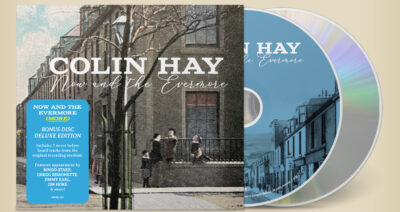
“I’m deeply grateful for the life I have,” says Colin Hay, “and I think my natural tendency has always been towards optimism and humor. Lately, though, I’ve had to be more intentional about it. I’ve had to actively seek out the positive, to let new rays of hope shine on some seemingly dark situations.”
That’s precisely what Hay does with his extraordinary new solo album, Now And The Evermore, facing down struggle, loss, and even his own mortality with grit and wit at every turn. Written and recorded in Hay’s adopted hometown of Los Angeles, the collection is a defiantly joyful celebration of life and love, one that insists on finding silver linings and reasons to smile. That’s not to say the record deludes itself about the realities of our modern world, but rather that it consistently chooses to respond to pain with beauty and doubt with wonder.
The music on Now And The Evermore (Lazy Eye/Compass Records) is vibrant and animated, brimming with fanciful melodies, lush orchestration, and even a guest appearance from Ringo Starr, who kicks the whole thing off with a signature drum fill. Hay’s performances are likewise buoyant and full of life, drawing on vintage pop charm, pub rock muscle, and folk sincerity to forge a sound that’s at once playful and profound, clever and compassionate, whimsical and earnest. At its most basic level, Now And The Evermore offers a deeply personal acknowledgement of the relentless march of time, but zoom out and you’ll see that Hay’s contemplations of identity and eternity are in fact broader reflections on our shared humanity, on letting go of dead weight and reaching for the light no matter how dark things may get.
“It’s a troubling and confounding and ever-inspiring world that we live in,” he muses. “I’m lucky to be able to wander downstairs and try to make some sense of it, at least to myself.”
Born in Scotland, Hay moved with his family as a teenager to Australia, where he first came to international fame with seminal ’80s hitmakers Men At Work. While the band would reach the heights of stardom—they took home a GRAMMY Award for Best New Artist and sold more than 30 million records worldwide on the strength of #1 singles like “Who Can It Be Now?” and “Down Under”—by 1985, they’d called it quits and gone their separate ways. Hay released his solo debut the following year and, over the course of the next three-and-a-half decades, went on to record twelve more critically acclaimed studio albums that would help establish him as one of his generation’s most hardworking and reliable craftsmen. Rolling Stone praised his “witty, hooky pop” tunes, while NPR’s World Café lauded his “distinctive voice,” and late night hosts from David Letterman and Craig Ferguson to Jimmy Fallon and Jimmy Kimmel have all welcomed him for performances.
Over the course of his remarkable solo career, Hay developed a reputation as a gifted raconteur with serious comedy chops, and his frequent appearances at LA’s Largo club helped garner him a legion of fans in the entertainment world. Among them was actor/director Zach Braff, who called Hay’s mix of heartfelt songwriting and hilarious storytelling “one of the most amazing things I had ever seen.” Braff would go on to feature Hay’s music prominently in the GRAMMY-winning soundtrack for Garden State and invite him to appear as himself on the hit series Scrubs, which helped introduce his music to a whole new generation of listeners.
On top of his rigorous schedule as a solo artist, Hay has also managed to tour the world several times over with Ringo Starr & His All–Star Band, release an audiobook of Aesop’s Fables, star in the award-winning documentary Waiting For My Real Life, and even provide the voice for Fergus Flamingo in Disney’s The Wild.
“When the pandemic hit, I was forced to stay put for the first time in years,” Hay recalls. “It was horrendous every day to watch the news and see so many people struggling, but even so, musical ideas were creeping into my head, so I followed where they led and embraced the freedom that came with sitting still for a change.”
With no tour dates on the horizon, Hay allowed himself to slow things down and work at a different pace than he was used to. For the first time in his career, he had several uninterrupted months to work continuously with his longtime friend and collaborator Michael Georgiades, and the two began penning a series of gorgeous, thoughtful tracks that would eventually form the framework of Now And The Evermore.
“It seemed like we tapped into some kind of creative vein that just felt good,” Hay explains. “Even when I thought we had enough material for a record, I just kept writing on my own because the songs kept presenting themselves to me.”
Hay took his time in the studio, too, going in alone at first to record basic tracks and then building up the tunes up around his core vocal and guitar performances. While he enlisted a handful of collaborators—including Georgiades, Compass Records co–founder/bassist Garry West, Cuban guitarist/tres master San Miguel Perez, wife and singer/songwriter Cecilia Noël, and drummer Greg Bissonette (Ringo Starr, David Lee Roth)—Hay tackled the majority of the work on his own until it was time to bring in keyboardist and string arranger Fred Kron, who helped flesh out the music with sweeping orchestration, which was recorded and produced by West at the Compass studio in Nashville.
“Once we started to put the strings on it, that’s when it felt like everything really came together,” says Hay. “There started to be this sense of beauty and grandeur to the music, this sense of romance and possibility.”
That romance and possibility lays at the heart of Now And The Evermore, which opens with the bittersweet title track. Lilting and jaunty, the song (which features Starr on drums) makes peace with life’s transience, accepting the fate that ultimately awaits us all and committing to make the most of what little time we’ve got. “Goodbye to the life we knew / Don’t save it till the end,” Hay sings, balancing faith and fatalism in equal measure. “It could be me, it could be you / Or some old long lost friend.”
“I think this pandemic made people recognize that we won’t be around forever,” he explains. “If there’s something you want to say to someone, some love you want to express, then you should do it now because you never know when your number’s up.”
Learning to live in the present is a recurring theme on the album. The sunny “Love Is Everywhere” mixes rootsy guitars and gospel harmonies as it reminds us that there’s always joy and gratitude to be found if we’re willing to seek it out, while the soaring “Into The Bright Lights” (written by Chris Trapper) waltzes its way to cinematic heights as it refuses to surrender to darkness and despair, and the playful “Sea Of Always” tips its cap to Roy Orbison and The Beatles as it casts away the trappings and distractions that all too often drag us down. “Sold my rings / Cut the strings / And said goodbye to sorrow,” Hay sings. “Close my eyes as I fly / A different sky to follow.”
“A lot of these songs involve different ways of thinking about the unknowable,” he reflects. “I find solace in nature and I often reach for those sorts of metaphors—the sea, the sky, mountains, rivers—when I’m trying to wrap my head around it all.”
Indeed, the unknowable looms large on the record. The loss of Hay’s parents informs the mesmerizing “Starfish and Unicorns,” which wrestles with the lingering pain and loneliness that comes with the end of a complicated relationship, as well as the Celtic-tinged “All I See Is You,” which chases after a past it can never get back. The deceptively breezy melody of “Agatha Bell,” meanwhile, disguises an eerie murder ballad that raises more questions than it answers, and the bright, punchy horns of “A Man Without A Name” wraps the never-ending search for self in an air of celebration. But it’s perhaps the album closer “When Does The End Begin?” that confronts the unknowable most directly, with Hay singing, “We’re following the rising moon / When darkness falls it will be none too soon / We’re passing all the loved and lost / Don’t want to look back and count the cost.”
“I’m approaching 70 now,” he explains, “and it’s clear to me that I’m in the home stretch. I don’t feel any fear or a resignation about it, though, just an urgency to say the things I need to say and do the things I need to do.”
Who knows what happens when we die? Perhaps our consciousness lingers on long after we leave our bodies. Perhaps the curtains simply close and the show ends for good. Regardless, Now And The Evermore reminds us that we’re all alive right here, right now. For Colin Hay, that’s plenty to smile about.
Dusk is a bittersweet time of day. There’s no other point in the sun’s arc that captures the imagination quite like it. Maybe the Nashville-based alternative folk-pop trio the Bittersweets can’t literally splash a sunset across the sky, but they can bring the same striking contrast of shadow and luminescence to the ears.
The Bittersweets—Chris Meyers (guitar, keyboards, vocals) and Hannah Prater (vocals, guitar)—live up to their name. They fuse yellows and blues, sunniness and melancholy, with evocative lyrics and lush arrangements, transcendent melodies and Prater’s alluring voice. On every track of their new album, Goodnight, San Francisco, their recent live set, Long Way From Home, and their 2006 full-length debut, The Life You Always Wanted, the Bittersweets weave a captivating tension between hope and poignancy that rings true.
“I think the name fits us because a lot of the songs talk about life’s tensions and that you can’t just have happy or just dwell on the sad,” Prater explains. “I feel like a lot of the songs embrace both, the beautiful and the ugly, happy and sad—life’s paradoxes.” And the Bittersweets are well-equipped for that sort of musical alchemy.
There’s a reason why Prater’s singing is such a satisfying pleasure. Both of the California native’s parents are music teachers; she sang in jazz groups and musical theatre productions; and she pursued a degree in vocal performance before discovering a different style of vocal expression in Joni Mitchell and Over the Rhine. Prater drew the best from each approach to hone her sumptuous vocal instrument.
“Hannah has so much vocal control,” says Meyers. “That’s a rarity for pop
vocalists. The technical stuff just seems like second nature to her.”
Before the Massachusetts-born Meyers ever picked up a guitar in his late teens, he was an accomplished jazz pianist. His musical epiphany came during college. As he dug into the history of American roots music and wrote at length about how country music made its way from front porches to radio airwaves, his musical palette was forever changed. Of his college studies, Meyers says, “They turned me on to a bunch of artists that I never really listened to before—everything from bluegrass to Johnny Cash or Gram Parsons, the whole spectrum.”
Meyers is the Bittersweets’ primary songwriter. He crafts poetic, often abstract lyrics and the kind of melodies that send shivers of sensory pleasure down the spine. “He keeps everything so interesting,” says Prater. “He keeps me thinking, he keeps me on my feet and having to interpret, and that’s something I’ve always loved to do.”
The chain of events leading up to Goodnight, San Francisco reads like a fairy tale. Meyers and Prater discovered their musical kinship in the Bay area after college. The manager of a teenage musician Meyers was tutoring got the Bittersweets’ demo into the hands of taste-making San Francisco station KFOG, and KFOG’s instant embrace of the Bittersweets built so much buzz that 200 people came out for their very first show—on Superbowl Sunday, no less. By only their third performance, the head of Virt Records was flying in to see them, and their first record deal soon followed. When the band arrived in Nashville two years later, Compass Records was ready to sign them the moment they breathed a word about starting a new album.
That new album, Goodnight, San Francisco, flows seamlessly through eleven gorgeous mood pieces. Lex Price—Mindy Smith producer and sideman—lent his delicate producing touch, and brought in a perfectly sympathetic team of players: steel guitarist Russ Pahl (Don Williams), bassist Dave Jacques (John Prine), drummer Steve Bowman (Counting Crows), guitarist Doug Lancio (Patty Griffin), cellist David Henry (Ben Folds), organ player John Deaderick (Emmylou Harris) and others. GRAMMY nominee Jason Lehning (Guster) also lent his mixing and playing abilities to the project.
Goodnight marks the end of the Bittersweets’ season in San Francisco and the beginning of a new one in Nashville with a leaner lineup (the Bittersweets recorded The Life You Always Wanted as a quintet). “Basically we were all going through various personal struggles the last year we were there, even as a band,” says Meyers. “One of the band members went to law school and another one had a baby—both of which are wonderful things.” But that meant shifting from their five-person lineup—which included bassist Daniel Schacht and multi-instrumentalist Jerry Becker—into a duo, a change that’s ultimately made the Bittersweets even more versatile.
The album’s title track, a slow-burning R&B ballad, captures the bruising and beauty of embarking on a new journey as no one but the Bittersweets can. It eases in with piano and Prater’s breathy lilting and swells into a full-band catharsis, stoked by B-3 organ and an eruptive guitar solo. The lyrics move between past and future, pain and hope: “Goodnight all you dreamers / Goodnight all you refugees of hope / Get on home, it’s getting real late / And time stands like a chorus calling my name out loud / from behind the curtain / The voices in my head say, ‘You’re gonna be a rock and roll star, someday.’”
The fine-grained meditation “When the War Is Over” is another song that
captures the uncertainty of change with devastating accuracy, picking up the story after the leap has already been taken. Like many of the songs on Goodnight, there’s a question ringing at its core: “When the war is over/is it ever over?”
Just like dusk, the Bittersweets’ songs have a stirring, not-neatly-sewn-up
quality that’s hard to shake. And that’s just the point. Says Meyers, “I think art is at its best when it’s asking questions rather than giving answers.”
Watch
Talking to Jeb Loy Nichols about his life is like watching a road movie. The restless pursuit of an unnamed goal, the constant search for something just out of reach. “It’s true”, he says, walking through the fields of his Welsh farm, “I’ve done some moving.” It’s all there in his music. The country, bluegrass, and pop of his early years, the rebel music of punk and reggae, the deep grooves of the south. “It’s all a road”, Nichols says, “one connecting to the other, all of them intersecting and crossing over.”
Born in Wyoming and raised in Missouri, Nichols absorbed the sounds of both rural America and the records played around his house. “We got it all”, he says, “my mom played jazz records, Don Shirley and Ella Fitzgerald, while my dad played bluegrass and Hank Williams.” But it was from the radio that Jeb received his most lasting education. Through the day and late into the night Jeb would listen and take to heart the disparate sounds of the airwaves. “The main station I listened to was out of Kansas City and played country music all day, then at nine o-clock at night they’d switch and become a soul station. It was magic, all this great music; Bobby Womack, Al Green, Curtis Mayfield, The Staples Singers, all of it right there, in my bedroom, for free.”
When Jeb was fourteen the family moved to Austin, Texas. “The best thing I learned in Austin”, Jeb says, “was how great live music could be. I saw everything from Funkadelic to Bob Marley to George Jones to The Ramones.” It was in Austin that he first heard, and was knocked out by, The Sex Pistols. “That was all new, the sound, the fury, the politics, all of it.” And it led straight to the road again, this time to New York. “I was seventeen”, recalls Jeb, “and New York was like nothing I’d ever seen. I’d always felt like an outsider and then there I was, in a town of outsiders. I thought I’d died and gone to heaven.” In New York he was awarded a full scholarship to study painting at Parsons School of Design. He also started hanging out at clubs like Tier 3, The Loft and the Mudd Club where he became friends with members of the Slits and Neneh Cherry. “It was a great time to be in New York, the whole scene was so wide open.” It was the emerging hip hop scene that was most fascinating for him. “It was 1979 – and nothing in the world was more exciting than rap. The Treacherous Three, Funky Four Plus One, Grandmaster Flash – that stuff was so great! And then you had DJs like Larry Levan, it was fantastic.”
After three years in New York, Jeb hit the road again, this time to London. He shared a house with Ari Up from the Slits, Neneh Cherry and producer Adrian Sherwood, and, as he had in NYC, dove into London’s artistic community. “I formed a country band with Joe Brack and we played every kind of show you can think of. We did some bluegrass, some country, a lot of old protest songs.” In 1990 a tape of songs ended up at OKra Records, a small label in Columbus, Ohio. OKra offered Jeb a deal, and Jeb put together a band that included his wife Loraine Morley, On-U Sound man Martin Harrison, and jazz trombonist John Harbourne. The Fellow Travellers merged country-tinged, acoustic-based songs with a dub bottom. “It was fun”, says Jeb “it just worked. We all played what we wanted and stayed out of each others way, and it sounded great. I’ve never had more fun.” The Fellow Travellers released three more albums and were described in Spin as “the lonesome children of Merle, Marley and Marx”.
In 2000, after releasing three solo records, Jeb Loy and Loraine Morley moved to Wales where they’re slowly reclaiming ten acres of neglected scrub land, renovating a barn and putting in a large garden. “I’m sure I’ll move again”, he says, “but not just yet. This feels good, feels like something close to home.”
For nearly a decade, Wolfstone’s music has brought its Highland spirit and youthful exuberance to the soul of Scottish tradition. What began as a traditional dance band has evolved into a Celtic rock extravaganza, crossing musical, cultural and age boundaries and winning fans around the world.
Fiddler Duncan Chisholm and guitarist Stuart Eaglesham first met in the late 1980s at a pub session in Inverness, Scotland, and formed a band for ceilidhs (Scottish dances). In 1989, they performed at the Highland Traditional Music Festival in Dingwall, fusing drums and bass with keyboards, pipes, guitar and fiddle. The combination was a hit. They were soon offered local gigs that expanded into tours up and down the length and breadth of the Highlands and the Islands.
Within two years, Wolfstone recorded its first album, Unleashed (GLCD3093), produced by Silly Wizard accordion virtuoso Phil Cunningham. During this time, the band was offered a support slot for the popular Scottish crossover group Runrig at Loch Lomond near Glasgow. The exposure and experience of playing for such a large audience catapulted them into a new circuit. They began playing larger venues and festivals, not only in the UK, but also increasingly in Europe, North America and Canada.
The follow-up album The Chase (GLCD3088) built upon their success and brought new members to their line-up. In 1992, drummer Mop Youngson, from Aberdeen and bassist Wayne Mackenzie, from Inverness, joined the pack. The thrill of the Highland bagpipes was added with piper Alan Wilson, later succeeded by the talented Stevie Saint from Pitlochry. In the meantime, Unleashed and The Chase went silver and gold, respectively, in Scotland.
In 1993, Wolfstone signed with Green Linnet Records and released Year of the Dog (GLCD1145) , marking their third collaboration with Phil Cunningham. They began a hectic touring schedule on both sides of the Atlantic, thrilling crowds at festivals and concert halls with their high-energy performances. Highlights included appearances at such major American festivals as Telluride, Strawberry, the Philadelphia Folk Festival and the Milwaukee Irish Festival, and in Europe at Tönder (Denmark), L’orient (France), and Cambridge (England).
As their recognition increased, so did the demand for their presence, until they spent more time on the road than they did at home. After recording The Half Tail (GLCD1172) in 1995, keyboardist Stuart Eaglesham departed the band for a quieter life, and Youngson followed suit. The remaining Wolfstone members took this opportunity to limit their appearances to festivals and take a new direction with their music. In the meantime, a best-selling compilation Pick of the Litter (GLCD1180) was released in 1997.
In early 1998, Green Linnet released This Strange Place (GLCD1188) , an album featuring the accomplished acoustic guitarwork and introspective songs of Ivan Drever. Co-produced by Drever and Wayne Mackenzie, the recording represented a departure from their previous work and offered proof of the band’s versatility.
Since then, keyboardist Andy Simmers and drummer Tony Soave have stepped in, and Ivan Drever has moved on to pursue other projects. Stuart Eaglesham now leads the pack as vocalist, as well as penning four cuts on the group’s latest outing, Seven (GLCD1198). A diverse mix of Celtic pop and folk with a touch of rock & roll, the album marks new territory for the band. With a two year break from heavy touring, the sextet is charged with renewed energy, and looks forward to electrifying audiences around the world again in the coming months.
Band Members
Stuart Eaglesham (lead vocals, guitar)
Duncan Chisholm (fiddle, backing vocals)
Wayne Mackenzie (bass, backing vocals)
Stevie Saint (pipes, whistles)
Andy Simmers (keyboards)
Tony Soave (drums)
Watch
Anything you want to call this is probably fine. It’s dusty rock’n’roll, or alternative country twice removed. Or it’s some kind of dislocated Heartland jangle blended with pathos, power pop and Peter Rowan.
Why Peter Rowan? “Because he’s God,” says Farmer not so John’s Richard McLaurin. “Mack and I worship that guy, and I instinctively knew he would dig our stuff.”
Indeed, Rowan liked the music. Ask him and he’ll tell you. The bluegrass legend sang with Mack Linebaugh and added his distinctive mandola to Receiver’s “Rise Above the Wreckage,” a song whose title is plainly appropriate for a band that has gone in a year’s time from an upstart Nashville quartet with a critically acclaimed self-titled album to a battle-scarred duo with a highly developed stubborn streak and an even better album.
Reasons for the crack-up and restructuring were multifold, predictable and somewhat acrimonious. The short story is former drummer Sean R. Keith became a father and wanted to get off the road. Former bass man Brian Ray had creative issues. Both of them contributed to Receiver. Neither will appear on tour with the band.
Want more biography? Okay. Linebaugh, a Nashville native and Hillsborough High School Class of ’88 graduate, grew up on R.E.M, Neil Young and Bruce Cockburn. He developed an early and ultimately temporary disdain for the country music his father enjoyed. McLaurin was born and reared in the flat, sandy Pee Dee region of South Carolina. He left Clemson University in the mid-1980’s, moved to Nashville without a job, and found touring gigs playing acoustic and electric guitar, lap steel, bass and/or mandolin with Vassar Clements, Maura O’Connell and Iris DeMent.
Then, in 1995, Linebaugh, Ray and Keith formed Farmer not so John. Further direction was established when McLaurin sat in on a practice one afternoon and joined that evening. The band secured a record deal with Compass, McLaurin produced the debut disc, publications from USA Today to Guitar Player took appreciative notice, and the group hopped in a van and began a year of bush league touring in hopes of giving legs to some major league songs.
“It was an odd year,” Linebaugh says. “There would be incredibly low moments of driving a long way for no money and no people. And then we’d go out and play the Bottom Line in New York and have a great response.”
One continuing annoyance was the insistence of some club owners to pair Farmer not so John with rockabilly, hillbilly, and psychobilly bands, as well as other combos of the retro-roots persuasion. The reason for the ill-conceived double bills was a misperception that Farmer not so John was an alternative country band. Linebaugh says this is mostly McLaurin’s fault.
“The only explanation I can think of is that we have a guy that plays steel and mandolin and grew up in South Carolina,” he says. “The whole alternative country thing is so problematic. Are we going to go back and revise history and move the Rolling Stones from Rock’n’Roll to alternative country just because they had some country-influenced songs? We’re a Southern band, but we didn’t grow up on country music, and I defy you to find a traditional country groove or progression anywhere on Receiver.”
Actually, McLaurin says there are three traditional country grooves and 1 1/2 country progressions on Receiver, though he won’t reveal their precise locations. The rest of the album is both a furtherance and a departure from the debut disc.
“We wanted to do a little metamorphosis,” McLaurin says. “This album is darker and more experimental. A lot of that is because of (producer) Tucker Martine, who is a mad scientist if there ever was one. We would do stuff like loop something I was playing on lap steel, using delay and reverb and Leslie effects and lots of tremelo. It ended up sounding real foreboding.”
We’ll skip the other “The Making of Receiver” inside-the-studio type stories, but you’re welcome to ask Mack or Richard about exploding amp cabinets, candle-lit drum booths, canine interruptions or vocal tracks marred by glancing blows from projectiles. You may also pose the “What was it like to work with…?” question as it pertains to special guest pals Rowan, Clive Gregson, Matthew Ryan, Daniel Tashian and Sean Ray.
But before you do any of that, give Receiver a spin. Mash the Repeat button if you like. This is an album textured enough to reward headphone listening and unruly enough for fast cars, high volumes or combinations thereof. It opens with the sweet air, warm wind and possibilities of “Paper Thin,” then takes a harrowing ride through the devastation that occurs when all of the above sour and chill and crumble. And then there are a couple of songs about women…
Boo Hewerdine lives in Cambridge, England. He’s incredibly tall. That’s a good thing, because his large frame has to accommodate a massive talent. He’s a singer of real depth and emotion, a musician who can coax a melody out of anything he picks up, and a songwriter who never fails to hit the mark. He has it all.
Boo’s first group was called the Great Divide. Following a couple of singles that made all the right noises (save the ringing of cash registers), the band emulated their name. Undeterred, Boo formed Georgia Peach, which proved to be a pretty silly name for a bunch of Brits. So, they became The Bible. The group played everywhere from student bars to concert halls and went from support act to headliners with almost indecent haste. The music was fantastic: Boo’s voice soared above seemingly effortless grooves. It was pure pop: guitars, choruses you could actually sing along to, and lyrics that spoke to anybody who’d been in and out of love. Walking The Ghost Back Home (1986) and Eureka (1988) were both full of great songs that should have been hits. The latter (produced by Steve Earle) featured Honey Be Good. If ever a turntable smash deserved a high chart position, this was it.
Sadly, commercial success eluded The Bible. As the group fell apart, Boo went to Texas to record with Darden Smith. Evidence (1989, Compass re-issue 1996) confirmed Boo’s talents. He seemed equally at home collaborating with a folkie from the American South as he had been fronting a pop group from the South of England.
Returning home, Boo set out to become a solo artist. For a year, he wrote songs and played them to the diehards who remembered him as “that bloke from The Bible”. Sometimes guitarist Neill Maccoll accompanied him but often it would be Boo alone. He opened for Tori Amos and Michelle Shocked; he played countless gigs where the promoters always seemed to get his name wrong. Finally, he went into the studio to begin his first solo album.
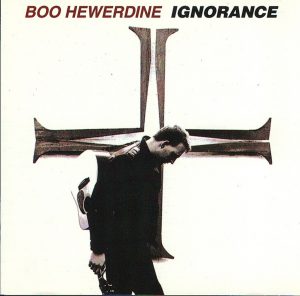
The result was Ignorance (1992, Compass re-issue 1996). The songs ranged from the gospel-tinged Swan Silvertone to the Lennon-esque Gravity. The sound veers from the acoustic starkness of the title track to the electric swagger of History: the mood swings between the rock ’n’ roll urgency of 59 Yards and the eeriness of Little Bits Of Zero, calling at all points in between. Ignorance features guest appearances by Clive Gregson (Any Trouble, Gregson & Collister), Kimberley Rew (Katrina & The Waves) and Ray Shulman (Gentle Giant). But the star of the show is always Boo: the voice, the songs, the vision…
More touring followed. Boo opened for Richard Thompson, Loudon Wainwright III, and formed a memorable trio with Clive Gregson and Eddi Reader (Fairground Attraction). He wrote several songs for Eddi’s 1994 solo CD, one of which, Patience Of Angels scaled pop charts throughout Europe. Boo was nominated for a Novello award for Song of the Year.
Following a brief Bible re-union at the end of 1994 (which yielded one EP, Dreamlife and renewed Boo’s enthusiasm for a solo career, Boo started planning his next solo album. He made a couple of writing trips to Nashville and found himself staying across the street from a medical centre. Thus Baptist Hospital (1996) was christened.
Produced by John Wood (Nick Drake, Richard Thompson, John Martyn), the album features songs written with familiar Boo collaborators (Gregson, Reader, Maccoll) and a couple written with Gary Clark (Danny Wilson). Guest performers include most of the above plus Richard Thompson, Danny Thompson and John “Rabbit” Bundrick. Several songs employ a string section. It’s an astonishing record: Nick Hornby (best-selling author of “Fever Pitch” and “High Fidelity”) wrote: “If I could write books that sounded like this, I’d be… maybe not happy, but very, very fulfilled.” A headlining tour culminated in a sell-out London show and rave reviews.
Following the release of Baptist Hospital, Boo toured the USA (with Darden) to promote the new album and the re-issues of Evidence and Ignorance. Eddi Reader released Candyfloss & Medicine, much of which Boo wrote and played on. He toured the UK, USA and Japan as a featured member of her band.
Boo also collaborated with Neill MacColl on several film scores, including “Fever Pitch” and “Twentyfourseven” which starred Bob Hoskins and was released in the USA. In 1998, Boo returned to the studio with Eddi Reader, this time to co-produce the album Angels & Electricity, which features many of his songs.
Throughout 1998, Boo re-united with producer John Wood to record what he describes as “Baptist Part 2”. Another Nashville writing trip over the Thanksgiving holiday led to a song and album title. Thanksgiving features Boo, Teddy Borowiecki (keys: kd Lang, Eddi Reader), Neill MacColl (guitar), Martin Barker (drums: Billy Bragg), Tim Harris (bass: Steeleye Span), Martha Wainwright (vocals: daughter of Loudon & Kate McGarrigle, sister of Rufus), Clive Gregson (guitars, etc) and the Electra Strings arranged by Tony Cox. The album was recorded in London, Montreal and Nashville.
Watch
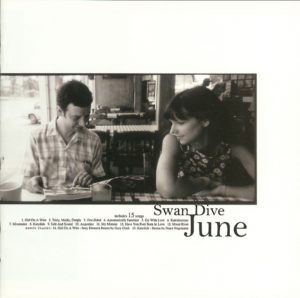
Like the month it’s named after, Swan Dive’s June is full of sunshine, color and warmth. With breezy melodies darting through lush arrangements, it’s pop music that sparkles with both the wonder of spring and the promise of summer.
“There’s a kind of upbeat feeling and optimism on this record,” says songwriter/guitarist Bill DeMain. “Even on the melancholy songs, there’s always a glimmer of hope shining through.”
Since forming in 1993, Swan Dive – the duo of DeMain and singing partner Molly Felder – have been connecting with fans both in their hometown of Nashville and in far-off Japan, where they’ve enjoyed much success – four top 10 singles, many television and radio appearances, videos on MTV and tours full of, as DeMain puts it, “Hard Day’s Night moments.”
As they did on their self-titled U.S. debut for Compass (which won Best Pop Record in the 2000 Independent Music Awards), DeMain and Felder filter the sounds of their favorite music – The Beatles, The Beach Boys, Dusty Springfield, Harry Nilsson, bossa nova, ‘70s soul – into their own striking, immediately recognizable style. From the ultra-catchy Girl On A Wire (a #2 radio hit on Japan’s Cross-FM last summer, and also featured on a recent episode of Felicity) and the ebulliently romantic Truly, Madly, Deeply to the sensual, French-tinged Safe And Sound and delicate Augustine, June delivers more of the intoxicating blend of singing and songwriting that Swan Dive is known for.
“There was a lot of collaboration on this record,” DeMain says of the songwriting process. I traveled to other cities for the sole purpose of co-writing, which was a lot of fun. I find it very freeing when I’m away from home and all the little demands of everyday life. I can really concentrate on writing.” From London to New York to Los Angeles, he teamed up with top tunesmiths such as Marshall Crenshaw, Jill Sobule, Kelley Ryan, Boo Hewerdine and Gary Clark, and brought his song treasures back to Nashville.
Felder says, “I think one of the greatest experiences of making this album was being able to record songs written by Bill with some of the artists we’ve always admired – Marshall, Boo, Jill and Gary Clark from Danny Wilson. It meant so much, personally and professionally.”
On June, DeMain and Felder continue their collaboration with ace producer Brad Jones (Jill Sobule, Cotton Mather, Richard Julian), a multi-instrumentalist and arranger who brings a wealth of creative ideas to the studio. “Brad has a great sense of adventure,” says Felder, “and an amazing ability to know exactly what a song needs to bring it to life.”
Originally released last summer in Japan, this is a newly remastered version of June, featuring two brand new songs plus two stunning remixes, done by Gary Clark.
With a sound that MOJO calls “an imaginative line in classic pop” and the Associated Press says is “sweet but mature, catchy but sophisticated,” Swan Dive is prepared once again to brighten up the independent music scene. Step into June.