
“It’s hard for me to express how I feel,” reflects Sean Doyle from his home in Sligo, Ireland. “I never thought I’d get to make this record.”
While most artists don’t make their debut album at age 58, vocalist, song collector, and retired policeman Doyle comes from an environment far removed from the mainstream music industry. A member of a large and deeply musical family, he has been content to hone his craft in pubs, at fleadhs, and assorted informal gatherings over the past six decades. The thought of recording a proper album in a studio simply never occurred to him until his son, the renowned guitarist/producer/songwriter John Doyle, suggested it.
“John browbeat me into it,” the elder Doyle states, matter-of-factly. “When John was doing his first record [2001’s Evening Comes Early], I came in and did one track. It seemed to go well and a lot of people liked it. I wasn’t that keen on doing my own album really, but he kept at it.” So began the saga of what eventually became The Light and the Half-Light.
“Doing my record was Dad’s first experience in the studio,” says John Doyle. “From then, I really had to stay on him and push him to make this record. But I feel it’s important: I grew up hearing him sing, he’s given me so much in terms of my music. And no one does what he does musically.”
What he does is mine a very narrow vein of song, a melodic strain that exists at the intersection of Irish, English, and Scottish traditions. “It’s in between English ballad singing and Irish sean nos,” explains John. “Dad likes that gap – he sings a lot of Irish songs that have been translated into English.”
Decades of performing in pubs and other noisy, informal environments has given Sean Doyle an edge that many of today’s concert-hall-bred musicians lack. “A pub doesn’t get completely quiet,” Sean explains, “so you need a strong voice to make yourself heard. You learn to project, to be assertive.”
While marked by an unapologetic boldness, Doyle’s singing never seems blustery or bathetic. Doyle achieves this by balancing his strong, deep voice with a disarming tenderness and keen sense for a song’s unfolding drama.
“Dad’s music is serious drama,” notes John. “It all comes down to how he relates to songs. He thinks of them not as music, but as stories. This influences everything he does: his meter, his phrasing, his timing. As an instrumentalist, accompanying him on this album has been a great challenge for me.”
“I’ve never sung with anyone before,” Sean adds. The tradition he comes from is based on unaccompanied vocal performance. “Apparently I sing in the strangest keys,” he laughs. “To John’s credit, he let me do my own thing and just followed on with what needed to be done. I sung as if there wasn’t accompaniment. I didn’t change what I did at all. I’m not used to fitting in with other people.”
“Sometimes I just told him not to listen to me,” cracks John. “I just watched him and listened – I really tried to preserve everything he does.” As producer, arranger, and primary accompanist on The Light and the Half-Light, the younger Doyle succeeds exquisitely. His playing elevates the material with dashes of rhythm and harmony, and yet leaves plenty of room for his father to maneuver and express the nuances of each song.
Choosing the songs for The Light and the Half-Light was an equally demanding process for John. “We started with about forty tunes – mind you, these are all from Dad’s memory, nothing written, no notation of any kind. And we slowly started to whittle it down to a manageable number. We tried to balance the serious, sad, and more humorous tunes. And every now and then, when I thought I’d heard everything he had, he would surprise me with something I’d never known about.”
“For instance,” John elaborates, “when me and Dad and my brothers all get together, we always wind up singing. Last Christmas we started going around the room, swapping songs. This started at about seven in the evening, and wrapped up around five in the morning. That’s where I first heard dad sing ‘Let Mr. Maguire Sit Down,’ which wound up on the album.”
“I couldn’t believe they hadn’t heard that one,” responds the elder Doyle. “It was old hat to me – we were tired of it in the fifties! That Christmas I started to discover how old I am!”
Born January 2, 1946, Sean Doyle – like his son John – was first introduced to music through his father. “My dad was an accordion player, and was part of a ceilidh band that would practice in the house. They’d drag me out and make me sing waltzes with them when I was small.” This opened Doyle’s young ears to singing, a pursuit further fueled by the social events in his native Sligo. “Any house dances finished with singing,” he explains. “It went around the whole assembly, and people were coerced into singing a tune apiece. When I heard a really good ballad, it affected me. I wanted to sing it myself.”
While leaving home to join the Dublin police force at age 18 (“There’s still some top secret stuff he won’t tell me about,” half-jokes John), Sean Doyle continued to pursue his interest in Irish singing through singing clubs, contests, and fleadhs. He watched with fascination and encouragement as vocal music achieved its rightful place alongside traditional instrumental music. “Singing has come up,” he says. “It was the poor second cousin to instrumental music for a long time. Now it’s on a much better footing.”
Those years of earnest apprenticeship come alive on The Light and the Half-Light. Completed over two years of intermittent sessions in Ireland; Asheville, North Carolina; and Louisiana, the album has a natural ease and dramatic flow that sounds as though it could have been recorded in one session. There is no audible trace of Sean’s initial apprehension. “We had to loosen him up a little,” says John. “The experience reminded me how artificial the studio environment is. Especially compared to the pub.” Despite the pristine fidelity, there is a beguiling intimacy throughout, especially on the album’s centerpiece “The Flying Cloud.”
“‘The Flying Cloud’ was the one song I really wanted to have on there,” says Sean. “I’m very drawn to the theme of it: an Irish sailor falling first into the awful slavery trade, then getting caught up with pirates and thieves. It’s dealt with with such intelligence and compassion. It’s a real epic.” Like all the songs on The Light and the Half-Light, it was learned the old-fashioned way, at a fleadh. “It stuck to me,” Doyle concludes. Delivered over eight chilling minutes and accompanied by gentle bouzouki chords from John, it is a mesmerizing, deeply affecting performance that finds Sean Doyle evoking the sadness and grief of the tale through expert dramatic timing and a vast dynamic range that veers from full-voice to hushed, whispered passages.
Throughout The Light and the Half-Light, the supporting music is sublime and understated. “I’m so overwhelmed with the people who played on this,” says Sean of the album’s cast, which includes Liz Carroll, John Williams, Dirk Powell, Rayna Gellert, and Kieran O’Hare. “It’s the crème de la crème of Irish music.” John Doyle’s expert hand brings it all together, paying the ultimate tribute to his greatest influence, his father.
With a masterful debut album now completed, Sean Doyle is playfully stubborn about a potential follow-up. “No second,” he laughs. “I put my foot down. I’m going back to retirement.”
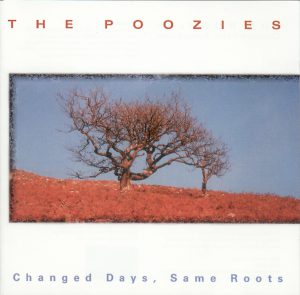
Currently celebrating their tenth anniversary as the UK’s finest all-female folk group, the Poozies continue to expand their sound their latest project, Changed Days, Same Roots. Deftly integrating Scandinavian, contemporary folk, Broadway, and Polish influences into their seasoned British Isles folk sound, Changed Days, Different Roots is marked by the same lush vocal quality, innovative arrangements, and superb instrumental performances that first distinguished the band.
Composed of founding members Karen Tweed (accordion, vocals), Patsy Seddon (electro-harp, clarsach, fiddle, vocals) and Mary MacMaster (electro-harp, clarsach, vocals) along with new arrival Eilidh Shaw (fiddle, vocals), the Poozies have been individually and collectively featured on recordings by Kathryn Tickell, Swap, The Two Duos Quartet, the May Day project, Sileas, Clan Alba, Caledon, and Harem Scarem, as well as many other live projects and guest sessions of artists including Roy Bailey, Lal and Norma Waterson, Dick Gaughan, June Tabor and Eliza Carthy.
“With their combined backgrounds, their ability is beyond question.” – Allmusic.com
“The Poozies deserve to be known beyond the confines of the British folk and roots scene…a delight.” – Q Magazine
“This is a band at the height of its powers. Forget their prestigious past. The future looks very bright for the Poozies.” – BBCinteractive

Glasgow native Eddi Reader embraces her Scottish roots on this stunning folk/pop song-cycle drawn from the tunes of the great bard Robert Burns. This ambitious project is Reader’s crowning achievement, a savvy translation of Burns’ classic songs into a modern setting, joined by a host of the finest British and Scottish musicians around (John McCusker, Kate Rusby, Ian Carr, Phil Cunningham, and more). Some of the songs are rendered faithfully, others are re-envisioned, all of them are marked by Reader’s trademark mix of swagger, tenderness, and sincerity.
USA Today: “Reader’s elegant renderings of such songs as My Love is Like a Red Red Rose and Jamie Come Try Me seem fresh and magical.”
Time Out NY: “Haunted hearts, unguarded affections, and drunken benders have long littered Reader’s musical landscape, so it’s not surprising that she would discover a kindred spirit in Burns…Devotees will welcome this warming balm against the bitterest of winter winds.”
Seattle Post-Intelligencer: “Reader brings new vitality to the songs of Robert Burns in this lovely collection. Reader’s voice is flawless…a magnificent gift from the heart of Scotland.” Grade: A
Irish-American News: “The most creative, wonderful, and difficult-to-describe album we have heard in years…a masterpiece. Flat out.”
Boston Herald: “Her enlightening tribute is a glorious set of towering romantic odes, sprightly jigs and reels, and poignant anti-war ballads.”

Catriona Macdonald (pronounced “Catrina”) is a proud bearer of one of the world’s great fiddle traditions, that of the Shetland Isles. A cluster of islands located in the North Sea, closer to Norway than Scotland, the Shetlands have offered some of Scotland’s finest and most beloved traditional musical exports including the legendary fiddler Aly Bain. Steeped in this tradition, Catriona Macdonald at once embodies the strength and spirit of her musical heritage and the freshness and diversity of a thoroughly modern performer. Her superb playing and charisma have established her a worldwide reputation.
Catriona began playing as a child back in 1981 under the masterful musical tutelage of Dr. Tom Anderson MBE. Less than two years later, she took both the title of Young Fiddler of the Year in the annual Shetland Folk Society competition and the deputy leadership of a new fiddle group, Shetland’s Young Heritage. Young Heritage was set up to help preserve Shetland traditional music and to help teach Shetland traditional fiddle to local school children. In 1991, her dexterity and presence became acknowledged on a wider stage when she won the prestigious BBC Radio Two Young Tradition Award, a high profile competition featuring the cream of Britain’s young traditional players. At the age of eighteen, she found she could sing and was whisked away for some enjoyable and instructive years training in opera at the Royal College of Music in London (where she met former playing partner Ian Lowthian). Even given all of these experiences, Catriona has still been lucky to focus her musical career on her first love, that of the Shetland fiddle.
On her new album BOLD, Catriona flourishes as a progressive performer in her own right, offering a wealth of exciting, original musical ideas while still firmly holding hands with the past, a part of the ever-evolving tradition. The gorgeous aires, reels and jigs on the album attest to her mastery of the Shetland fiddle styles while the expert accompaniment provided by her guest musicians leaves little doubt that the future of traditional music is in able hands. Bassist Conrad Ivitsky and pianist David Milligan, 2/3 of Catriona’s touring trio are on hand, as well as top percussionist James Mackintosh (also a member of Shooglenifty, in addition to his regular high-profile appearances with Capercaillie and the Afro-Celts Sound System); much sought-after Norwegian church organist Iver Kleive (a Winter Olympian musician, and lynchpin of the renowned Kirklige Kulturverkstad label) and former playing partner Ian Lowthian, (whose wizard piano accordion playing offers continuity in sound from ’opus blue’, Catriona’s previous album), and guitarist Tony McManus, one of the most distinctive celtic guitarists of this age.
In addition to her solo work, Catriona is well known for her splendid duo with piano accordion wizard Ian Lowthian. The superb technical mastery and beautiful evocative arrangements for which they were critically acclaimed (amongst their fans is Mark Knopfler, former frontman of Dire Straits) led them to play for audiences throughout the world…always purveying a unique spirit, enjoyment and charisma on any stage. She is also involved with the wildly energetic Highlands and Islands fiddle ensemble, Blazing Fiddles (also featuring Iain McFarlane, Allan Henderson, Aidan O’Rourke, Bruce MacGregor, Duncan Chisholm, Andy Thorburn & Marc Clements) and does occasional work with Norwegian Hardanger fiddle player, Annbjorg Lien (Catriona herself has studied Hardanger fiddling with Norway’s foremost player Knut Buen.) The two women play exciting contemporary sounding music celebrating the many musical links between their respective traditions, which are rooted back in the 15th century.
Catriona’s commitment to the promotion of her Shetland Island heritage through education is also an important part of her work. She is currently acting as visiting tutor as part of the Scottish Music Degree (the first of its kind!) at the Royal Scottish Academy of Music and Dance in Glasgow. She is also personally researching a book and CD of whole archives of previously unknown/untranscribed Shetland tunes due for release in the next year or so. Catriona also teaches Shetland fiddle on a regular basis, particularly at many of the country’s summer schools such as Folkworks, Burwell House (in Cambridge), Stirling and her own Shetland Fiddle School in Vementry, Shetland.

Accordionist Tweed (Poozies, Bill Jones) and guitarist Carr (Kate Rusby, John McCusker) meet for an engaging, thoughtful session that encompasses not only their English roots but influences from the world over.
The medleys that Tweed and Carr weave from contemporary compositions and traditional dance tunes are simultaneously modern in conception and rooted in tradition…Tweed is an inventive accordionist who manages to pull music of remarkable depth out of an instrument that is not generally known for its subtlety…Carr stretches the boundaries of folk guitar with unusual chord voicings, quirky melodic lines and playful rhythms….the music of Tweed and Carr brings together the best parts of ancient and modern music. – TipWorld.com

First emerging amid the creative fervor of the 1960s British Isles folk renaissance, singer, songwriter, and raconteur Gibb Todd continues to be one of the scene’s most beloved and respected figures. Constant international touring – both solo and with such groups as the legendary Dubliners, the Fureys, and Cherish the Ladies – has made this Scotsman (now based in Australia) welcome around the world and added intriguing layers of international influence to his songwriting and repertoire.
Astonishingly, Goin’ Home is only Todd’s second solo album in a career that now spans over four decades. Recorded in Nashville with an international cast of folk, Celtic, and bluegrass luminaries, it reflects Todd’s wide musical range over a program of aching ballads, rousing shanties, and several compelling originals. Joining Todd are innovative Irish guitarist John Doyle (ex-Solas), maverick banjoist Alison Brown, bluegrass fiddler Stuart Duncan, double bassist Danny Thompson (Richard Thompson Band, Pentangle), Nashville fiddler Andrea Zonn (Vince Gill Band, James Taylor), and vocalist and multi-instrumentalist Tim O’Brien.
With such fine support, Gibb Todd shines as never before – his vocals rugged but nuanced, his performances focused and moving. His greatest gift, his effortlessly affable give-and-take with an audience of any size, takes center stage throughout Goin’ Home. Fittingly considering his reputation as a live performer, Todd will premiere songs from Goin’ Home this February at Glasgow’s massive Celtic Connection festival, where he is a longtime fixture and festival favorite.

Through the Round Window, the solo debut of renowned tenor banjo player Éamonn Coyne, is a rare achievement. Using his masterful technique as a foundation, Coyne builds a musical bridge between the traditional Irish sounds of his upbringing and his other, more international influences. The high esteem Coyne commands in Irish music circles is reflected in the clarity, precision, and impeccable timing of each note he plays. Wherever his vast musical imagination takes him, the power and resonance of his ingrained heritage shines through. The result is a remarkable album that explores new terrain for the Irish tenor banjo while radiating the warmth and integrity of a centuries-old musical lineage.
“Over the years,” Coyne explains, “I have been lucky enough to experience lots of different types of music. I wanted to record a CD to explore some of these influences on my playing. Through the Round Window comes from the music of these different sources passing from me through the main instrument I play, the Irish tenor banjo – whether it be Donegal fiddle music, Irish box and flute playing, or old-timey American fiddle and banjo tunes.”
Channeling Coyne’s eclectic tastes through his own virtuosity on the tenor banjo lends Through the Round Window a freshness that never sounds incongruent – even at its most far-reaching. On the more traditional side are “Whistling Reels,” a set recorded with flautist Michael McGoldrick, “Mazurka & Jigs,” which combines a Donegal-styled mazurka with a pair of jigs, and the languid “Tommy & Jerry,” which ingeniously blends tunes from Tommy Peoples (in a highland style) and two Cape Breton tunes from Jerry Holland.
Careful sequencing allows Through the Round Window to unfold gracefully, the more adventurous excursions beautifully balanced by the invigoratingly executed traditional fare. One of the threads unifying Through the Round Window is the interrelation between different cultures. Nowhere is that give-and-take better demonstrated than on “Nine String Susannah,” a trio of American old-tyme fiddle tunes played as a duet with Grammy-winning 5-string banjoist Alison Brown. Kevin Doherty, of the acclaimed eclectic Celtic band Four Men and a Dog, contributes two original compositions that combine the soulfulness of classic balladry with a contemporary edge.
All of the performances on Through the Round Window sparkle with empathy and audible camaraderie between the players. “That’s because this CD has come together thanks to the great friends I have,” Éamonn Coyne says with a smile, “who happen to be musicians.” That sound – of good friends, good taste, and good times – is what, more than anything, makes Through the Round Window such a gem.
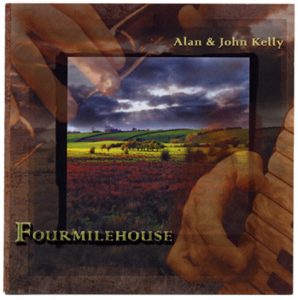
To the musical question of our time, “O Brother, Where Art Thou?” Alan and John Kelly can each answer, “Right here.” The pure-drop playing of Alan on piano accordion and John, his younger brother, on flute and whistle can be likened to the impact of that movie soundtrack. Fourmilehouse is traditional music served straight up, with no need for studio sweeteners or sleight of hand, and harks back to a time when Irish music, like American old-timey and early country music, had a back-porch ease belying considerable skill.
Such skill runs deep in the family of Alan and John Kelly, who were born in Roscommon town. Their grandfather was a fiddler; their grandmother, a melodeon player; their father, Frank Kelly, a piano accordionist from Fourmilehouse in southern Roscommon who won the All-Ireland senior title in 1964; and their mother, Mary ( Ryan) Kelly, an adept pianist and saxophonist. From the late 1950s to the early 1960s, Frank and Mary Kelly were members of the Killina C Band, a gifted ensemble also featuring fiddler Paddy Ryan, a first cousin of Mary and a music instructor to both Alan and John.
“When we were children, Paddy and my father gave us th e encouragement and the rudiments for playing,” Alan explained. “We used old notation from Paddy for a lot of the tunes we recorded on Fourmilehouse.” John drolly added that “we hadn’t played some of those tunes in years, so we had to learn them all over again.”
Learning tunes and honing technique came rapidly for both brothers. Alan found his first piano accordion, an old Paolo Soprani model won by his dad in a raffle, tucked in a turf shed. Besides his father, he counts former Silly Wizard member Phil Cunningham as a prime reason for taking up the instrument. “I heard Phil play the piano accordion one night on Radio One and couldn’t believe how much music he got out of it,” Alan recalled. His brother John points to Mary Bergin as the main influence on his whistle playing and to Roscommon’s Patsy Hanley, John Carlos, and Frank Jordan as the principal influences on his flute playing.
This album captures the two brothers in peak performance. It is the first full-bore recording by John, who previously guested on a few tracks of his brother’s solo albums, Out of the Blue in 1996 and Mosaic in 2000. Alan’s other recording credits include appearances on Niamh Parsons’s Loosely Connected in 1992, Michael McGoldrick’s Morning Rory in 1996 and Fused in 2000, and Seán Keane’s Seansongs in 2002. He also played for such acclaimed theatrical productions as Brian Friel’s Wonderful Tennessee and Mabou Mines’s Peter & Wendy.
The repertoire Alan and John have chosen is a deft blend of unaging standards, such as “The Duke of Leinster” reel that Sligo fiddler Michael Coleman made popular in 1927, and more recent tunes destined to become standards, such as Liz Carroll’s “Diplodocus” reel, Pat Crowley’s “Harp and Shamrock” hornpipe, and Billy McComiskey’s “Palm Tree” reel. Some evergreen compositions of Newtown, County Tipperary’s Paddy O’Brien (1922-1991) also make the mix that much more appealing, and the support the Kellys get from guitarist Arty McGlynn, percussionist Jim Higgins, organist/pianist Rod McVey, bouzouki player Cyril O’Donoghue, banjoist/pianist Brian McGrath, and bodhrán player John Moloney is exemplary.
For Alan and John Kelly, Fourmilehouse proves you can go home again musically. What a stunning duet album these talented brothers have given us.”
– from the liner notes by Earle Hitchner

Cara Dillon seems to have seduced the entire nation in just a few short, breathtaking, eventful years. Make that several nations, for among the rare ingredients of her irresistibly natural personality and mesmerising ability to relate a great story in song, is an all-embracing quality that defies borders, cultures, and even languages.
Born in 1975 in Dungiven, Co. Derry, Ireland, Cara demonstrated her striking vocal ability in winning the All Ireland Traditional Singing Trophy at the tender age of 14 and a year later she was in her first band, Oige. They were pretty successful too. She went on to sing with De Dannan and then folk supergroup, Equation, joining the latter in 1995 as a replacement to Kate Rusby.
Equation (signed to Blanco Y Negro, WEA) seemed to be heading for the top, but the album they recorded ’Return To Me’ didn’t get a release. However, Cara had found her soulmate Sam Lakeman in the band and the pair decided to try their luck as a duo. They re-signed to Blanco and there followed a long and frustrating period as they experimented with writing and recording songs with a succession of top producers and songwriters around the world. However, none of the projects and collaborations seemed to fulfill the inner visions that Cara and Sam had developed, so after six years of being tied to a major label, they decided to abandon ship and set sail on their own. The world is glad they did.
“Cara Dillon, is without exaggeration, amongst the very finest to be heard today.”
– Folk Roots
“Blessed with a voice of unearthly beauty” – Sunday Herald
“Every so often a singer comes along and stops me in my tracks making me look at music in a slightly different light.”- The Living Tradition

Orkney-born and son of singer-songwriter Ivan Drever (Wolfstone), Kris Drever emerges from within the surging folk scene with Black Water, a debut album that is “as marvelous as it is timeless.” (Maverick) . Produced by John McCusker and featuring constant conspirators and collaborators Kate Rusby, Donald Shaw, Roddy Woomble and Eddi Reader, Black Water gives a modern washing to folk standards such as “Braw Sailin’ On the Sail” and “Patrick Spence”. “I like either to do songs that haven’t been covered much before,” Drever says, “or folky standards that are open to a different interpretation. I try to steer clear of that kind of typical folk-singer sound, and put my own mark on things.”
Drever admittedly spent most of his youth listening to Metallica and Pantera, all the while learning the guitar and ruining other people’s sessions at the Orkney Folk Festival. At seventeen, Drever left home for the mainland, eventually gravitating towards Edinburgh’s burgeoning session scene and The Tron Ceilidh House, which was then (late 1990’s) the place to be. It wasn’t long before Drever was a regular at this Scottish musicians haven, playing several nights a week.
After a temporary switch to the double bass, Drever subsequently returned to the guitar and began honing his highly individual style – a blend of rhythm and harmony, folk, jazz, rock and country inflections – that now finds him in near-constant demand as a session player. Drever’s earlier live and recorded work includes collaborations with Cathy Ryan of Irish-American supergroup Cherish the Ladies, Scottish fiddlers John McCusker and Bruce MacGregor, Irish accordionist Leo McCann and Gaelic band Tannas, as well as tours of the US and South America with the Irish dance show Celtic Fusion. Drever was also a member of the highly acclaimed trio Fine Friday which released two albums on the Foot Stompin’ label and toured the UK, Europe and Australia before the three went their separate ways to concentrate on individual projects.
In February 2007, Kris Drever was honored with the prestigious Horizon Award at the 2007 BBC2 Folk Awards. Drever recently toured the UK with Eddi Reader and Roddy Hart and will release an album with the band Lau (Aidan O’Rourke on fiddle, Martin Green on accordion) on Compass Records summer 2007.

In 1961, Irish fiddle virtuoso Martin Hayes was born into one of the most influential musical dynasties ever to exist in Irish music. Raised in East Clare, Ireland, Martin was surrounded by exquisite world-class music, supportive family and friends, and both performance and competition opportunities, all of which proved to be the perfect formula necessary to create, arguably, one of the world’s finest Irish fiddlers.
Hayes’ father, the celebrated fiddle player P.J. Hayes, who was the leader of the legendary Tulla Ceili Band, was instrumental in his son’s early musical development. His uncle, national fiddle champion Paddy Canny, was likewise influential in the creation of his inimitable musical style.
Hayes toured with his father in the Tulla Ceili Band from the age of thirteen and was very active in Comhaltas Ceoltoiri Eireann, the worldwide organization devoted to the preservation of Irish music. During his years competing in Comhaltas music competitions, Hayes took home six All-Ireland championships, the highest level of individual competitive achievement, and by the age of twenty, he had won every competition that Irish music had to offer.
The 1980’s saw Hayes moving to Chicago to take up commercial fiddling. Experimenting in the diverse musical styles of the city, he spent three years playing locally in various rock bands, including the electric/Irish/rock fusion band Midnight Court, where he met his current musical partner, guitarist Dennis Cahill. When his now-manager convinced him to record an all-Irish fiddle album, Hayes recorded his self-titled first US album on the Green Linnet Label, in 1993.
That album was greeted with such extensive critical acclaim that he became an almost instant household name among Irish music connoisseurs, and the album won Ireland’s National Entertainment Award. Hayes’ second album, Under the Moon, was released in 1995, and in 1997, he, along with Dennis Cahill, created an album that would enrapture audiences across the globe and reach over genre divides with expressive candor and natural grace, entitled The Lonesome Touch.
Now living in Seattle, WA, the two tour extensively having released Live in Seattle in 1999, and Welcome Here Again in late 2007.

Nuala Kennedy is a celebrated traditional Irish musician and internationally acclaimed flute player and singer. Touted as “spellbinding” and “a delight,” by the Irish Times, her live performances over the last few years inspired her return to the studio to record Noble Stranger (Compass, avail Aug. 28), a road-tested collection of innovative originals and traditional songs recorded with her touring band. Kennedy uses her traditional music background as a springboard for the new album which offers a 12 song set on which her adventurous instrumentation and progressive instrumentation shine.
Noble Stranger was recorded over a week in the beautiful rolling hills near Biggar, a little town nestled between Edinburgh and Glasgow by Kennedy, her percussionist Donald Hay, 10-string mandolinist Iain Macleod, guitarist Mike Bryan and guest vocalist AJ Roach. Their stage camaraderie translated seamlessly to the studio and this third album is a natural byproduct of their energetic and spontaneous live shows. “The tracks were laid down live, all together, with generally sparse overdubs. The band has been touring together for so long that there’s no other way I could imagine having made Noble Stranger,” comments Kennedy. “The whole album is a real reflection of our live sound.”
Accompanied by the spirited interplay between Bryan’s guitar and Macleod’s mandolin and supported by the tasteful percussion of Hays, tracks on the album intimately connect Kennedy’s own interests in traditional music and her neo-folk composition style. “Spending time in America has given me a greater appreciation of my own traditional musical heritage, and this renewed appreciation is reflected in the choices of some of the older material on the album. Classic traditional songs such as “My Bonny Labouring Boy” and the bonus track “Matt Hyland” are songs I have known for a long time and they seemed to re-emerge as a natural part of this record.” Not all is tradition here, a vintage Casio keyboard given to Kennedy by Norman Blake of the Glasgow band Teenage Fanclub inspired several album tracks, including the light and groovy album opening “Gabriel Sings.” “I was immediately drawn to the simplicity and transportability of the instrument and it strongly influenced the direction of the arrangements.”
Kennedy has recently been calling New York City a home-away-from-home, absorbing and contributing to the City’s growing neo-folk scene. She was raised playing and singing traditional music on the East coast of Ireland – an artistic area steeped in mythology with long historical ties to Scotland. Captivated by the traditional Irish and Scottish repertoire, she went on to study at the Edinburgh College of Art, mentored under fellow Irish expatriate Cathal McConnell and formed her first trio with guitarist Kris Drever and fiddler Anna-Wendy Stevenson and released two critically acclaimed albums. Her first two solo albums, The New Shoes and Tune In, were released through Nashville-based roots music company Compass Records Group and were universally well received. She has performed and recorded with Will Oldham (Bonnie ‘Prince’ Billy), Norman Blake (Teenage Fanclub), Norwegian musicians Frode Haltli and Vegar Vårdal as well as the late Canadian composer Oliver Schroer. Kennedy is also a member of the traditional music group Oirialla performing music of her native North-East area of Ireland alongside Gerry ‘fiddle’ O’ Connor and Martin Quinn and she holds a Masters Degree in Music Performance and Composition from Newcastle University.
“Noble Stranger, you have ventured to me from the land of your fathers,” sings Kennedy on Noble Stranger‘s final track “Napoleon’s Dream,” a sentiment that reflects the underlying theme of the album. In joining the burgeoning New York folk music scene, she has also imported her distinct virtuosity and strong sense of traditional Irish identity—an identity that, inspired by her many influences, continues to evolve and define new boundaries for her tradition.
-->

