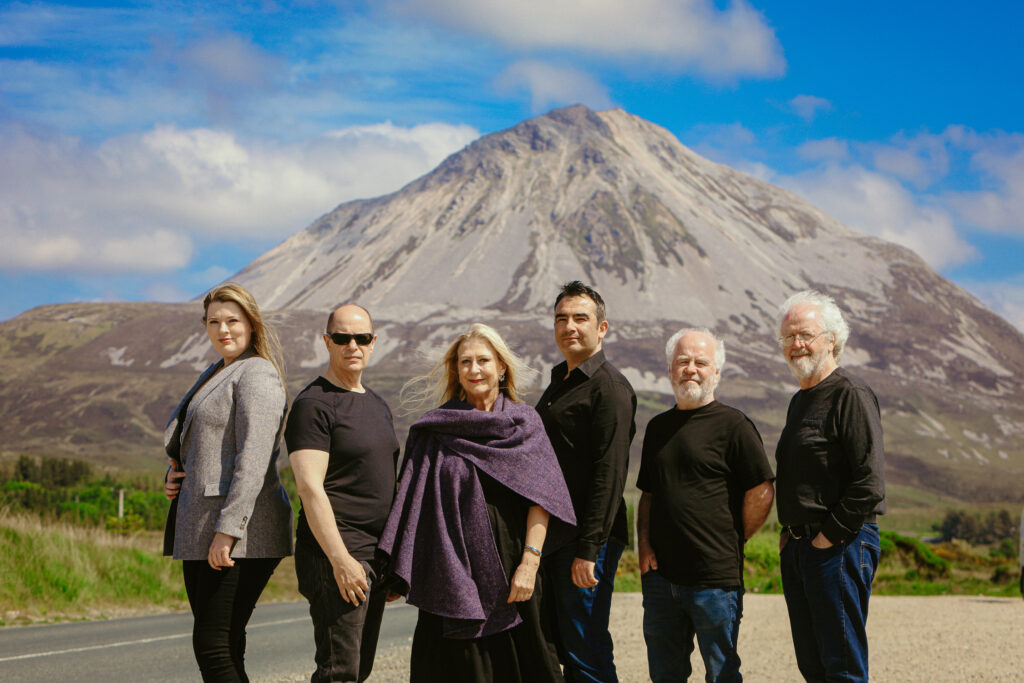
Altan is one of the most iconic bands in Irish music. The band delivers on their reputation as among Ireland’s most important cultural ambassadors with their new release DONEGAL. Irish-language songs and dynamic twin-fiddling, both hallmarks of Altan’s sound, framework the new album which tributes Altan’s native County Donegal and its rich musical heritage, breathtaking landscapes and vibrant culture.
Bandleader, lead vocalist and fiddler Mairéad Ní Mhaonaigh is in fine form thoughout, lending her angelic voice to “Liostáil mé le Sáirsint” and “The Barley and the Rye” and contributing “Port Árainn Mhór/Port Kitty Rua Mooney”, an outstanding set of jigs, to the project. Altan’s newest member, Clare Friel, shares vocal duties with Ní Mhaonaigh, most notably on the track “Faoiseamh a Gheobhadsa” and adds her fiery twin fiddle playing to great effect. Accordionist Martin Tourish brings his formidable chops and compositional sense to the medley “The House of Baoithín” which pays homage to the mid 6th century Saint Baoithín. Dáithí Sproule (guitar), Mark Kelly (guitar, harmony vocals) and Ciarán Curran (bouzouki, mandolin) round out the band which is augmented by special guests Jim Higgins (percussion), Steve Cooney (bass) and Graham Henderson (keyboards) on select tracks. Taken as a whole, the music transports listeners to a bygone time in rural Ireland while simultaneously forging a connection between the past and modern times.
Recorded by Manus Lunny at Stiúidió na Mara (“Seafront Studio”) in County Donegal, DONEGAL captures the essence of the region which has inspired Altan since the band’s inception and further cements Altan’s legacy as one of the great cultural treasures of Ireland.
No Irish traditional band in the last thirty years has had a wider impact on audiences throughout the world than Altan. Formed in County Donegal in 1987 by lead vocalist Mairéad Ní Mhaonaigh and her late husband Frankie Kennedy, the group’s music is influenced by traditional Irish language songs and tunes from Donegal. Over the course of their career, Altan has sold over a million records.

Departing from an Irish pub circa 1962 and passing through Hungary for a chance encounter with a blue-eyed beauty before stopping in the Virginias for an old-fashioned hoedown, Mozaik’s Changing Trains is a musical journey hindered not by genre, place or time signature. Recorded in 2005 in Budapest, Mozaik’s first studio album explores and celebrates the fusion of Irish, European and American folk music. While Changing Trains is a “unique cross-cultural exercise” (Irish Music Magazine), the strength of this album lies within each individual member’s deep respect and understanding of their own musical traditions.
Mozaik are Ireland’s Andy Irvine and Donal Lunny (both original members of Planxty), American born old-time musician Bruce Molsky, Dutch guitarist Rens Van Der Zalm, and Hungarian multi-instrumentalist Nikola Parov. Together they form the ultimate global stringband with a legendary lineage. It was on a lengthy drive through Australia that the great Irish singer, songwriter, and multi-instrumentalist Andy Irvine first envisioned Mozaik. According to Irvine, “The Muse said ‘Get a bunch of your favorite musicians together and do a tour of this beautiful country.’” He continues, “I pondered for not very long before emailing the suspects I had in mind. To my delight they were all into it and thus emerged Mozaik – a band to die for…”
ANDY IRVINE
Born to Irish-Scottish parents in London, Irvine began his artistic career as a young child, trying his hand in acting, acoustic guitar, and traditional music. He moved to Dublin to further develop his Irish trad musical talents, playing such instruments as the guitar, bouzouki, and mandolin. Irvine collaborated with several talented musicians, and formed such bands as Sweeny’s Men, Planxty, and Mosaic. After Mosaic, Irvine began producing music with fiddler Kevin Burke, guitarist/vocalist Gerry O’Beirne, and accordionist Jackie Daly as Patrick Street. Mozaik (a revamped version of the old name) is the most recent culmination of Irvine’s diverse musical experience and visionary propensity.
DONAL LUNNY
Irishman Donnal Lunny’s thirty years of musical prowess is the stronghold of Mozaik. He has been hailed by Irvine as one of the most innovative musicians that Ireland has ever produced. Multi-talented Lunny acts as not only a close friend to Irvine, but also as a professional musician and master arranger for the group. He hears each band member’s niche flavor and acts as the glue that holds the sound of Mozaik together.
BRUCE MOLSKY
Bruce Molsky and Irvine met at a house party Molsky was hosting in Atlanta, Georgia. Irvine first became aware of Molsky’s incredible talent when he first heard him perform “I Truly Understand.” Molsky’s talents with the guitar and 5-string banjo in combination with his old-time musical style contribute a unique zest to the group. Intricate string arrangements perfectly complement Molsky’s plaintive vocals.
NICOLA PAROV
Irvine first met Parov in Budapest twenty years previously, playing with his Balkan band Zsaratnok. Irvine has commented that Parov’s musical propensity is so extensive that an instrument that Parov cannot play has not yet been invented. When Irvine and Parov played together in The East Wind Trio, Parov wielded not only the gadulka, gajda, kaval, and other traditional Bulgarian instruments, but also the guitar, bodhran, and clarinet. As if Parov’s instrumental talents were not astounding enough, he was additionally involvemed with the finest Irish musicians through his performance with Riverdance.
RENS VAN DER ZALM
Rens Van Der Zalm and Andy Irvine first met in Slovenia on the road immediately after Van Der Zalm had graduated. Ver Der Zalm’s style is inventive and creative, incorporating such instruments as the mandolin, fiddle, guitar, accordion, bass guitar, tin whistle, and many other zany gadgets.

Guitar aficionados may be ready to hail the new display of virtuosity on Russ Barenberg’s When At Last—his first solo album in almost 20 years—but for the legendary guitarist himself, the value of the collection is somewhat different. “What I maybe have to bring to the world,” he says with a kind of wry deliberation, “is some good tunes.”
Of course, When At Last does, indeed, showcase subtle, compelling musicianship—and not only from Barenberg, but also from the carefully chosen crew of players who accompany him—yet the point is well-taken. In a world filled with guitarists renowned for technique, Russ Barenberg has always stood out for his intensely melodic approach to playing and writing, and the new album shows that the years since he, resonator guitarist Jerry Douglas and string bass maestro Edgar Meyer made the widely acclaimed, supremely influential Skip, Hop & Wobble have only deepened his musicality. For while Barenberg decided in the late 80s to forego a full-time musical career—or, more accurately, to defer one—he hardly stopped making music, and Skip, Hop & Wobble was only the most visible manifestation of that determination.
“I moved to Nashville in 1986 to be around the scene here and try to get studio work,” Russ recalls. “I thought that possibly I could make a living at it, that I might not have to travel so much. And I did some when I first came down here, but it became clear that it wasn’t a great match for me—I wasn’t deeply enough into pop music that I could thrive in that world. So I took a job that allowed me to have a predictable income, that let me be at home more while my kids were growing up, and that allowed me to do the music I really wanted to do without having to feign interest in stuff I didn’t care about just to put together a living. But it felt to me like I was still dead in the thick of music, because for a lot of that time I was playing in the trio with Jerry and Edgar, and I thought, this is as good a musical situation as I could ever hope for. And so I really felt that even though I was just doing it part-time, I was still doing it in a pretty fulfilling way.”
And indeed, despite the restraints on his time, Barenberg was still wrapped up in music, not only with the trio but with a variety of other projects, most notably the Transatlantic Sessions—a set of filmed-for-TV performances featuring musicians from the British Isles, Canada and the United States in a stunning, evocative cross-cultural exchange. “I’ve been in the house band for all three of them, and a featured artist, too” Barenberg says. “In some ways, it’s the best musical experience one could have. You wake up every morning learning these tunes, and then you film them with different combinations of great musicians—some of whom you’ve never met before. It’s very invigorating.”
Still, despite the satisfactions of projects like the Transatlantic Session, the Barenberg-Douglas-Meyer trio and a miscellany of appearances with friends like fellow guitarist Bryan Sutton, fiddler Aubrey Haynie and singer Tim O’Brien, Barenberg looked forward to the resumption of a career fully devoted to music. “What you miss when you’re working during the day is having the time to really practice and write as much as you would like,” he notes. “One of the most satisfying things for me is writing tunes, and even more, to actually record them and put them together and play them with other people. So I’m very happy to be back in that situation again.”
The fruit of that long gestation, and of his move back to full-time status, When At Last is likely to make a lot of people besides Barenberg happy too. Leading off with the taut groove of “Little Monk,” the set winds its way through bluegrass, Celtic and contradance-flavored tunes that frame Barenberg’s lyricism and rhythmic subtleties in intricate ensembles that feature long-time friends and collaborators. Douglas, fiddle giant Stuart Duncan and percussionist Kenny Malone, who appeared on Barenberg’s last solo album, Moving Pictures, are back for the ride, while the bottom end is held down by Viktor Krauss and Dennis Crouch. “I’d played with both of them in various settings, but I hadn’t recorded with either of them before,” Russ says. “I wanted acoustic bass on the album, and those are two guys whose playing I really like.”
Less familiar contributors turn up too and add a delightful new flavor to the work. “Ruthie Dornfeld is just a fantastic musician,” Barenberg notes. “I played a lot of contra dances with her up around Boston in the early 80s. She’s a great dance fiddler, but she does a lot of other things too and she has a great feel and rhythmic sense; she plays a lot of traditional music and understands it really well. And Jeremiah McLane is a fine accordion and piano player from Vermont who plays in a wonderful trio called Nightingale; they’re one of my favorite bands. He and I and Ruthie, along with Susan Kevra, who’s a great contradance caller and teacher, went to France a few years ago and did a little tour doing dances and concerts. So we have that history together, and I wanted to have some different people from outside of the Nashville crowd on there, particularly on some of the more traditional-sounding tunes.”
Still, while ensemble interplay is the foundation of When At Last, its heart and soul ultimately is to be found in Barenberg’s tunes—some dating back to the early 90s, others composed shortly before recording began—and in his glistening playing. Few guitarists so perfectly blend a mastery of roots music traditions with melodic originality, or so finely balance muscularity with delicacy, and each moment of the album is shaped by these artistic dualities—and by Barenberg’s newfound energy and re-dedication to making music central to his life. “I’m at a point in my life now where I really appreciate what a gift it is to be a musician,” Russ Barenberg says with a smile, “and I’m ready to embrace whatever’s involved in doing it for a living. It’s just a great time for me.”
 The latest release from folk-siren Kate Rusby, ’The Girl Who Couldn’t Fly’ is her most personal and revealing album to date. Now (in her own self-mocking words) a “sprightly old lady of 31, The Girl Who Couldn’t Fly is Kate’s sixth solo album. Her dedication to the most pure version of English folk music has transformed the genre. Because of Kate, “English Folk Music” is no longer considered a dirty phrase among fans and critics. She makes folk music for people who never thought they would like folk music. The Girl Who Couldn’t Fly is a blend of traditional folk tunes and new originals. The same graceful, timeless feel of the songs Kate digs out of dusty old books can be found in her own compositions. A casual listener would be hard-pressed to distinguish one from the other.
When Kate enters the studio, the unwavering test she sets herself is simple enough: how to make a record of music she adores. Critics who shriek for something different might as well whistle in a gale-force wind. “Some people will like it, and some won’t,” says Kate. “I’d never in a million years expect everybody to like my music. But anyone who tells me I need to change direction or whatever can bog off. This is the music I make, and I make it like this because I want to.”
Anyone who has followed Kate’s progress from her first solo album, Mercury Prize-winning ’Hourglass’ in 1997, to the accomplished maturity of ’Underneath The Stars,’ will quickly fall in love with ’The Girl Who Couldn’t Fly.’ From the infectious opener, a sultry arrangement of the traditional “The Game Of All Fours”, to the bonus track, “Little Jack Frost”, written for a BBC cartoon, it oozes quality, enthusiasm, and equal parts fun and heartbreak. Roddy Woomble from Idlewild, Kate’s current rock listening, was roped in to share vocal honors on an anguished ballad of breaking love, titled “No Names.”
Perhaps the album’s most striking feature is Kate’s development as a songwriter. Of the 12 tracks, she composed 7 of them, along with writing new tunes for 2 of the traditional ballads included on the album. Don’t get the idea that this represents a major departure. Although it may have crept up on some, Kate is no beginner at composing music. “I have written music for as long as I can remember,” she says. “In the past, most went in the bin. But there have been several of my own songs on different albums. My first love is the older, story songs. You really can’t beat a good, long murder ballad! That means most of the songs I write are story-based. I suppose that’s why they sound like traditional songs. I think ’Old Man Time’ (on ’Hourglass’) was the first I had written out of that mold, and there have been three or four since.”
The input on ’The Girl Who Couldn’t Fly’ from John McCusker, Kate’s producer and fiddle player, was crucial to her creative process. As well as playing fiddle, all manner of other instruments, and producing the album, John collaborated with Kate to arrange all its tracks. Between the two of them, they drew on the talent and passion of a brilliant team of musicians ranging from Ian Carr, ace guitarist and dab hand at table tennis (the band’s new therapy of choice when touring), to brass bandsmen from the Coldstream Guards.
After putting in the CD, many fans will take out the booklet. Once they’ve stopped gawking at the stunning artwork by former Blur guitarist Graham Coxon, will wonder about the album title.
Well wonder no more. The truth is, Kate really can’t…fly, that is. Or at least, not comfortably. Of the title, Kate said, “It just came out of my mouth one day, and it sounded nice. I hate flying as much as ever. Since the last time I toured in America, I have flown only once – a short flight to Spain when we hired a big villa for a family holiday. “It was the first time my nephews had flown, so I thought I might get carried along on their enthusiasm and not even notice that I was on a plane. They played with me lots to take my mind off it, but I still hated it.”
Kate has tried hypnotherapy, read books about planes and their safety records, but none of it seems to help. The girl who couldn’t fly feels lucky that her music can travel the world without her.

It’s not a typical starting point for a new album, the band members asking each other to nominate the worst song they’ve ever written. Then again, there’s a lot about The Waifs that defies convention.
This unlikely scenario unfolded when Vikki Thorn, her sister Donna Simpson and Josh Cunningham got together in a studio in Western Australia last year. The three mainstays of The Waifs hadn’t seen much of each other since touring on the back of their last album, 2011’s Temptation. The reunion called for a break with tradition. Instead of writing separately, the formula that has served them so well for almost 20 years, it was time for total collaboration. The three musicians would work together as a unit until a bunch of songs emerged.
Much to their surprise, the three amigos drew a blank.
“It was all very exciting,” says Vikki. “We probably hadn’t sat together in a room like that for 15 years. We got out pens and paper and guitars. It felt like it should be an easy thing … but it wasn’t. We tried in earnest to jam and shape songs. We tried going through ‘what’s the worst Waifs song you’ve ever written?’ Even that became awkward because we couldn’t all agree which were the worst ones. It was all very intimate and personal. Then Donna one day got the shits and went off and wrote a song.”
We can be glad she did. That moment of frustration opened the floodgates to what has become The Waifs’ seventh studio album Beautiful You, an exquisitely crafted collection of songs from the three songwriters that bears all the hallmarks of a Waifs classic.
“I thought, ‘I’m just going to walk outside and write something’,” Donna recalls of that false start. ‘It just kind of comes to me that way. It came and just kept rolling.”
In January 2015, aided by their regular rhythm section of drummer Dave Ross Macdonald and bassist Ben Franz, The Waifs entered 301 Studios in Byron Bay, NSW with producer Nick DiDia (Bruce Springsteen, Rage Against the Machine, Powderfinger) and emerged several weeks later with Beautiful You. The emotionally raw but musically buoyant Beautiful You demonstrates the easy chemistry that has bound The Waifs together for more than two decades, as well as celebrating the depth of songwriting talent they have at their disposal.
The 12 new tracks – four from Donna, three from Josh and five from Vikki – play to the strengths of one of Australia’s most enduring and lauded folk, pop and roots outfits. There’s a familiar mix here of celebration and reflection, combined with that easy musical energy and intuition spawned from so many years of touring, whether in the pubs of rural Australia in the early days or on the road internationally ever since then. Beautiful You boasts abundant choruses, intoxicating instrumental exchanges and joyful harmonies, the characteristics that make so memorable the band’s noughties hits London Still, Bridal Train and Sun Dirt Water.
The title track, Donna’s aching vocal drifting over a simple guitar motif, has a deeply personal undertow, a plea to a friend struggling with addiction: “You gotta change the road you’ve been taking,” sings Donna, “lay down your weapons and surrender.”
Simpson’s shuffling, alt country ballad “When a Man Gets Down,” another personal account, this time of a relationship breakdown, is equally emotive. “I sat bawling my eyes out when I wrote that song,” she says. “It was something real that was happening in my life.”
Josh’s country stroll “Dark Highway” is a gentle prod at humanity inspired by the night his van broke down and no one stopped to help him. He wrote the song in the back of the van to kill time until assistance arrived (“obviously I eventually got out of there” he says).
Then there’s the overtly poppy “Blindly Believing,” complete with a killer hook that explores the fleeting nature of love. Vikki wrote the song with WA singer Bex Chilcott, better known as Ruby Boots, in a session in Utah that marked Vikki’s first attempt at co-writing and that produced several co-writes for Ruby Boots’ debut album, Solitude.
Donna’s “Rowena and Wallace” is a bluesy coming-of-age romp punctuated by Vikki’s harmonica stabs and Josh’s piercing electric guitar, while Josh’s “Born to Love” echoes the folk/blues swagger of his hit song Lighthouse from the band’s breakthrough, ARIA Award winning album Up All Night (2003).
Home has been in a variety of places for The Waifs during their career. Donna lives in Fremantle after spending eight years in Minneapolis, where the band recorded Temptation four years ago. Josh splits his time between California and the NSW south coast, where he’s building a house for his family. Vikki is based in Utah. It’s no accident that what inhabits Beautiful You most of all is that attachment to home, wherever that might be.
Twenty-three years after Donna and Vikki set off from Albany to play music across Australia to anyone who would listen, teaming up with Josh en route, the three have come to appreciate the places they left behind. It’s hardly surprising then that Vikki, who with her sister grew up at Cosy Corner Beach near Albany, WA, steeped in the simple, rural traditions of their salmon-fishing family, should reflect on and celebrate those things on the new album. This she does beautifully and longingly on the pulsing, heartfelt album opener, “Black Dirt Track.” “The longer I am away from Australia the more connected I feel to Australia and I keep writing songs about that,” Vikki says. “I grew up near the salmon camp where my grandfather fished, my father played there as a kid and when I go back there now I do the same things with my children. I physically feel connected to that place when I’m there. It’s almost a spiritual thing. It’s where I grew up. It’s where I learned to play guitar, where my husband proposed to me. I’ve had all these deeply personal moments and significant things happen in this one place.”
There’s a similar bent to “6000 Miles”, on which Vikki contemplates the distance between her old home and her new one.
The closing “February”, a sparse acoustic ballad that develops quickly into a full-tilt rocker, has Vikki anticipating warmer, brighter days: “February hitches up her skirt and rolls her stockings down,” she sings.
There are plenty of brighter days ahead for The Waifs. As Josh notes, “the relationship deepens”. Beautiful You is a powerful statement of the individual songwriters’ skills, their beliefs, their passions and their dreams. Bound together by expert musicianship and the love and respect that have developed between them since the early 1990s, it’s also a moving, entertaining and ultimately joyful statement from a group of musicians dedicated to each other and to their craft.
“It’s still great to look across at each other and know where we are going to go with the music,” says Donna. “That has never changed. And we get along better now than we ever have.”

With his stunning bottleneck slide guitar technique and smooth blues vocals, Brooks Williams has mesmerized audiences for over two decades. The Statesboro, GA native has recorded over a dozen albums, including Green Linnet releases Back to Mercy (1992) and Inland Sailor (1994).
A highly respected teacher when not on the road, Williams runs the Guitar for Kids program and is a regular on the summer guitar camp circuit.

Unless you’ve heard them before, you’ve never quite heard anything like the Deighton Family. And if you are familiar with them, then you know that they really are a family of mixed South Moluccan/ English heritage who combine folk, Celtic, Cajun, bluegrass, rock, and everything else around to introduce some of the most refreshing and uplifting music this side of heaven.

Celebrating their 40th Anniversary this year, The Green Fields of America was the first group on either side of the Atlantic to bring together Irish vocal, instrumental and dance traditions on the concert and festival stage. The group continues to feature some of the most celebrated names in Irish American music and dance in including National Heritage Award Recipients Mick Moloney on Banjo, Vocals and Octave Mandolin, and Billy McComiskey on Button Accordion. The group also includes: legendary singer/songwriter Robbie O’Connell, Riverdance and Sharon Shannon Band alum Athena Tergis on 5-string fiddle, World Irish Step Dance Champion Niall O’Leary, acclaimed concertina player and singer Brenda Castles, Pianist and flute player Brendan Dolan and the riveting vocals and fiddle of Liz Hanley.
An evening with The Green Fields of America is an unforgettable experience. They perform a brilliant repertoire of Reels, Jigs, Barndances, Slow airs, and Hornpipes and Set Dances accompanied by exciting, virtuoso Irish dancing from World Champion step dancers, as well as a variety of traditional and contemporary songs in Gaelic and English. These include love songs, humorous songs, patriotic songs, songs of emigration and settlement, Irish American songs from variety theater and vaudeville and the myriad other themes that have made the Irish oral literature and song tradition among the richest in the Western world. All this is linked by the urbane, informative witty commentary which the group is renowned for. They have the rare capacity to appeal to folk and Irish music devotees and to general audiences of any age.

London-born multi-instrumentalist, film composer, producer, and songwriter John Faulkner grew up with the sounds of the Rock Revolution, and was greatly inspired by the likes of Elvis, Little Richard, and Gerry Lee Lewis.
After exhausting modern rock, Faulkner looked to the roots, discovering the great blues and folk musicians. During the English Folk Revival of the 1960s, Faulkner met and developed a professional relationship with singer/songwriter/folklorist Ewan McColl and his wife Peggy Seeger, who in turn introduced Faulkner to the world of British and Irish folk music.
When Faulkner was living in Britian in the late 60s and early 70s, he became close and began to play with many of the best London-based traditional Irish musicians, including West Clare fiddler Bobby Casey, piper Tom McCarthy, and Sligo flautist Rodger Sherlock.
In the 70s, Faulkner wrote the music for the BBC children’s television show “Bagpuss.” Then, in 1977, he met and married Co. Galway singer and De Dannan founder Dolores Keane. The couple worked on several more film scores for the BBC as well as formed the successful Trad bands “The Reel Union” and “Kinvara,” recorded three duet albums, toured extensively throughout the US, Canada, Australia, and Europe, and collaborated on several musical projects.
Faulkner has worked with the best in Irish traditional music, and has appeared on over fifteen albums (four of which he either produced or co-produced). In the new millennium, Faulkner joined forces with accordion great Jackie Daly to create a highly-acclaimed duet tour.

Developed by Trapezoid’s Paul Reisler in collaboration with the Nashville Chamber Orchestra, Kid Pan Alley: Nashville includes songs co-written by more than 1,000 children from 40 different Nashville area schools and features top Nashville talent including Amy Grant, Delbert McClinton, Kix Brooks (Brooks & Dunn), Raul Malo, Beth Nielsen Chapman and many more.
Kid Pan Alley brings these professional songwriters and musicians together with school children in a group songwriting process. Through songwriting, children are able to articulate their feelings in a way that aids with the prevention, intervention and healing of crisis situations. Through Kid Pan Alley they develop self-awareness and self-confidence in their own abilities while learning respect for intellectual property in a direct first-hand way. To date, Paul Reisler has collaboratively written over 600 songs with nearly 12,000 children.
Founder and artistic director Paul Reisler comments: “Kids need to know they can be creators and not just consumers. I see what it’s like for these students to have their first song recorded by artists such as Suzy Bogguss, Beth Nielsen Chapman, and Darrell Scott, and it’s hard not to imagine what they are going to be able to create now that they are off to such a powerful start.”
Kid Pan Alley: Nashville received the 2005 Parent’s Choice Foundation Gold Award for excellence in children’s music, a Gold Medal Prize from NAPPA, and a GRAMMY nomination for the track Scary Things.
About Kid Pan Alley:
Kid Pan Alley started with a brilliant, yet obvious discovery – kids make the best co-writers. Kid Pan Alley is a national children’s songwriting project developed by Trapezoid’s Paul Reisler in which children are inspired to be creators and not just consumers of music. To date, KPA has written more than 600 songs with more than 12,000 children and won five ASCAP Foundation awards. www.kidpanalley.org
About Nashville Chamber Orchestra:
The Nashville Chamber Orchestra has come to be recognized as one of America’s most creative and innovative orchestras, presenting it’s unique style of Music Without Boundaries. Under the leadership of music director Paul Gambill and executive director Connie Linsler Valentine, the extraordinary music making of this ensemble has garnered a steady of national media attention plus recordings for Warner Bros., NAXOS, Angel, Almanac, and Alabaster Records, and a national award for Adventurous Programming from ASCAP. www.nco.org
Track Listing
1. Suzy Bogguss / Bouncin’ off the Bottom
2. Beth Nielsen Chapman / Little Drop of Water
3. Jonell Mosser / The Cheetah
4. Darrell Scott / Rainforest
5. Mustafa Abdul-Aleem / Goin’ to the Park
6. Jimmy Hall / True to Me
7. Raul Malo / Whispering in Spanish
8. Delbert McClinton / Freaky Friday
9. Kaset/Middleman/Lloyd/Vezner / Download it all for Free
10. Kix Brooks / Cartoons
11. Tommy Sims / Can’t Remember What I Forgot
12. John Bindel / Scary Things
13. Paul Colman / Pretty Good Day
14. Lari White / Stinky Socks
15. Amy Grant
Christmas in Tennessee
16. Will Hoge / No Fair
17. Nashville Bluegrass Band with Kathy Chiavola / Extra Hand
18. Kim Richey / Sleep All Day

Niamh Parsons has come to be known as one of Ireland’s most distinctive singers. Her earthy, sensuous voice has drawn comparisons to such venerated singers as Dolores Keane, June Tabor and Sandy Denny. The great Scottish balladeer Archie Fisher said of her, “a songstress like her comes along once or twice in a generation.”
Never has this been more clear than on Niamh’s (pronounced “Neeve”) latest album, Heart’s Desire (Green Linnet, 2002), produced by Dennis Cahill. As with her two previous releases, she furthers the tradition of Irish song with heartfelt delivery and unadorned settings. The collection of songs is drawn from both traditional sources and modern writers, including Mark Knopfler and Andy Irvine. Heart’s Desire has received glowing reviews, and named “Celtic Album of the Year” by the Association for Independent Music (AFIM).
Born and raised in Dublin, Niamh and her sister learned to love traditional Irish singing and harmonizing from their father, Jack Parsons, to whom Niamh dedicates Heart’s Desire. “Daddy had a beautiful voice,” she says, “and a great ear for a good song.” Her mother was also a singer and a set dancer from Co. Clare. The family would often join in song at the local Dublin singers’ club, to which Niamh still attends.
Niamh’s passion for singing blossomed naturally into a penchant for collecting songs. She is always on the lookout for songs, new and old, that speak to her-listening to new albums, scouring the Traditional Music Archives in Dublin, sharing notes with a network of friends and other singers. Once she discovers a song she likes, Niamh views herself as the vehicle for the music. “For me the song is more important than listening to my voice,” she says. “I consider myself more a songstress than a singer – a carrier of tradition.”
Throughout her career, Niamh has performed with a wide variety of artists, and has appeared at nearly every prestigious folk festival on either side of the Atlantic. As a member of the traditional Irish band Arcady (led by De Dannan’s Johnny “Ringo” McDonagh), she is featured on the group’s AFIM-awarded CD Many Happy Returns. She appeared before President Clinton and Irish Prime Minister Bertie Ahern in Washington, joined Grammy Award winner Paul Winter for an album and a summer concert in New York, and performed on A Prairie Home Companion when the show broadcast live from Dublin.
Niamh’s recording career began with The Loose Connections, a band of top-notch Belfast musicians she formed with songwriter and bass-player Dee Moore. The band recorded two albums of contemporary and traditional material together. Their debut recording, Loosely Connected (Greentrax, 1992; Green Linnet, 1995) met with the highest of praise. A beautiful mix of traditional Irish and contemporary songs, it featured the memorable “Tinkerman’s Daughter” and featured Brian Kennedy, piper John McSherry (Lúnasa, Coolfin), and accordionist Alan Kelly.
The Loose Connections’ second album, Loosen Up (Green Linnet, 1997) was another buoyant mix of originals and well-chosen contemporary ballads, like the gorgeous “Cloinhinne Winds” and Tom Waits’ “The Briar and the Rose,” a powerful a cappella duet with Fran McPhail of the Voice Squad. Once again the album featured first-class musicians, including guitarist Gavin Ralston (Mike Scott, Sharon Shannon) and Kilkenny accordion player Mick McAuley (now with Solas).
In 1999, Niamh took a bold step and returned to her roots with her first solo album, Blackbirds and Thrushes (Green Linnet) a collection of traditional Irish ballads gathered from over 15 years of Niamh’s singing repertoire. In her words, “these songs are living in me.” The album won instant acclaim as a welcome return to traditionalism. The Boston Globe declared that it “expressed the sorrow and longing of the Celtic soul more deeply than any within recent memory”, and Irish Music Magazine called it “simply magnificent traditional singing.”
Keeping in form, Niamh’s next CD In My Prime (Green Linnet 2000) was another collection of mostly traditional material, and again received widespread praise. Folk Roots named it one of the top albums of the year and The Irish Voice called the album “a must-have disc for lovers of Irish song.” It also saw the emergence of Niamh’s new accompanist, talented young guitarist Graham Dunne. The album was nominated for Album of the Year by BBC Radio 2 (UK) and the Association for Independent Music (US).
With Heart’s Desire the newest addition, it is a body of work that has proven Niamh Parsons one of the premier vocalists of her time and a keeper of the flame in Irish traditional song.
Quotes From the Press
“Simply magnificent traditional singing.” – Irish Music Magazine
“Let’s cut to the chase. Niamh Parsons has a drop-dead, stop-you-in-your-tracks, unbelievably gorgeous voice.” – Calgary Herald
“Niamh Parsons sings like an angel.” – Chicago Tribune
“It’s quite, quite wonderful, throw back the head stuff, utterly devoid of pretense or preciousness.” – Hot Press (Ireland)
“Subtle and expressive in delivery… one of those singers who sounds totally wrapped up in the meaning and message of everything she performs.” – The Scotsman
“One of the freshest and brightest on the Irish music scene today. Her strong expressively husky voice combines some of the best qualities of such stalwart vocalists as Dolores Keane and June Tabor. She has Keane’s gift for emotive sweep and Tabor’s talent for deep-rooted interpretation.” – Irish Echo
In My Prime
“Irish singer Niamh Parsons proves by this CD that she’s still very much indeed in her prime….She’s done it again here with, with more lovely songs from Ireland and beyond. But it’s not just the beauty of the songs that makes this CD, it’s what Parsons does with each song. She breathes sweet life – and sometimes bittersweet sorrow – into each word as she lifts the lyrics off the page and sets them flying.” – Pulse!
“A diva in her prime….dusky mature vocal chords, beautiful, coaxing musicality and phrasing, and heart slicing emotion.” – Irish Times
“Parsons has a beautiful voice, with a wide range which maintains purity from crystalline soprano down to throaty alto. What makes In My Prime a great recording (other than her considerable ability) is her comfort with the material and awareness of where her strengths lie.” – Irish Herald
“For anyone who hasn’t been paying attention over the last few years, Niamh Parsons has a drop-dead gorgeous voice and is a stunning singer of anything from traditional ballads to contemporary rock….What makes Niamh so outstanding is her ability to just let herself be the vehicle for a good song, rather than taking it by the neck and ’making it hers’. By going back to these songs in her prime, she breathes new life and freshness into them.” – Folk Roots
“Niamh Parsons has quietly become one of Ireland’s leading traditional singers. Her voice has an expressive subtlety and warmth that few other singers have…Perhaps the best parts are the two unaccompanied songs that truly show the power and timelessness of her voice. A recording that will sound as fresh 10 years from now as it does today.” – Dirty Linen
Blackbirds and Thrushes
“This album from emerging star Niamh Parsons Blackbirds & Thrushes expresses the sorrow and longing of the Celtic soul more deeply than any within recent memory. Parsons relies on simple accompaniment and a lovely heartache of a voice…Spare settings allow every nuance of her splendid voice to shine through.” – The Boston Globe
“A marvel of musical purity and unadorned charm, its 12 songs exude a pristine beauty that grows more fetching with each new listening. The Dublin-based Parsons is a splendid singer, and her purity of tone, shimmering clarity and heartfelt delivery perfectly serve the timeless airs and laments featured here.” – San Diego Union-Tribune
“Niamh Parsons may be well known for her work with Arcady and with her own band, the Loose Connections, but she is also an outstanding solo artiste. She has put together an impressive collection of songs, all painstakingly researched and immaculately presented, a true labor of love.” – The Living Tradition
“Parsons’ beautifully crafted phrases, sharp vocal control and soulful tone makes even the most melancholic song riveting.” – CMJ New Music Report

Button accordion master James Keane was born in Drimnagh, Dublin, in 1948 into an intensely musical family. He began playing the box at the age of six, and by the time he was ten, he was an active musician in the Dublin traditional music scene alongside greats such as Seamus Ennis and Sonny Brogan.
As a young teenager, Keane co-founded the Castle Ceili Band, which would go on win the All-Ireland Ceili Band Championship in 1965. Keane also won All-Irelands in soloist categories, including three consecutive wins in the senior division (a record that still stands unbroken).
As an adult, Keane and his brother, fiddler Seán Keane teamed up with flautist Mick O’Connor to assemble a group of musicians that would become the musical “melting pot from which the Chieftans would emerge.” The gentlemen included Joe Ryan, John Dwyer, Liam Rowsome, Michael Tubridy, Bridie Lafferty, John Kelly, and were drawn from both the Castle Ceili Band as well as Sean O’Riada’s legendary Ceoltoiri Cualann (the first Irish band ever assembled for the purpose of the music only, without regard to dancers).
During the Dublin folk-revival during the mid-1960s, Keane became a powerful mentor for many of Irish Trad music’s most well known musicians, including singer/guitarist/composer Paul Brady and multi-instrumentalist-turned-musicologist Dr. Mick Moloney.
1967 brought Keane to America for a tour with accordionist Joe Burke, flautist Paddy Carty, and the Loughrea Ceili Band. Keane felt the palpable opportunity America had to offer Irish music, and moved to New York in 1968. Once established in the city, Keane was invited to play everywhere from Madison Square Garden to Carnegie Hall, and was hailed as “the accordionist, who swung through reels with such exciting drive that he virtually lifted the audience out of their seats,” (music critic John S Wilson).
During his first years in New York, Keane recorded his first solo albums for Rex Records, 1980 brought a move to Nova Scotia to become a member of the band Ryan’s Fancy, with whom he performed on television, toured, and recorded three records. His next solo endeavor united he and his brother Sean for the first time since the latter was recruited by the Chieftains in 1968, titled Roll Away The Reel World, and produced by Mick Moloney.
Keane moved back to New York when Ryan’s Fancy broke up, and made his US Network TV debut on NBC’s The Today Show. The rest of the 1980s were full of solo performances, duo tours with Seamus Connelly and a stint with the All-Star touring act The Green Fields of America.
1991 brought Keane a homecoming, and he played his first public performance in 23 years for the Dublin Traditional Music Festival with Chieftan’s singer Kevin Conneff and former student Paul Brady. Afterward, he starred in the New York Public Television’s weekly music program Irish Eyes and Erin Focus. In 1993, Keane recorded That’s the Spirit with John Doyle (1994) and in 1996, Keane and Doyle were joined by Solas’s Seamus Egan and Winifred Horan to record The Irish Isle for a companion cookbook called “New Irish Cuisine.”
In 1997, Keane moved back to Ireland and recorded With Friends Like These (Shanachie Records) with Bothy Band members Paddy Glackin and Tommy Peoples, Chieftans’ Kevin Conneff, Liam O’Flynn of Planxty, and Matt Molloy. This all-star effort was the perfect way to celebrate and honor a lifetime of music and friendship.
-->


