“There’s something wonderful about the God-given pleasure of putting new strings on an old banjo and picking on them a little when they’re all loose and way down low and lonesome like an old sweet voice coming across a wet field after a spring rain.” – John Hartford
“John Hartford was one of the rarest of musical birds. He had one foot deeply rooted in the past and the other always at least a few steps into the future- and both were dancing.” – Larry Groce, Mountain Stage
Overview Nearly a decade after his passing, Memories of John was recorded to commemorate the life and music John Hartford. The core of the project is the John Hartford Stringband—Chris Sharp/guitar, Bob Carlin/banjo, Matt Combs/fiddle, Mike Compton/mandolin and Mark Schatz/bass—the same group of musicians who appeared on Hartford’s last five Rounder Records projects and who were his touring band during the last years of his life.
Special guests Tim O’Brien, Bela Fleck, Alison Brown, Alan O’Bryant, George Buckner and Eileen Carson Schatz join the band on renditions of hit original John Hartford songs, traditional fiddle tunes, country and bluegrass songs refashioned by Hartford as well as a few rarely heard Hartford originals written shortly before his death. But the most special guest on the CD is John Hartford himself who appears on several previously unreleased tracks. Memories of John is a loving tribute to one of the most influential musicians of his time and an essential recording for all John Hartford fans.
Watch
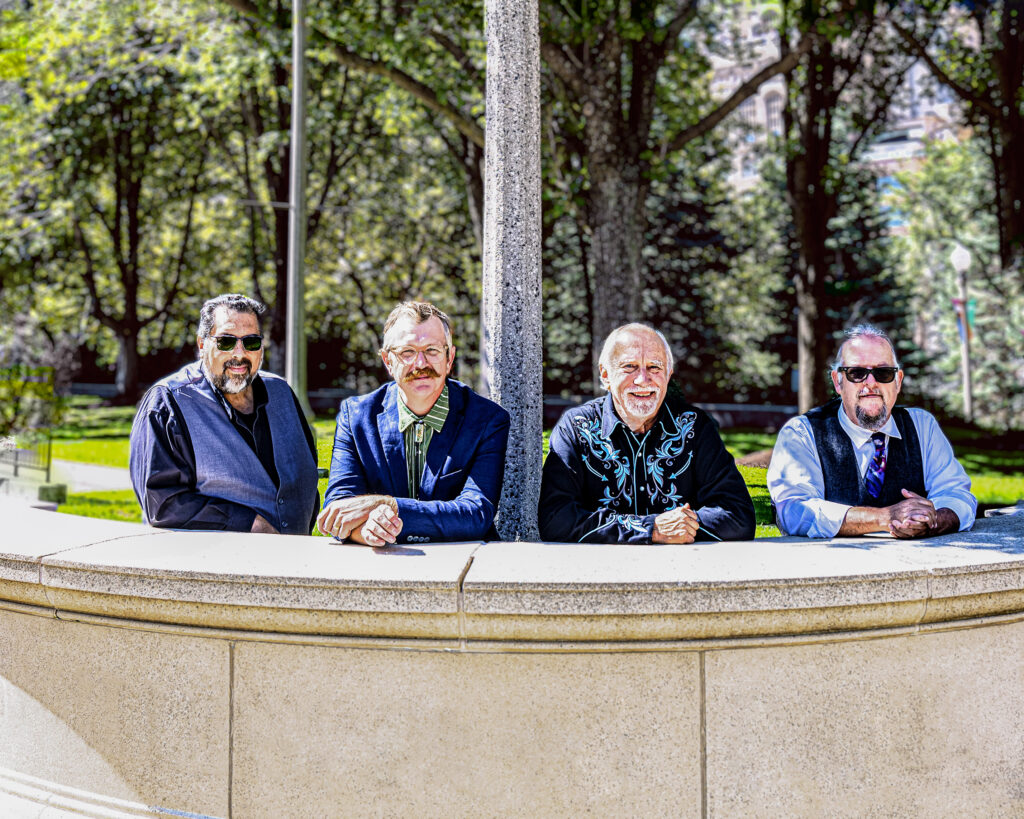
Special Consensus at Millennium Park, Chicago. Credit: Karen Murphy
No band has done more to elevate bluegrass music over the past 50 years than Chicago-based Special Consensus. The two-time Grammy-nominees and multiple IBMA-Award winners are celebrating their golden anniversary with the release of Been All Around This World, a stellar set of contemporary bluegrass featuring special guest appearances from notable lead singers from over the band’s 50-year history: Robbie Fulks, Rick Faris, Josh Williams, Chris Jones, Ashby Frank and Dallas Wayne.
Working again with producer Alison Brown, Special Consensus builds on their legacy of blending classic sounds with contemporary influences. Bluegrass standards including “I’ve Been All Around This World”and Tony Rice’s “Like a Train” sit alongside re-workings of The Marvelettes’ “Please Mr. Postman” and Roger Miller’s “King of the Road.” All but two of the album’s tracks are collaborations between the current and former band members and the spirit of musical camaraderie that informed the recording sessions shines through the music.
The most heartfelt track on the album, the John Hartford-penned “I Wish We Had Our Time Again” has special guests join in with current band members Greg Cahill (banjo), Brian McCarty (mandolin), Greg Blake (guitar) and Dan Eubanks (bass) and the track is infused with a casual jam session vibe, everyone trading vocal lines and swapping fiddle tunes during the instrumental sections. The friendship between all the musicians is palpable and bandleader Greg says the session filled him with gratitude. “I feel so very fortunate to have had so many talented, fantastic musicians and great people pass through the band and remain friends forever. I am so lucky to have been able to follow my ‘path with heart’ for the past 50 years!”
Been All Around This World is chock full of stellar collaborations. The album kicks off with “What Am I Doing Hangin’ Round,” a song made popular by the Monkees, featuring Chris Jones on lead vocals and a climactic final chorus that includes harmonies from Rick Faris and Dallas Wayne. Faris’s high tenor vocals are featured on the album’s second single “Please Mr. Postman” and Dallas Wayne delivers a stunning version of “Always on a Mountain” made popular by Merle Haggard in the late 1970s. Greg Cahill and Alison Brown continue their tradition of including a twin banjo tune on every Special Consensus album, this time with a tasty take on the classic Louis Armstrong song “Red, Red Robin.”
The album’s title track, “I’ve Been All Around This World,” winds through three modulations, each section featuring a different lead singer starting with Josh Williams on the first verse, Greg Blake with Ashby Frank on the second verse and ending with Robbie Fulks.
Over the course of their 50-year career, Chicago-based Special Consensus has toured across the globe, playing in every state in the continental US as well as in over a dozen countries on multiple continents. The band’s founder and banjoist Greg Cahill has built a legendary farm team for a long list of bluegrass musicians who started their careers as members of the band. Special Consensus has released over two dozen albums, received two Grammy nominations and eight IBMA Awards. They hold the distinction of being the longest continuously touring and recording band in bluegrass music still performing today.
“The music she makes is tender, sometimes melancholy, and yet her voice, walking a line between her sister’s combined with the timbre of Nanci Griffith’s, is expressive of emotions behind or perhaps beyond the lyrics of the songs she chooses to sing.” —All Music Guide
After taking a 10-year break from recording, Frances Black, one of Ireland’s top vocalists, makes her long-awaited return with Stronger. Her pure vocal tone and energetic, pop-minded delivery showcase an artist stronger and more passionate than ever about her music. “This is an album of all my favorite songs that I have sung through the years. I have loved and lived these songs, they all tell the stories of my life,” adds Black. A former member of Arcady and The Black Family, Black made her solo debut with two tracks on the million-selling, multi-artist compilation Woman’s Heart in 1993. An album-related tour with Maura O’Connell, Dolores Keane, Sharon Shannon, Sinead Lohan, and her sister, Mary Black, broke all of Ireland’s box office records. While Black’s debut solo album, Talk to Me (released in 1994), sold over 100,000 copies and spent eight weeks at the top of Ireland’s music charts, her releases The Sky Road (1995), The Smile on Your Face (1996), and Don’t Get Me Wrong (1998) further established her as an internationally known performer.
T with the Maggies are Tríona & Maighread Ní Dhomhnaill, Mairéad Ní Mhaonaigh & Moya Brennan.
In May 2007, a remarkable gathering of traditional Irish musicians and singers came together at Vicar Street in Dublin to celebrate the life and music of Mícheál Ó Domhnaill, who, with Skara Brae and The Bothy Band, had been a pioneering force in Irish music.
Among the many artists and groups coming together that evening was an evocative performance by four of Ireland’s finest female singers. Tríona and Maighread Ní Dhomhnaill (Míchaél’s two sisters, concert organisers and co-members of Skara Brae and The Bothy Band) were joined by Mairéad Ní Mhaonaigh of Altan and Moya Brennan of Clannad.
And so was born one of the most inspirational and heartening collaborations in traditional Irish music.
Tríona, Maighread, Mairéad and Moya, T with the Maggies, all come from the same corner of County Donegal (with Gaelic as their first language) and all have illustrious career histories. Each individual brings a unique and varied interpretation of their musical heritage but the result is one of the finest ever amalgamations of Irish female voices. They are real Celtic women!
Their first show in January 2009, at the Temple Bar Tradfest in Dublin, sold out immediately and they went on to perform at last year’s Irish Global Economic summit. A new recording of their repertoire favourite, “Two Sisters”, was commissioned by Sam Shepard, for his play, Ages of the Moon.
On the stage the ‘Maggies bubble with a mixture of instinctive tone, harmony and a generous helping of laughs. Each bring their choice of songs but mould them into the group with a unique soundscape of voice, piano, fiddle and harp. You can tell that they are the best of friends.
Watch
With a poet’s heart and a rockster’s soul, Luka Bloom is regarded as one of Ireland’s best-respected contemporary folk artists, having produced 20 albums since the 1970s, Bloom continues to push the boundaries of what his music can do, and the 2012/13 Heartman Tour proves he is still making provocative, poetic music that delves deep into the intricacies of the human soul and pulls out the nuggets and puts them in a song.
Like many who write songs, Luka’s orchestra of choice is the guitar. What makes his career a little different is his constant search for a new voice within the guitar. The guitar is the landscape on which the song is created, and he is forever probing that landscape for new inspiration. No effects, no gadgets. Time, effort and a whole lot of love bring forth new voicings within the instrument, and bit by bit, the songs come to life. And eventually they fly, bringing Luka with them to be heard in Byron Bay, San Francisco, Hamburg, or even Doolin.
Luka Bloom writes and performs songs and has done for four decades now. For a man of limitless passion for music, change, tradition and its lessons, he says of it all that “It’s all about the Song”.
That summer of love in 1969 was the first time Luka Bloom (known then by his birth name Barry Moore) set to the stage to support his older brother and renowned Irish singer Christy Moore and since then he has been bringing his unique, passionate sound to indigenous and international audiences on stages from the United States to Australia, and through every venue imaginable in his native Ireland (in turf bogs, record stores, up on a bike and on protest sites) Belgium, Germany, Switzerland and Holland (to name a few of the countries with avid fans) playing atop mountains, cycling onto stage and even supporting His Holiness The Dalai Lama in 2011 in Australia. Brought about by sharing a stage in his native Kildare with the Dalai Lama during his visit to Ireland. It was here the Tibetan Leader heard Bloom’s dedication song to his plight “As I Waved Goodbye” from Between the Mountain and the Moon.
The song was written to capture the moment in 1959 the Dalai Lama said farewell to his beloved city of Lhasa, his country Tibet, and his beloved people. Luka could never have imagined that this song would bring him to sing for three weeks with His Holiness in Australia. This has given Luka a simple motto for life; ‘Follow the song’.
Kevin Barry Moore, as he was named in the beginning, came from the land of St Brigid in Co. Kildare, Ireland. It was in a musical family he was brought up and his journey began through traditional music and the all important Song. It was soon clear that he was developing his own sound, one that centres around place and standing up for the rights of the land, yet is grounded in the poetry of the old traditional Irish Folk songs.
He moved from Ireland, first to Holland and then to Washington DC and New York City, USA and his song changed somewhat to a new sound for the Irish Emigrant as the sense of displacement in his lyrics mingled with a positive delight to be exploring the world outside the boundaries of Ireland.
On his way to New York in 1987 he decided to embrace fully the change of leaving the home land and became officially for the first time Luka (from Suzanne Vega’s song of the same name) Bloom (Joyce’s great Dubliner from Ulysses). Bloom by name and bloom by nature, the music and the man blossomed in New York and songs of love and loss such as Dreams in America and songs with humour and vivaciousness, with a nod to a new beginning such as An Irish Man in China Town sprang forth and Luka Bloom was firmly on the scene.
Luka Bloom has the power to bring audiences to a hush as his poetic lyrics bounce over melodies in a beautiful, captivating way. The same artist can rouse the spirit of the audience to the ceiling when he changes the tempo. His latest tour Heartman has been coupled with the release of the new album This New Morning which features songs such as You Survive and leave an everlasting message of strength and a celebration of the will and power of us mere humans.
Watch
John Cowan, also known as the Voice of Newgrass, has been singing his heart out for thirty-five years, and his soaring vocals have only improved with time. A true innovator, John applies his powerful pipes to genres from country, bluegrass, and gospel to soul, jazz, and rock-and-roll – often within the space of a single concert. His ability to move fluidly through multiple styles, and carry mesmerized audiences on the journey with him, has set him apart as one of the most loved and admired vocal artists of his generation, not just by fans and critics but among fellow musicians as well.
Cowan’s rise to fame began in 1974 when he auditioned as the bassist for the then up-and-coming New Grass Revival. Needless to say, John was offered the gig, but it wasn’t until he’d accepted the job that the shy 22-year-old casually mentioned that he could sing. With his distinctive, rock-tinged tenor vocal and heart-thumping electric bass, John, along with fellow New Grass Revival band mates Sam Bush, Courtney Johnson, and Curtis Burch, and later Béla Fleck and Pat Flynn, introduced a new generation of music fans to an explosive, experimental and ultimately, eponymous brand of bluegrass. The “newgrass” sound spawned popular jam bands such as Leftover Salmon and Yonder Mountain String Band in addition to shaping the sensibilities of country megastars Garth Brooks, the Dixie Chicks, the Zac Brown Band, and Darius Rucker.
After New Grass Revival disbanded in 1990, John went on to record a series of critically acclaimed solo albums in addition to laying down guest bass and vocal parts on some 120 recordings for artists including Steve Earle, Béla Fleck, Alison Krauss, and John Prine. A few years later, John teamed up with Rusty Young of Poco, Bill Lloyd of Foster & Lloyd, and Pat Simmons of the Doobie Brothers in The Sky Kings, a widely successful country rock band. John’s newfound alliance with Pat Simmons gained him the role of bassist for the Doobie Brothers from 1992 through 1995, as well as a songwriting credit for “Can’t Stand to Lose” on the Doobie Brothers 2000 release Sibling Rivalry.
Not content to remain a sideman, however, John left the Doobie Brothers to follow his creative muse in pursuit of a solo career that, at the dawn of the 21st century, found him circling back to his acoustic “newgrass” roots. “What we did back in the New Grass Revival days was unique,” he says. “Our vision was to take acoustic music somewhere new. What I’ve done with the John Cowan Band is try to recapture the magic of that ground-breaking experimentation and take it to the next level.”
The John Cowan Band, featuring some of acoustic music’s finest players, has been a force to be reckoned with these fifteen years – and counting. John is a fixture and a favorite at major festivals like the Telluride Bluegrass Festival in Colorado and Wilkesboro, North Carolina’s “traditional-plus” MerleFest. Stints in his band have helped launch the careers of Noam Pikelny (Punch Brothers), Luke Bulla (Lyle Lovett), and Scott Vestal, among others. The band’s current lineup features long-time collaborator and outstanding flatpick guitarist Jeff Autry, renowned and in-demand fiddler Shad Cobb, and fellow Doobie Brother, Ed Toth, on drums. John again found himself the bassist of the Doobie Brothers in 2010, and currently tours around the world with the Doobies, laying down the low notes and singing the high ones as they perform various hits.
In 2014 John signed to Nashville-based Compass Records for the release of Sixty, a career retrospective of sorts that is the singer’s most ambitious project to date. Produced by fellow Doobie Brother, John McFee, the album’s 12 tracks showcase Cowan’s iconic vocals alongside an incredible array of special guests including Leon Russell, Alison Krauss, Rodney Crowell, Bernie Leadon, Sam Bush, Chris Hillman, Huey Lewis, Bonnie Bramlett, Ray Benson and many more. Tracks range from the Dixieland-influenced, heartfelt song “Miss the Mississippi,” to “Why Are You Crying,” a banjo-pickin’ foot stomper, to the rocking “Run For Your Life,” which could easily become a blues rock classic. The album’s opener “Things I Haven’t Done” allude to Cowan’s newgrass roots while the standout piano/vocal duet with the legendary Leon Russell, recorded live in one take, is an absolute stunner. Taken as a whole, the album illustrates the breadth of Cowan’s vocal talents while showcasing his remarkable vocal dexterity across a variety of genres, proving that 45 years into his career, John is still one of the most iconic singers in roots music. “I love my ‘job’,” Cowan says. “I love playing music for people every night. I’m very grateful for every opportunity I have to play my music with my own band for the fans that have been so loyal to me over the years. I don’t ever want to stop sharing my music with them.”
If you’ve seen David Mayfield perform with The Avett Brothers, Mumford & Sons, Jessica Lea Mayfield, or at Bonnaroo, you’ve caught the charisma, the heart, and the comedy, and it’s likely you’ll come back for more.
This singer-songwriter, band leader, and GRAMMY nominated producer stepped out of the sideman shadows with his 2011 album The David Mayfield Parade his follow-up Good Man Down was self released and funded with a surprising succesful Kickstarter campaign that more than doubled its initial goal of $18,000.
On the heels of that sucsess, Mayfield has partnered with Compass Records to release STRANGERS—a tour de force, stretching from the avant-garde to Mayfield’s musical roots, which are buried deep in the bluegrass tradition from a childhood of touring with his family’s band. Tracks range from the Celtic-inspired opener “Caution,” which features Mayfield’s deft ability in orchestrating complex instrumentation, to “The Man I’m Trying to Be,” a sharply honest song that is as dark and it is tender. Mayfield is truly a wordsmith, forging the mundane into the evocative in each track, most notably with “Ohio (It’s Fake),” whose innovative lyrics are propelled from acoustic beginnings into a pure pop finish, Mayfield’s trembling tenor rising above the grooving band. With the release of Strangers, David Mayfield is clearly going places, fueled by a deadly combination of infectious energy and songwriting chops that only come around once in a blue moon.
“Acoustic, beardy goodness.” —American Songwriter
“Anyone with a craving for rustic Americana—frayed edges and all—will find Mayfield and company effective practitioners.” —Blurt
“A massively skilled picker and singer with a knack for stagecraft.” —Nashville Scene
“…his songs are sturdy enough to work in any format, because his tunes are that lovely and his words that understated.”
—Washington Post
“…a dynamic combination of music and comedy worthy of a traveling vaudeville act” —The Boston Globe
“…the wild man of Americana!” —The Independent
“this abundantly bearded multi- instrumentalist/songwriter impresses with a sound on the cutting edge of indie folk- rock” —Spirit Magazine
David Mayfield grew up playing bass and touring with his family’s bluegrass band. As a teenager he established himself as a hot picker collecting national awards for his dexterity on guitar and mandolin. His knack for colorful performances was evident as a backing player in his sister Jessica Lea Mayfield’s band including their appearance on “The Late Show with David Letterman.” He oozed personality on stage – a trait that makes him a natural frontman. He took his skills and personality when he joined the bluegrass outfit Cadillac Sky, playing sold out shows with British folk revivalists Mumford and Sons. Around then Mayfield began writing songs after hearing artists like Randy Newman and Simon & Garfunkel. Encouraged by his sister Jessica, & friend Seth Avett, to record his original material, Mayfield did just that, to much acclaim. Since that time he has toured almost non-stop. Conscious of not just being a musician, but an entertainer – something his father instilled in him in the family band—he certainly makes an impression live. But it’s the strength of his songwriting and musicianship, combined with that charm and personality that keep audiences consistantly lining up to join the parade.
“The definitively Canadian duo has an ear for pop hooks, but writes songs that sound warm and comfortable.” —NPR
Dala, the award-winning duo of Amanda Walther and Sheila Carabine, are releasing their fifth studio record, Best Day this June on Compass Records. With lush intertwining harmonies, the duo underscores the folk-pop album’s “life is short” message with accompaniment from piano, guitar, ukulele and minimal drums. The title track of the album is available as a single exclusively on iTunes with an accompanying video.
Throughout their career the duo have toured tirelessly, building their following the old-fashioned way, turning first-time listeners into instant, die-hard fans, winning 5 Canadian Folk Music Awards and a Juno nomination. Dala has played all over North America and for the highest profile music festivals, among them New Orleans Jazz Fest, Philadelphia Folk Festival, Denver’s Swallow Hill, the Lowell Summer Concert Series, Strawberry Music Fest, Sisters Folk Festival the and 50th Anniversary of the Newport Folk Festival in 2009 – where Dala were the only Canadian act invited to play. Last summer Dala hosted a PBS special primetime concert entitled “Girls From The North Country” which aired all over North America with multiple plays in Los Angeles, Chicago, Philadelphia, Boston Portland, Austin, Cleveland, Charlotte and more.
Dala is grateful, but they tend to measure the success of their records according to more personal benchmarks, such as how well a given record reflects their friendship and how it might enable them connect more effectively with their diverse audience of both the young and young at heart. Best Day is no exception. “We really feel this album represents all of the aspects of our personalities, individually and together,” Carabine says. Walther and Carabine underline their message beautifully by bracketing Best Day with ‘Life on Earth’ and ‘Still Life’; two songs that encourage listeners to view their lives as masterpieces in the making, regardless of the materials they’re given to work with.
Lyrically, many of the songs on Best Day tread a fine line between uncertainty and hope, often finding Carabine and Walther asking questions both believe can never be answered completely. “They’re the things we’re always grappling with, regardless of life’s highs and lows,” Carabine says, “but that’s the thread that ties all our music together.”
Nowhere is that more evident than on Walther’s, ‘Father’ and Carabine’s, ‘Good as Gold’, both of which deal with the most complex, yet assuredly impermanent relationship – the relationship between parents and their children. But even playful tracks, like ‘First Love’ and ‘Lennon McCartney’, carry the kind of emotional weight that whether a listener is passing from the wooly comforts of childhood into adulthood or recalling memories long since buried, the songs will stop them in their tracks.
What drew Dala together initially was their shared love of the absurd – a quirky, irreverent and occasionally self-critical brand of humor that comes out as clearly in their music as it does their onstage banter. “We go to some emotional places in our music,” Walther says, “Humor serves as a relief from that, and a way to give the audience permission to laugh.” The more spontaneous the dialogue between songs, Carabine adds: “The better the performance and the more memorable the evening.”
That’s exactly the quality Dala hope to capture with every song they write and record – a high standard, perhaps, but one they credit producer, Mike Roth, for holding them in the studio. Roth shares many of their most treasured influences, The Beatles, Joni Mitchell and Bob Dylan among them. Additionally, having produced all of their records to date, he’s uniquely suited to help the duo capture their evolving vision as more recent influences, American folk singer, Eliza Gilkyson, Radiohead and Fleet Foxes, for example, come to bear on their music.
Watch
Louisa Branscomb was born writing music for the country-bluegrass world and came to fame for the 1991 SPBGMA song of the year “Steel Rails.” Now it’s 2011, she’s had over 90 songs recorded in bluegrass and acoustic music, and Compass Records has announced the launch of her 9th project, the first distributed by a national label. I’ll Take Love pairs 13 Branscomb originals with world-class vocalists and players, resulting in a musical feat as powerful in its execution as in it’s originality. Co-produced by Branscomb and Missy Raines, the collection features bluegrass and acoustic vocal legends Dale Ann Bradley, John Cowan, Claire Lynch, The Whites, Dave Peterson, emerging artist Josh Williams, and more. Among other surprises is Alison Krauss returning to her early career connection with Branscomb (“Steel Rails”) to sing harmony on the title track. These and other vocal and instrumental collaborations make every song a recorded event in itself.
The title song, “I’ll take Love,” presents Dale Ann Bradley with Alison Krauss and Steve Gulley in a song both poignant and profound: the plaintive words of someone nearing the end of life to a beloved mate – a song that moves from grief to celebration of a life lived with love. In the words of Dale Ann Bradley, co-writer, “I could not wait to step up to the challenge of expressing the emotion of this song—sadness to joy in a life well-lived. To have a chance to sing with Alison Krauss and Steve Gulley made this a recording experience that ranks near the top for me.”
It doesn’t stop there. The front door of the project opens with Claire Lynch and previous band member and vocal partner Jim Hurst on an uplifting co-write by Branscomb and Lynch, and the selections move through unique collaborations – vocal giant John Cowan with power-singer Dave Peterson, and Emerging Artist Josh Williams with Dave Peterson. Unusual in bluegrass, Branscomb presents two duets sung by long time friends Dale Ann Bradley and Steve Gulley, along with guests Claire Lynch and Jim Hurst respectively – one an exchange between a returning combat veteran and his wife (“Surrender”), and the other a haunting song about regret. “Closin’ Nashville Down,” plaintively rendered by Grasstown’s Steve Gulley, shows Branscomb’s competence as a country songwriter and recalls Keith Whitley back when, as they say, country was country.
Add instrumental virtuosos Alison Brown (banjo), Stuart Duncan (fiddle), Missy Raines (bass), Rob Ickes (dobro and slide guitar), Jim Hurst (guitar), Alan Bibey (mandolin), Buck White (piano)—the list goes on—and this is a CD that keeps its promise to hit home from beginning to end.
For Branscomb, it all goes back to a childhood filled with imagination fueled by the roots music and story-telling culture of Birmingham, Alabama, interwoven with the magic of childhood memories from Nashville, Tennessee. “When I was 5, I wrote songs by writing stair-steps for the melody, and putting the words under the steps. I always saw music, and it just seemed natural…I just did it. One summer when I was six, I met a girl at camp who had a ukulele…but she wasn’t very generous about sharing it. It’s embarrassing to admit, but I’d say I had a stomachache during canoeing, and I’d get her ukulele out and write songs every day. I was hooked.”
From this perspective, it seems inevitable that a child who preferred to write songwriting to recess would end up having penned some of the best-known songs in bluegrass music, including “Steel Rails,” the Krauss standard credited with bringing “a whole generation” into bluegrass music.
Branscomb’s serendipitous introduction to Krauss came from a Union Station performance of “Steel Rails” at the Station Inn in Nashville. “I walked in…and was transported by Union Station, totally, who isn’t? I was awestruck. But I made myself speak to Alison Brown because I had a TB 6 like hers. Then she said, “You’re Louisa Branscomb? We’ve been trying to find you for two years!” I was SO confused. Like I went from complete humility to confusion, then Alison Krauss said, “Did you like your song?” I hadn’t heard them do “Steel Rails”, so I was still confused. I was hoping someone would tell me what was going on. Then they came back out and did the song and that was a moment I will never forget,” Branscomb recalls.
“That’s What Texas Was For” is a dance hall-flavored tune Branscomb penned in the middle of the project. ”Mom had passed away right after we scheduled our first session – ironic in a way, because the song we planned on that session was “I’ll Take Love.” And when we went home to take care of her effects, I saw how my father had stacked all her things neatly on tables and in boxes in the garage, and on the way home I wrote a song about someone facing that, having to pack up the memories of someone they love. The song talks about Texas being really made for waltzing together over the years. The Whites were scheduled to sing on the project…I wanted to bring in the elements of Buck’s Texas style piano playing, which I’ve always loved, their unbeatable family harmony, and the Texas roots from the Whites as well as my own Grandmother. I was thrilled when they said they liked the tune, and prepared to sing on it less than a week away. Then Dad rode the bus up from Birmingham and played harmonica on the song. In the studio, I think we all felt recording this song was one of those profoundly life altering and healing experiences only music can create. And in the middle, while listening to the piano track, Buck grabbed me and we danced around the room! That was my favorite moment.”
Thus Louisa’s label as “a pioneer for women in bluegrass.” She was one of the first women to play banjo and front a bluegrass band, and one of the first to provide enough original material for her band to be known primarily as a mostly all-original band. Louisa’s list of “firsts” goes on. She was likely the youngest clinical employee of University of Alabama when she took her first job at age 15, and later the youngest faculty member at Bowman Gray School of Medicine in 1971, which she left to play banjo full time with her band, Boot Hill, for 9 years. She runs a songwriter retreat center at her North Georgia farm, Woodsong Retreat, where she has worked with songwriters for two decades in an experiential approach to songwriting. In addition, Louisa has served as a mentor for songwriters for several decades through private workshops, festivals, and working as a founding member of the IBMA Bluegrass Songwriter Committee, which she chaired for its first 5 years.
So this Compass release, though not the first to showcase a songwriter, is unique in meeting the vision described by co-producer Missy Raines: “We wanted to pick some of Louisa’s best songs, and really consider the very best singer for each song.” Missy goes on to say, ” The problem was, Louisa gave me 38 songs, and I picked 32! Narrowing them down was difficult, and it didn’t make it easier that she kept writing songs during the project. But on this project we are really just wanting it to be about the songs, presented by great musicians in a tasteful, clean arrangements. Seeing it come to life, to see so much enthusiasm that each artist brought to the project - everyone wanting to be a part – was a special experience.”
And so Branscomb reaches another leading edge, in I’ll Take Love. And that is where you are left listening to these songs. At the edge, the frontier of a thought or feeling, perhaps taken farther than you planned, but likely with a closer connection to something beyond the song. And without words, because Branscomb has done that part — and her hallmark evocative melodies have done the rest. As she herself says in the liner notes when talking about the journey of a song, “I hope something in the long journey of these words and melodies finds its way into your heart, and if it does, the song will know it has come home.”
Songwriting has always been a soul-baring exercise for British singer-songwriter Bobby Long. From the dark themes of his earliest work through to the thought-provoking subject matter he has traversed since then, his body of work is at its core captivating and emotionally raw. Whether mining the depths of despair and alienation or exploring spirituality, apathy and even more mundane topics like love and passion, his songs are word pictures that transfix and transport.
For his fourth album, Sultans, Long has chosen a somewhat different approach, from conceptualization through the recording process itself. Rather than working within the confines of a producer’s tight schedule, he chose to work with multi-instrumentalist and close friend Jack Dawson, with whom he had toured and collaborated on the 2012 EP The Backing Singer, and they took their time. “Usually with other producers I have worked with, we would meet just before recording. The relationship blossoms just as we record and work together, and by the end, we are really close. With this album, working with Jack especially, the friendship was already so deep, and there isn’t another musician I have played with as much as Jack, so everything was intertwined.”
As a result, Sultans as a whole is unlike Long’s three previous releases, A WINTER TALE (2011), WISHBONE (2013) and ODE TO THINKING (2015), beginning with the songwriting and preparation. “I started writing the songs a year before and did a lot more pre-production than usual,” he explains. “When I write, I usually just record my vocals and guitar, but this time I ended up using drum loops, played bass lines and spent a long time working on guitar parts and harmonies. I usually don’t go into too much detail because I would want whoever played bass or drums to come up with something naturally, but this time, I really wanted to work on the greater detail. When it came time to record, Jack (the producer) and Dave Lindsay (sound engineer) were incredibly respectful of the demos I had concocted. They honoured the originals and advanced them. Dave, who played drums on the album, actually liked some of the drum loops so much that he copied some of the fills. His drumming is a really important part of the album. It sets the tone and drives us forward.”
The trio recorded at Lindsay’s Country Club Studio in Brooklyn over a one year period. “We became a little band during the recording,” says Long. “I played guitar and sang, Dave played drums and Jack played bass. We basically recorded those parts as a band live. We would jam songs out and work things out. We then built the song up by adding parts and using other musicians/magicians to play different instruments. Having the record based around the natural feel of a live performance really added a human element to the album and set the earthy feel, which I really felt was important. As much as I wanted to experiment and feel the freedom to add anything and everything, we all felt it was incredibly important to stay true to our own playing and build from there. Just like the Beatles would have done.”
The Beatles actually loomed large in this project according to Long. “Me and Jack are massive Beatles fans and other bands like ELO and other psychedelic music really was a huge factor in our approach,” he explains. .”We would set up each day to do a new song, play it through a bunch, smoke, drink and then attack it. The results were always so varied and dynamic. It was a very liberating feeling. We made playlists and spoke about different techniques used on albums we loved from the 60s to present day. Nothing was off the table. No music was too weird or too un-cool.
“When you write a song, you always have the greater picture in your head. Your imagination runs over the tracks, and the songs take on all sorts of forms. The sounds of this record are the closest to my imaginings that I’ve ever come before, and this record is without doubt the closest I’ve come to matching what is in my head. Ironically, it came through working with a great friend of mine and feeling free to experiment because of our closeness before we went in the studio.”
Sultans takes its name from the first and last tracks on the album—essentially “Sultans Part 1” and “Sultans Part 2.” “It was a song that was originally just drums, ukulele and a sample that Jack gravitated towards,” Bobby explains. “I feel it sets the tone for the entire album and ends it quite nicely as well. We were obviously inspired by Sgt. Pepper when coming up with the idea of the same start and end point. It gives the album a concept, and although the songs are quite similar, there are differences in dynamics and playfulness.
“Also, vocally this album was different for me. I was really inspired by John Lennon’s vocals and the rawness he would get, especially on early Beatles records or his solo stuff. Letting emotion get in the way and kind of showing my true colours. I wanted to be brave, especially on the deeply personal songs so I just left it all out there.”
The songs that embody the album are varied in subject matter, some mining universal themes Long has touched on since the beginning like love and death, while other topics can be found on the 6PM news on a daily basis. “Some of the songs are from the standpoint of watching from the outside and putting myself in that situation,” he explains. “Being displaced and trying to understand others in certain situations creates patience and brotherhood not only in a song, but in real life. I think I wrote these songs with greater imagination. I was feeling a lot of frustration towards religion and religious establishments for one thing. I didn’t understand the depth of my frustration until I noticed the same issues arising again and again. My wife was expecting our first child during most of the making of the album, and my son was born pretty much right as we finished. Maybe that had something to do with certain frustrations—I don’t know. I do know that the lyrical content of the songs came from my experiences throughout my life, rather than just from the year before recording it like usual. I suppose my outlook has changed, but my writing is always in some sort of evolutionary stage. At the moment, I’m just harboring ideas. In the past, I’d write a song a day. I’m always changing it up.”
If you’re looking for some truth,
you’ve lost it,
get saved,
take the furthest thing that you can’t prove,
believe it,
you’re spared,
or try to make some sense of it all
from “Mazerati”
Bobby Long was born in Wigan, near Manchester in Northern England and moved with his family when he was two years old to the town of Calne in the countryside of southwest England known where he grew up. Dyslexic as a kid, his learning disability kept him from fully expressing the thoughts in his head until an observant teacher introduced him to the poetry of Dylan Thomas and suddenly the world of literature was his playground. His musical parents provided a constant flow of music in the house, from the Beatles to Bob Dylan to the blues, but he resisted the music bug until he was 16 when he was given a guitar and began writing songs.
At 18, he enrolled at London Metropolitan University where he studied sound and media for film (another passion) and became a regular on the local open mic circuit. Often playing five shows a week, he worked at developing his own unique guitar style and learned how to sing while showcasing his original songs. There he also fell in with a tightly-knit community of fellow musicians and actors who would become his close circle of friends. Among them was musician Marcus Foster, with whom he wrote a song called “Let Me Sign,” and soon-to-be movie star Robert Pattinson, who would sing their song in the 2008 blockbuster film Twilight.
The notoriety surrounding the film gave him the opportunity to come play his music in America, and he essentially never left, settling in New York City as home base for his life and career. Long headlines his own shows and has supported major artists, among them Steve Winwood, Iron & Wine, Rodrigo y Gabriela and Brett Dennen, as well as playing high profile festivals like Bonnaroo, Austin City Limits, the Dave Matthews Caravan, Bamboozle and England’s venerable Glastonbury Festival.
In between albums, he channels his writing skills into poetry and has now published two volumes of his work, Losing My Brotherhood (2012) and Losing My Misery (2016). For Losing My Misery he also created the original illustrations. “I feel like a better songwriter after I write poetry,” he says. As for another book, he says, “I have a few things I’m stuck with or half way through. Sometimes you’ve got to wait for a bit of inspiration or timing.”
Sultans represents Bobby Long’s continuation of his commitment to creating music that both challenges and entertains. “It’s about the whole body of work for me. It’s all part of the greater. I don’t think you can define anyone by one album. I certainly cannot. The good, bad, successful, underappreciated–it doesn’t matter. It’s about expressing yourself and feeling better for it. I want to do many more albums…no matter what.”
Watch
“Tim and Dan are blood related to A.P., Sarah and Maybelle Carter but they don’t make a big deal out of it. Like their mama, who taught them to rinse collard greens in the Maytag, they make their new old timey music with tried and true ingredients and modern appliances,” says esteemed mandolinist and vocalist Tim O’Brien of Carter Brothers. Now living north of Nashville, Tim and Danny Reid Carter arrived in Music City with the kind of tight harmony only siblings can claim. Performing to adoring fans for the past two decades, the Carter Brothers are releasing their first album of rocking bluegrass, and their first with Compass, The Road To Roosky, on October 25.
Raised in the Carter Family musical legacy, The Road To Roosky embodies their unique heritage with equal parts of reverence and raucousness. Their talent on their many instruments – Tim on banjo, vocal harp, mandolin and guitar, Danny Reid on guitar – lends itself to masterful arrangements alongside the drums of Dann Sherill and electric bass of Ross Sermons.
The brothers were also charmed by black gospel and blues music, especially musicians like Blind Willie Johnson. The album covers “Soul of a Man” in a tribute to the style while Tim’s bluesy banjo permeates throughout. “I’ve been playing with my brother for so long and he’s such a blues guitar player that all of that rubbed off on my playing through the years. I wanted to make sure that the banjo on this was not so much about playing Earl Scruggs style banjo but that [the banjo] fit these tunes,” comments Tim. Sam Bush, the patron musician of newgrass music, is featured on many of the tracks, including the traditional tune “Jerusalem Moan,” which became a special collaboration between past and present. Recorded with Vassar Clements a few months before his untimely death in 2005, “Jerusalem Moan” is possibly the only recording that features Vassar singing and scatting as well as playing fiddle.
Additional standout tracks include “She’s a Hurricane,” which features Ferrell Stowe on slide guitar as well as the title track, a story-song about a vagabond with no arms, his dog and the small town in Ireland that the Carter Brothers can’t seem to get off their minds. “Any American that has ever been to Ireland and that has any roots to there gets a feeling that they’ve been there before, it’s eerie. We love that place.” The album rounds out nicely with the bluegrass tune “What Does the Deep Sea Say,” a track that foregoes the drum set for the classic brother duo tradition and features Tim O’Brien on mandolin and vocals.
The Carter Brothers’ music is universal, inspiring fans from California’s west coast, to Florida’s Key West, to the heart of Ireland. Dave McAdams of the Dublin Times praises, “Electrifying and hard driving original rock/folk/blues and newgrass music. Superb songwriters on a level all their own. Stunningly precise musicianship performed with a seemingly effortless and totally joyful demeanor.” Their loyal following shares the sentiment with a fan club that runs merchandise tables and uses their airline points for cross-country tours. “We allowed people to come into our lives and be a part of this, we encourage it. We try our best to go out and make friends and fans along the way. When we were approached to start a fan club, we were hesitant to call it a fan club, we wanted to call it a friends club,” laughs Tim.
Tim and Danny Reid will be on tour promoting the album this fall in Ireland and Key West, FL with dates throughout the Southeast United States to be announced. Their CD release event will take place on October 8th, in Key West at the Hog’s Breath Saloon.




 “The sweetest voice of Ireland.” —Nanci Griffith