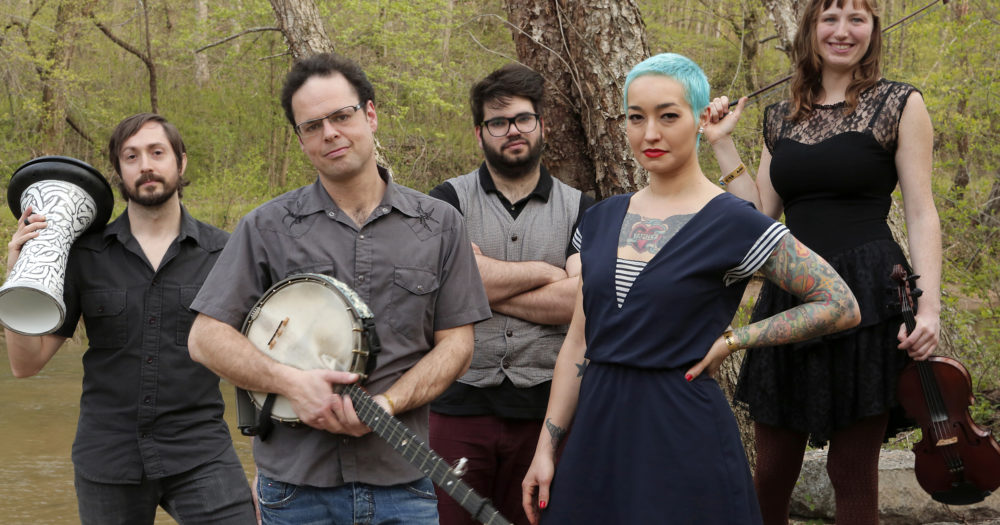
One of the most musically adventurous bands to come from the roots scene in the past decade, The Duhks return to the stage is definitely a cause for celebration. Hailed by The New York Times as one of the artists at the forefront of the neo-folk movement, The Duhks (pronounced Ducks) have won admirers as diverse as David Crosby, Dolly Parton and Doc Watson.
No band epitomizes the polyethnic strands of modern folk music better than The Duhks. Since forming in Winnipeg in 2001 The Duhks have created a dynamic blend of old-timey, French Canadian and Celtic music punched up with shades of blues, soul and driving Afro Cuban rhythms that leaves festival crowds on their feet. Over the course of 4 critically-acclaimed albums the band has earned Juno and Grammy awards and nominations and have played a significant role in the neo-folk revival.
On Beyond the Blue The Duhks are in the best form of their 13 year career. Rejuvenated by a two year hiatus and energized by the return of vocalist Jessee Havey and the addition of new members, fiddler Rosie Newton, drummer/percussionist Kevin Garcia, and guitarist/bouzouki player Colin Savoie-Levac, The Duhks founder Leonard Podolak found an amazing pallet of inspiration for the new project. “All of the people who have been in the band over the years, including non-touring founding members Tania Elizabeth and Jordan McConnell(who both appear on the album) have had a hand in shaping our sound and direction. The goal with the new record was to draw on everything we’ve learned over the years and everything we know about where we want to take the music now and create something as fresh, exciting and forward thinking as possible.” Toward that end, the band turned to the rising production team of Mike + Ruthy (Mike Merenda and Ruth Unger of The Mammals), who brought a progressive approach to production that was still firmly rooted in the traditions of folk music.
Musically, the new project is reminiscent of 2006’s Grammy-nominated Migrations, but with a sound that is even more dense and grittier than 2008’s Fast Paced World. The album opens with the title track, a gorgeous song by Beth Nielsen Chapmanand Gary Nicholson that begins with the bell-like drone of Leonard’s claw hammer banjo and the ethereal sound of guest Charlie Rose’s lap steel before giving way to Jessee’s expressive alto, perfectly complemented by Tania’s harmonies. On “Banjo Roustabout” electric guitar and drums bring out the more aggressive side of the band’s sound while “Suffer No Fools” is a beautifully rendered acoustic waltz ornamented by banjo, strings and percussion and beautifully sung by Jesse and Tania. Taken as a whole, Beyond the Blue represents a group of musicians at the peak of their powers, the music shaped by their collective experience of years on the road and driven by the sheer joy and inspiration that comes from reuniting and rediscovering that magic that drew them together in the first place.
“The inventive Canadians in The Duhks are widely beloved for their smooth blend of traditional roots music, bluegrass and soul which they inject with well-placed Afro-Cuban and Celtic influences” —NPR
Love and fear are two of life’s greatest motivators. Both played a key role in taking Hilary Perkins (aka Nell Robinson) back to the musical passions of her youth and on to pursue a recording and performing career.
Described variously as “a modern-day Patsy Cline” and one of the “freshest voices in roots music,” and compared to early Emmylou Harris, Dolly Parton, and Hazel Dickens, Perkins has come full circle on her musical journey. Singing since she was a young child in Alabama, whether in the church choir or the colorful backyard musicals she orchestrated with her friends, Perkins paid homage to her Southern roots by taking the name of her grandmother, Nell Robinson, when she moved on to professional stages and studios.
Those roots were two-edged. One side was rich with storytelling, old world traditions, and a time-out-of mind way of life that Perkins found resonant and enchanting; the other bound by social mores rewarding conformity and discouraging self-expression–whistling women, cackling hens; speak when spoken to; skeletons belong in the closet. Plus, despite very progressive parents, she was raised on military bases where there were serious consequences for not toeing the line. “At a certain age,” she recalls, “ I just went underground.”
Consequently, singing ultimately became a private endeavor, an emotional outlet, and something she did alone, on her own. “It was a way for me to be completely myself, completely authentic, and free myself from certain emotional messages.”
While Perkins went on to work in political organizing and fundraising, she never lost sight of her love of music. In her mid-40s, after “25 years of singing by myself in my car,” she became “intrigued by fear, by what I was afraid of, and exploring it,” Perkins says. “I didn’t want it to get in the way of living.”
Bracketing that motivation was one of love, a force Perkins found even more powerful. On the verge of celebrating an important anniversary with her husband, she mustered the courage to hire a local country band and sing a special tune for him in front of friends and family. “I was terrified; it was like an out of body experience;” she recalls. Her husband got up and joined her for the last chorus and their friends went nuts. “And what happened to me was I didn’t want to stop.”
Not only didn’t she stop, but in moving forward found a deep connection with her audience and a remarkable onstage charisma that served to forge and foster it.
And so with love and fear as powerful fuel, Perkins closed the gap and returned to a place of farmhouses and country stores, backwoods wisdom and back porch ghost stories, fireflies and family spirit that echoes with the sounds of Hank Williams and Johnny Cash.
The result is what one critic calls “a timeless, sepia-toned world at the intersection of bluegrass, country, folk, and Americana.”
Inspired by tradition but not bound by it, she finds value in the past, in the lives of her elders and those they knew, in the rich tapestry of tales they told and which she in turn re-tells in her own fashion as Nell Robinson. Perkins speaks of stories that “foster this deep connection to people and place, so much so that sometimes I miss a past I wasn’t even present for. These histories occupy me and music is a voice for expressing that part of myself.”
“Singing is my current mode of subversion. There are all sorts of things I still I feel I am ‘not supposed to do,’ and at this point in time, I relish breaking free of limits I have felt all my life.”
Whether playing with musical partner Jim Nunally or backed by her All-Star band of John Reischman and the Jaybirds, Perkins is equally at home. Her side-projects, from the poignancy of Soldier Stories to the whimsy of The Henriettas, further attest to the breadth and ambition of the youthful musical passions she let flower.
In performance, she’s interested in bridging worlds and breaking down the barriers between performers and audience. She invites fans and ghosts alike to be part of the show. Everyone is welcome.
Credit: Yann Orhan
“A finer gift hasn’t come from France since the Statue of Liberty was delivered,” said Irish American News about Doolin’s self-titled 2016 Compass Records debut.
After three years of breakout touring at some of the biggest roots festivals in the United States and Canada, and another three years locked out of the live performance world they have so ambitiously cultivated, Doolin’, France’s premiere practitioners of Irish and Celtic music, return in early 2023 with a new album entitled CIRCUS BOY.
Recorded in part in the US (Chicago, Kansas City and Pittsburgh) during their 2019 tour, the album was completed at the legendary Studio Ferber in Paris, France, under the direction of two legendary producers, Olivier Lude and Patrice Renson, both of whom have collaborated with some of the biggest names in French music.
While their 2016 album drew its inspiration from the fusion of traditional Irish music, French chanson, and American roots music, CIRCUS BOY is resolutely more adventurous, as evidenced by their original compositions (“Circus Boy”, “When I’m Gone”, “A Place Where We Belong”), as well as by the added punch and sonic elements that were brought to the project by producers Lude and Renson.
WilfriedBesse’s vocals are supported as usual by the driving rhythm section of Josselin Fournel (percussion), Sébastien Saunié (bass) and Nicolas Besse (guitars), and the trad-Irish influence remains evidenced through the whistles of Jacob Fournel, the bodhran of his brother, Josselin, and the nimble accordion playing of Nicolas’ brother, Wilfried. But CIRCUS BOY represents a more powerful and bigger musical vision for the band, made possible by the introduction of piano, drums, and brass as new sonic elements. That said, the Irish music tradition is not complete without the presence of a fiddle or two, and on CIRCUS BOY Doolin’ includes three of the best European fiddlers of the genre: Niahm Gallagher, Niall Murphy, and Guilhem Cavaillé, himself a founding member of the band.
CIRCUS BOY is at its core an exploration of the recurring feelings and themes experienced during the group’s US tours: the friendship and solidarity on the road (“Circus Boy”), the personal and artistic encounters gained through extensive touring, and the exploration of a new country with a dizzying musical culture. It is also the acknowledgement of a sometimes difficult world (“Top Of The Mountain”), as well as the recent challenging times and the topics we’ve all been forced to reckon with; to this Doolin’ have included a necessary and heartfelt tribute to women (“Man Smart, Woman Smarter”). On the latter — a Calypso standard first brought to mainstream attention by Harry Belafonte, and later by Robert Palmer — they are joined by the female triumvirate of the Diver sisters, aka The Screaming Orphans and Ashley Davis (Lunasa, The Chieftains) on backing vocals, and Niahm Gallagher (Lord Of The Dance) on violin.
CIRCUS BOY is simultaneously Doolin’s declaration of love for their region of France (in particular their hometown of Toulouse [“L’Amour Sorcier”]), for those at home who miss them when they are away (“When I’m Gone”, “A Place Where We Belong”), and for their many friends and newfound fans (“Thank You”).
Powerful, full of emotion, and eminently appealing, Doolin’ is poised to take their career to the next level with the release of CIRCUS BOY.
Watch
A fiddle prodigy who received a GRAMMY nod for his Compass Records release, PORTRAITS IN FIDDLES, Mike Barnett returns with a new album of 14 duets he’s titled + 1. The album, originally slated for a fall 2020 release, was delayed when Mike suffered a brain aneurysm last summer at his Nashville home. Friends and fellow musicians rallied, and Mike’s friend and fellow Kentucky Thunder band-member Jeff Picker started a GoFundMe to assist Mike and his wife, violinist Annalise Ohse, through two successful surgeries and an initial round of rehabilitation in Atlanta. Annalise and Mike are currently doing an intensive round of rehabilitation in Chicago, where, he tells The Bluegrass Situation, he is working to “reconnect his brain to his fingers,” and is “excited about getting the music on ‘+ 1’ to the fans and community that have offered him so much support.”
Mike says: “Here’s a good old Bill Monroe classic… oh wait, except for the ‘A’ part. I put one note per ping pong ball and played lottery bingo for that part… just kidding, though it might sound that way. I sometimes enjoy taking tunes outside the box, but still maintain some semblance of where it came from. This is a hybrid of ‘outside’ and ‘in’ based on Bill Monroe’s ‘Wheel Hoss.’ Grounding this in the tradition of banjo/fiddle seemed appropriate. Cory Walker’s instincts and diverse musical pallet make him one of very few people who could tackle this.”
Though he’s a Nashville native who became a professional player at a young age as part of Jesse McReynolds’ band, Barnett can still be considered among the recent crop of breakout talents from the Boston roots music scene that produced the likes of Lake Street Dive, I’m With Her and The Deadly Gentlemen, a newgrass outfit where he held fiddle duties from 2011 to 2014. Now relocated to Nashville where he holds down fiddle duties as a member of Ricky Skaggs and Kentucky Thunder, Barnett has been working on +1 over a period of four years. He started recording when he was still living in NYC and was collaborating with fellow artists from his years in the Berklee Music Scene, including Sarah Jarosz; later tracks came once he moved to Nashville and include duets with fellow Nashvillians Sierra Hull, Molly Tuttle and Dominic Leslie in addition to Skaggs.
Drawing on the deep virtuosic talents of the cast of players, the album’s tracks flow seamlessly from traditional American tunes to newgrass with elements of Celtic music, pop and jazz-tinged improvisation thrown in for good measure. From an instrumental sea shanty performed on fiddle and saxophone (“The Breath and the Bow” featuring Eddie Barbash) to “hopped up bluegrass with a little extra thrown in” (“Hybrid Hoss” featuring Cory Walker) to the plaintive vocal melodies of “Righteous Bell” and “Hollow City,” both featuring Sarah Jarosz, + 1 is a dynamic collection that spans cities, countries and genres.
Barnett always intended + 1 to be a studio project. Inspired by some of his favorite duet albums, including two Compass Records releases from the early 2000s – Darol Anger’s DIARY OF A FIDDLER and THE DUO LIVE: AT HOME AND ON THE RANGE with Mike Marshall – coupled with the realization that he enjoyed the musical freedom the duo configuration offers, Barnett began plans for the album. A lot of the music grew out of the time Barnett spent living in Brooklyn.
It was living and gigging in New York City that Barnett started playing a lot as a duo. “The nature of playing around the city is that there are a lot of small venues and I had a lot of friends I enjoyed playing with who were in and out of town,” he says. “It’s one of my favorite contexts to play music in, but it’s a challenging context to record in, especially for a fiddle, which in general, in band context, plays the role of the melodic instrument. In a duo context, when another person is soloing, you have to fill out the music in a different way and get creative there. It was something I thought would be nice to write some music specifically for.”
While in NYC, Barnett’s girlfriend, now wife, got a job offer in Austin, TX. “I decided to follow her but I wanted to stay connected to my NYC friends, so I used writing tunes in these duo contests and going back up there to record, as a way to keep in touch with my friends and keep making music in that scene From there I got a call from Ricky Skaggs to audition for his band.”
Relocating to Nashville, Barnett soon began playing with other young players in the area, including Sierra Hull and Molly Tuttle, and brought them into the project.
“I was playing with different folks around Nashville – old friends and new friends,” says Barnett. “I got to a place with a nice cohesive list of songs that represented different genres of music that I’ve spent time digging into and that I love so much, and a collection of people that I feel proud to know and be friends with.” The project lives as “a nice snapshot in time, a time capsule,” he says. Barnett also includes a gorgeous duet featuring Ricky Skaggs on clawhammer banjo and vocals on the hauntingly beautiful medley of old time tunes cleverly dubbed “Little Sisters Melodies.”
With the perspective of having completed the project, Barnett muses, “There’s always the feeling as an artist of looking back on something you started long ago where you want to redo this – it’s kind of nice to look back and see it as a moment in time and let it be at a certain point.”
+1, with its musical breadth, stunning virtuosity and deep musicality, is an album that is sure to stand the test of time and assert Barnett’s place as one of acoustic music’s greatest fiddle players and musical visionaries of his generation.
Coming off of an incredible GRAMMY win for 2015’s SHINE FOR ALL THE PEOPLE (Best Roots Gospel album), Nashville rocker Mike Farris keeps it earthy and personal on SILVER & STONE, out September 7 on Compass Records. The title refers to his wife, Julie’s wedding ring, and the album is a celebration of their 23 years of marriage and her steadfastness in sticking by him through his years struggling with addiction and alcoholism. Now sober for 7 years, Farris has the energy and conviction of a man saved, a stack of anecdotes and life experiences that would make most people’s heads spin, and a soulful vocal delivery reminiscent of Sam Cooke or Otis Redding. SILVER & STONE isn’t a “gospel” album by any means, but Farris still takes us to church on these 12 engaging tracks, including a cover of Bill Withers’ “Hope She’ll be Happier.”
Produced at Compass Sound Studio (AKA “Hillbilly Central” – the birthplace of Outlaw Country) in Nashville by Compass Records co-founder, Garry West, SILVER & STONE finds Farris imbuing his songs with a vibey, lighthearted feel, returning to his roots as a rocker and soul singer. The album weaves through the traditions of American music the way that Tennessee born and bred Farris has done expertly throughout his 25-year career, starting with his major label band, Screamin’ Cheetah Wheelies.
Sonically, SILVER & STONE’s warm organic sound and stellar playing recalls the cream of the Stax Records’ catalog. The album opener and Farris original, “Tennessee Girl,” seguing into “Are You Lonely For Me Baby?” and “Can I Get a Witness,” are loose and groove-driven, hitting all the right notes of soul, and blues with an effortlessness that shows what a natural Farris is for this sound.
The studio band includes famed “Memphis Boy” Gene Chrisman (Dusty Springfield, Elvis Presley, Dan Auerbach) sharing drum duties with Derrek Phillips (Robben Ford, Hank Williams Jr.), keyboardists Reese Wynans (Joe Bonamassa, Double Trouble) and long-time Farris collaborator Paul Brown (Waterboys, Ann Peebles), guitarists Doug Lancio (Patty Griffin, John Hiatt), Rob McNelly (Delbert McClinton) and George Marinelli (Bonnie Raitt) with Steve Mackey (Wallflowers, Delbert McClinton) and producer West splitting bass duties. Farris is quick to credit the crew in the band for putting their modern spin on classic grooves and progressions. The band was given just enough structure so they could add their own flavor. Among the album’s many standout moments is Joe Bonamassa‘s searing solo on “Movin’ Me” (Bonamassa became a fan and friend while opening for Screamin’ Cheetah Wheelies in the 90’s).
Melding the spiritual and the earthly, Farris says the album is about “reaching something better without actually trying.” This sentiment drives the Farris-penned composition, “Golden Wings”, written for his son, Christian, at “a pivotal point in his life, with so many options in front of him. That feeling of ‘Where am I supposed to be?’”
Farris told Rolling Stone Country. “It’s one of those songs that just flowed out after I did an exercise where you write a letter to your younger self. It has a dual message— something to say to a young person who is looking for answers, but also a reminder to myself to be free and open to the possibilities of life.”
Another Farris composition, “When Mavis Sings,” hits equally close to his heart. Over his years as a performer, he’s had the privilege of becoming close to legendary singer and gospel icon Mavis Staples. He says, “Mavis is everything you want your heroes to be.” Julie Farris elaborates, “She calls him ‘Mikey’.” The song is actually a history lesson on Mavis’ life, as it’s completely comprised of literal tidbits of her life.
“I wanted to explore that upbringing, being in that neighborhood with all of these luminaries and absorbing that music,” he says. “It was exciting to watch all the pieces come together and fit lyrically.”
The album closes with “I’ll Come Running Back To You,” an acknowledgment of the surrender intrinsic in love by accepting the kind of love that conquers shame and self-doubt. Where the narrator of this song is losing his identity in service of unrequited love, for Farris, it’s quite the opposite—it’s relinquishing a vision of identity that needs to be served by attention or self-medication and instead takes root and grows through love.
“It’s the most essential, yet most difficult, part of faith,” Farris says. “Remembering to open up and allow the universe to have its way with you and your gifts. Be open and free to the possibilities of life.”