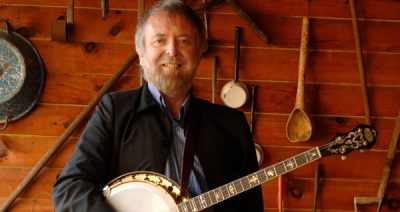
“No one has succeeded more in taking this once vital part of Irish American culture out of musty archives and moldering dissertations and placing it afresh on CD and concert stage than Mick Moloney.” – Earle Hitchner,The Irish Echo
Musician, singer, anthropologist and musical historian Mick Moloney celebrates the joyous and creative era in American popular song from the early 1890’s to the end of vaudeville and the start of the Great Depression on his new release If It Wasn’t For the Irish and the Jews. Each of the album’s 14 tracks is notable for having been created in a collaboration between Irish and Jewish lyricists and composers. Irish/Jewish Tin Pan Alley collaborations were commonplace in the heyday of vaudeville and Tin Pan Alley, and, though there were doubtless the usual business break ups and make ups, these collaborations represent a charming story of decades of good natured ethnic flux, competition and cooperation which left a lasting imprint on the history of American popular music. The end result is a fascinating and highly entertaining look at a historically critical point in American music.
Equally qualified as a musician and anthropologist, Mick Moloney brings the perfect balance of historical insight and musical relevance to these songs. Born in Ireland, Moloney came to America in 1973 and pursued a career that uniquely combines the roles of musician, folklorist, author, presenter, radio and television personality, and educator. He holds a Ph.D. in folklore, and teaches at New York University in the Irish Studies program. Mick Moloney has been featured on Fresh Air with Terry Gross, in the Village Voice and in Irish Music Magazine. He is also the recipient of the National Heritage Fellowship from the NEA, the highest honor a traditional artist can receive in the United States.

Departing from an Irish pub circa 1962 and passing through Hungary for a chance encounter with a blue-eyed beauty before stopping in the Virginias for an old-fashioned hoedown, Mozaik’s Changing Trains is a musical journey hindered not by genre, place or time signature. Recorded in 2005 in Budapest, Mozaik’s first studio album explores and celebrates the fusion of Irish, European and American folk music. While Changing Trains is a “unique cross-cultural exercise” (Irish Music Magazine), the strength of this album lies within each individual member’s deep respect and understanding of their own musical traditions.
Mozaik are Ireland’s Andy Irvine and Donal Lunny (both original members of Planxty), American born old-time musician Bruce Molsky, Dutch guitarist Rens Van Der Zalm, and Hungarian multi-instrumentalist Nikola Parov. Together they form the ultimate global stringband with a legendary lineage. It was on a lengthy drive through Australia that the great Irish singer, songwriter, and multi-instrumentalist Andy Irvine first envisioned Mozaik. According to Irvine, “The Muse said ‘Get a bunch of your favorite musicians together and do a tour of this beautiful country.’” He continues, “I pondered for not very long before emailing the suspects I had in mind. To my delight they were all into it and thus emerged Mozaik – a band to die for…”
ANDY IRVINE
Born to Irish-Scottish parents in London, Irvine began his artistic career as a young child, trying his hand in acting, acoustic guitar, and traditional music. He moved to Dublin to further develop his Irish trad musical talents, playing such instruments as the guitar, bouzouki, and mandolin. Irvine collaborated with several talented musicians, and formed such bands as Sweeny’s Men, Planxty, and Mosaic. After Mosaic, Irvine began producing music with fiddler Kevin Burke, guitarist/vocalist Gerry O’Beirne, and accordionist Jackie Daly as Patrick Street. Mozaik (a revamped version of the old name) is the most recent culmination of Irvine’s diverse musical experience and visionary propensity.
DONAL LUNNY
Irishman Donnal Lunny’s thirty years of musical prowess is the stronghold of Mozaik. He has been hailed by Irvine as one of the most innovative musicians that Ireland has ever produced. Multi-talented Lunny acts as not only a close friend to Irvine, but also as a professional musician and master arranger for the group. He hears each band member’s niche flavor and acts as the glue that holds the sound of Mozaik together.
BRUCE MOLSKY
Bruce Molsky and Irvine met at a house party Molsky was hosting in Atlanta, Georgia. Irvine first became aware of Molsky’s incredible talent when he first heard him perform “I Truly Understand.” Molsky’s talents with the guitar and 5-string banjo in combination with his old-time musical style contribute a unique zest to the group. Intricate string arrangements perfectly complement Molsky’s plaintive vocals.
NICOLA PAROV
Irvine first met Parov in Budapest twenty years previously, playing with his Balkan band Zsaratnok. Irvine has commented that Parov’s musical propensity is so extensive that an instrument that Parov cannot play has not yet been invented. When Irvine and Parov played together in The East Wind Trio, Parov wielded not only the gadulka, gajda, kaval, and other traditional Bulgarian instruments, but also the guitar, bodhran, and clarinet. As if Parov’s instrumental talents were not astounding enough, he was additionally involvemed with the finest Irish musicians through his performance with Riverdance.
RENS VAN DER ZALM
Rens Van Der Zalm and Andy Irvine first met in Slovenia on the road immediately after Van Der Zalm had graduated. Ver Der Zalm’s style is inventive and creative, incorporating such instruments as the mandolin, fiddle, guitar, accordion, bass guitar, tin whistle, and many other zany gadgets.

Philip Aaberg • Darol Anger • Alison Brown •
Mike Marshall • Tim O’Brien • Todd Phillips
NewGrange is the quintessential Americana band. These six celebrated acoustic music veterans take the listener into the heart of American folk music, the common ground from which jazz, blues and country music emerged. By looking backward to move forward, NewGrange has created a completely unique band sound. They pay homage to the roots of American music while delivering a sophisticated, contemporary take on the string band. No other group has been as successful at combining traditional stringed instruments with piano and creating such a cohesive texture.
With the 2007 release of A Christmas Heritage on Compass Records, these six giants of acoustic music come together to explore musical holiday traditions at the roots of Americana. This collaboration is a seasonal recording unlike any other, featuring traditional holiday music from Ireland, France, and Eastern Europe woven together with Americana and Gospel repertoire. A Christmas Heritage digs deep to explore the full diversity of the American Christmas season.
From the first strains of Mike Marshall’s solo fingerstyle guitar on ’Greensleeves’ through Tim O’Brien’s spirited blues reading of ’Go Tell It on the Mountain,’ this all-star acoustic ensemble offers a variety of lush soundscapes, fresh takes on venerable chestnuts, and some surprising new additions to the holiday canon. Alison Brown’s five-string klezmer banjo breaks fresh ground in a medley with a fiddle trio led by Darol Anger on “Shalom Aleichem/Breakin’ Up Christmas.” Pianist Philip Aaberg leads the group through an extended romp on “Christmas Eve,” and bassist Todd Phillips provides the impeccable underpinnings for the sextet’s flights of fancy.
Imaginative, whimsical, and at times contemplative, this collection is a welcome addition to the Christmas music library.
NewGrange was born on the road. In 1998, Mike Marshall and Darol Anger assembled their personal “dream team” of acoustic musicians for a 22-city holiday season concert tour. The performances drew raves, as did the group’s recording: more than anything, audiences and critics responded to how well the band played together. Probably no one was more delighted than the band itself. Mike Marshall explained, “I was ready for anything when we decided on the players. I thought, ’Well, this is going to be really great or really horrible.’ I was amazed at just how easily these musicians worked together.”
The series of concerts was such an exciting musical experience that the six members decided to transform NewGrange from a one-off touring ensemble into a band. In the spring of 1999, they reconvened in San Francisco and recorded a self-titled album. Though the members of New Grange maintain busy schedules as solo artists, session players, and music business executives, their work together is clearly something special, the sort of innovation that inspires new directions in music.
“It’s exciting to me to think where this style is going,” Mike Marshall said following the release of NewGrange’s self-title. “I’m most excited by the initial impulse that creates a new form. Earl Scruggs, or Bill Monroe, what was going on in their heads at the moment they created those styles? What music were they aware of? What did they want to bring out?”
It should come as no surprise that NewGrange has ventured off the beaten path. All six members of the group are musical innovators as well as instrumental virtuosi. “Darol Anger and Todd Phillips were in the original David Grisman Quartet,” bandmate Alison Brown notes, adding, “That band was the beginning of new acoustic music. I can’t imagine what acoustic instrumental music would be like without these innovations and these innovators. These guys took it to a whole new place.” Brown herself has made a distinctive mark on acoustic music both as a genre-bending, jazz-savvy banjo player/composer and as the president of Compass Records. Mike Marshall, another former member of the Grisman band, has moved beyond American roots and jazz to explore Latin and classical styles, playing mandolin, guitar and violin with everyone from Bela Fleck to Stephane Grappelli to MacArthur Fellowship winner Edgar Meyer. Tim O’Brien, a singer/songwriter whose material has been covered by the likes of the Dixie Chicks, Garth Brooks, and Kathy Mattea, was an early, steadfast exponent of the country/bluegrass/roots-rock fusion now known as Americana. Philip Aaberg, perhaps the boldest choice for the group, has lent his talents as a pianist and composer to a variety of projects, classical to country, jazz to rock. His credits include recordings and performances with the Boston Pops, Peter Gabriel, Elvin Bishop, and John Hiatt.
However, NewGrange not only draws on the innovative style of each of its members: it pushes each musician to extend their creativity even further. “I think they challenged me, pushed me to try new tonalities and stretch a bit,” said Tim O’Brien of his bandmates following the group’s second recording. Brown agreed. “It really is an inspiration to play with these guys, who are some of the giants of modern acoustic music.”
The name of the group reflects the combination of spontaneity, inspiration, and discipline the six-person ensemble generates. “There’s a place in Ireland called Newgrange, and Tim wrote a song about it for our Christmas record,” explained bass player Todd Phillips. “It’s a place where the people of an ancient civilization built this structure so the light would shine through it on the winter solstice kinda like a ’Raiders of the Lost Ark’ sort of thing where you have to stand there and wait for the sun to shine through at just the right time.”

Gerry O’Connor, described by many as the best four string banjoist in the history of Irish music, lets creativity take him where it wants to. He’s been doing this for some time now, and in the process has collected a great army of admirers not only in Ireland but also around the world.
O’Connor’s first U.S. release and Compass debut, Myriad is a musical journey of sorts. O’Connor says, “It is really an album about where I’ve been musically over the past while and most importantly where I am at the moment.” The album contains a wide range of colors, textures and rhythms for the listener to experience. “I haven’t done a solo album in a while. That has given me time to feel and experience a great range of influences, ideas and emotions and they’re all sort of collected here.”
Myriad was recorded over a 5-year period, during O’Connor’s time as a member of the Irish band Four Men and a Dog. The band recorded three albums in that time and toured excessively throughout the U.K., U.S., Canada, Australia and Europe. During his off time from touring that O’Connor entered the studio and put down tracks for the album. “Myriad is definitely influenced by the music I’ve been exposed to on my travels. But I was also aware that I carried inside me the musical heritage of my grandparents, my mom and my dad. So that’s why the last track features tunes with my dad and brother. It’s my effort to give back something of myself to the tradition.” The album features many guest artists including Kevin Doherty of Four Men and a Dog on guitar and Manus Lunny on bousouki and bodhran.
Described by Irish Music Magazine as a “banjoist extraordinaire,” O’Connor has developed a phenomenal technique on the tenor banjo, which sometimes gives the impression that there are perhaps three or four clones of the man all playing at the same time, as is apparent on Cam a Lochaigh (Cam-a-luck-ig). “It just sort of happened. I have no conscious memory of, for instance setting out to develop a particular way of playing triplets. I suppose if you keep at it and it’s inside you sooner or later it will wriggle out from that part of your being where it has been hiding.” Indian Storm was composed in a hotel room in Calgary, Alberta, Canada. O’Connor explains, “I had just witnessed the biggest thunder storm of my life. It was awesome, as you say in America. We don’t get storms like that in Ireland. We have ’soft days’ as they say. I couldn’t help but wonder what it was like for people back centuries ago who didn’t have hotel rooms, or the comforts of the 20th century. I tried to capture that feeling in this tune.”
O’Connor’s family heritage has always played an important part in his love of music and to celebrate that, The GarryKennedy Set became a family event. “My father travelled over 100 miles from Tipperary to Dublin to play these tunes with my brother Michael and me. It was my wish to give something back to him for all the music and encouragement he gave me over the years.”
In the tradition of the O’Connor family, Gerry was presented with a fiddle even before he was old enough to hold it properly. His father and uncles were all fiddle players. “The fiddle I got was too big for me and I couldn’t manage it at all,” he says, “But there was more to it than that. I wanted to be a bit different, sure I loved the music but I wanted to make a sound that was different from the fiddle.” It was this desire that lead him to the banjo after hearing a player from Limerick play at the Barge Inn in GarryKennedy. O’Connor instantly fell in love with the bright, rippling sound and had at last discovered the vehicle that would allow him to make an enormous contribution to the development of Irish music.
O’Connor’s music has been featured on the BBC Series Tacsi and he has appeared as a guest on over 12 albums by such artists as Gordon Duncan and Niamh Parsons. Is he satisfied? “Well, I suppose it is the curse and the joy of the musician and the artist in general. You’re never quite satisfied. I suppose the day I’m satisfied is the day I’ll lay down the banjo for good.”

“…the hottest new guitarist in the Celtic Realm.”
– SCOTT ALARIK, BOSTON GLOBE
Innovation combined with tradition: that’s a hallmark of Clancy family musicians, and it’s one that guitarist Donal Clancy is carrying forward into the twenty first century with his first solo release, Close to Home.
The title is no accident, either. “These are songs I grew up with, songs I can’t truly remember learning,” Clancy recalls. The tunes include the slow air “An Buachaill Caol Dubh”, the hornpipe “Kitty’s Wedding”, and the jig “Ask My Father”. Donal did indeed ask his father, Liam Clancy of Clancy Brothers fame, to show him a few chords on the guitar when he took up the instrument as a young boy after starting out on the tin whistle and trying out the mandolin. He’d found a home. “Something about the the sound of the guitar, the plucked strings, just appealed to me,” he says.
That’s where the innovation comes in, too. The acoustic guitar adds many colors and textures to Irish music, but there’s no long history of it in Celtic tradition, as there is with the fiddle and the accordion. Donal Clancy is one who’s bringing the guitar forward to its rightful place as a strong part of Irish tradition. He’s been involved with the best bands in Irish music, starting out in Clancy, O’Connell, and Clancy with his father Liam and his cousin Robbie O’Connell, helping to found the band Danu and then moving on to become part of Eileen Ivers Band before taking a pivotal spot playing guitar with one of the hottest Irish and Irish American bands around, Solas. When it was time to make a change, he found his old band Danu in need of a guitar player again, and that’s still one of his main gigs. “It was like coming home again, bringing it all back home,” he says, laughing.
Band work isn’t the only thing he’s done, though: Donal is an in demand session guitarist and road warrior, supporting top Celtic artists including Kevin Crawford, Cherish the Ladies, Aoife Clancy, The Chieftains, Niall Vallely, and Cathie Ryan. That may explain why it has taken him a while to get aroudn to making a solo album, but it was worth the wait.
Close to Home is a chance to hear one of the finest guitarists of this generation in a quiet, intimate setting, just the man and his guitar. Donal produced the disc himself and “I just went into the studio and played. I just wanted to capture the way I played the tunes on that day, without a lot of editing and things that you often go through in recording,” he says.
Though the tunes are all traditional, he’s still the innovator: they are all melodies Donal heard first on other instruments and brought over to the guitar with his own arrangements. “ I just absorbed this music over the years,” he says. “This is a record I’ve always wanted to make.”
Developed by Trapezoid’s Paul Reisler in collaboration with the Nashville Chamber Orchestra, Kid Pan Alley: Nashville includes songs co-written by more than 1,000 children from 40 different Nashville area schools and features top Nashville talent including Amy Grant, Delbert McClinton, Kix Brooks (Brooks & Dunn), Raul Malo, Beth Nielsen Chapman and many more.
Kid Pan Alley brings these professional songwriters and musicians together with school children in a group songwriting process. Through songwriting, children are able to articulate their feelings in a way that aids with the prevention, intervention and healing of crisis situations. Through Kid Pan Alley they develop self-awareness and self-confidence in their own abilities while learning respect for intellectual property in a direct first-hand way. To date, Paul Reisler has collaboratively written over 600 songs with nearly 12,000 children.
Founder and artistic director Paul Reisler comments: “Kids need to know they can be creators and not just consumers. I see what it’s like for these students to have their first song recorded by artists such as Suzy Bogguss, Beth Nielsen Chapman, and Darrell Scott, and it’s hard not to imagine what they are going to be able to create now that they are off to such a powerful start.”
Kid Pan Alley: Nashville received the 2005 Parent’s Choice Foundation Gold Award for excellence in children’s music, a Gold Medal Prize from NAPPA, and a GRAMMY nomination for the track Scary Things.
About Kid Pan Alley:
Kid Pan Alley started with a brilliant, yet obvious discovery – kids make the best co-writers. Kid Pan Alley is a national children’s songwriting project developed by Trapezoid’s Paul Reisler in which children are inspired to be creators and not just consumers of music. To date, KPA has written more than 600 songs with more than 12,000 children and won five ASCAP Foundation awards. www.kidpanalley.org
About Nashville Chamber Orchestra:
The Nashville Chamber Orchestra has come to be recognized as one of America’s most creative and innovative orchestras, presenting it’s unique style of Music Without Boundaries. Under the leadership of music director Paul Gambill and executive director Connie Linsler Valentine, the extraordinary music making of this ensemble has garnered a steady of national media attention plus recordings for Warner Bros., NAXOS, Angel, Almanac, and Alabaster Records, and a national award for Adventurous Programming from ASCAP. www.nco.org
Track Listing
1. Suzy Bogguss / Bouncin’ off the Bottom
2. Beth Nielsen Chapman / Little Drop of Water
3. Jonell Mosser / The Cheetah
4. Darrell Scott / Rainforest
5. Mustafa Abdul-Aleem / Goin’ to the Park
6. Jimmy Hall / True to Me
7. Raul Malo / Whispering in Spanish
8. Delbert McClinton / Freaky Friday
9. Kaset/Middleman/Lloyd/Vezner / Download it all for Free
10. Kix Brooks / Cartoons
11. Tommy Sims / Can’t Remember What I Forgot
12. John Bindel / Scary Things
13. Paul Colman / Pretty Good Day
14. Lari White / Stinky Socks
15. Amy Grant
Christmas in Tennessee
16. Will Hoge / No Fair
17. Nashville Bluegrass Band with Kathy Chiavola / Extra Hand
18. Kim Richey / Sleep All Day
Master musicians Paul Brock and Enda Scahill accompanied by the brilliant piano playing of Ryan Molloy and percussion of Tommy Hayes have evoked the atmosphere and artistry of the Irish dance hall era in dazzling fashion with the first ever CD of Irish traditional music on the melodeon and tenor banjo.
PAUL BROCK
Paul Brock has been at the forefront of button accordion playing for many years. A multiple All-Ireland champion born in Athlone, County Westmeath, and now residing in Ennis, Paul pursued a solo career through the 60’s and 70’s. His collaborations with fiddle player Frankie Gavin during the 70’s and 80’s culminated in their 1986 Gael-Linn recording ‘A Tribute to Joe Cooley’, regarded by critics and fellow musicians as one of the outstanding traditional albums of the modern era. Paul’s solo album, ‘Mo Chairdin’ (Gael-Linn, 1992), was described in the Rough Guide to Irish Music as a ‘modern masterpiece of accordion music’. In May 1989, Paul co-founded the group Moving Cloud with fiddle player, Manus McGuire. This Clare-based group produced two albums for Green Linnet Records, including their 1994 self-titled release that was selected by well-known U.S. music critic Earle Hitchner as the best Irish traditional album of that year. Paul was recently voted as ‘Best Male Musician’ of 2004 by the Irish American News. He founded Brock McGuire Band jointly with Manus McGuire and the band continues to tour internationally.
ENDA SCAHILL
Enda Scahill comes from a very musical family from Corofin in East Galway and has long established himself as one of the finest exponents of traditional Irish banjo playing. His solo album Pick It Up (SUNCD 36. 2000) was widely acclaimed. Enda has been described as “just about the strongest banjo I’ve have ever heard” (Art Ketchin, Celtic Beat) and Irish American News in Chicago said “Enda does things on the banjo which should be impossible”. Irish Music Magazine has described his playing as “simply divine”.
Enda has been a member of the Brock McGuire Band since its inception in 2001; has performed with Sessions from the Hearth whose debut album was acclaimed by Hotpress as “the best ever live recording of Irish Music”; with the Furey Brothers and most recently with The Frankie Gavin Band in Ireland and Canada. He has been All Ireland Champion 4 times on Banjo and Mandolin and was finalist in the Celtic Note Young Musician of the Year in 1999.

“The most exciting new traditional band to emerge from Ireland this century.” —Wall Street Journal
“Super vocals, a terrific staccato beat to the rhythm with a real sense of style and wit. This is a major, major band to be reckoned with.” —The Chicago Irish-American News
“A heady, virtually head-spinning, sonic blend stamping Beoga as perhaps the most audacious Irish band rooted in trad today.” —The Irish Echo
Since forming ten years ago, Beoga has expanded the vocabulary of Irish music with a unique accent all their own, becoming one of the most celebrated Irish bands of the century. To commemorate a decade of musical innovation the band returned home to Ireland for a gala performance featuring material from their 4 critically acclaimed CDs. The resulting live concert DVD/CD project titled Live at 10 showcases the band at its virtuosic best.
Beoga, consisting of the twin dueling accordions of Damian McKee and multi-instrumentalist Seán Óg Graham, pianist Liam Bradley, four time All-Ireland bodhrán champion Eamon Murray and vocalist/fiddler Niamh Dunne are joined by special guests from among Irish music’s glitterati including Alan Doherty, Bríd Dunne, Brona Graham, Trevor Hutchinson, Martin O’Neill, Niall Vallely and Clodagh Warnock. Over the course of their 20 song, 93 minute performance, Beoga’s madcap instrumental prowess and gorgeous vocals shine, illustrating why the critics have called them one of the most influential ensembles in modern Irish traditional music. The concert DVD was mixed in 5.1 surround sound and includes over 80 minutes of extras, including highlights from Beoga’s debut concert in 2002 and five behind-the-scenes tour diaries filmed over several years.
Beoga (gaelic for ‘lively’) is based in County Antrim, in Northern Ireland. The bedrock of their sound lies firmly within the Irish tradition, however they are not afraid to incorporate other genres’ nuances into their arrangements. From bluesy riffs to Astor Piazzola-style jazz, to a raunchy New Orleans jamboree vibe, their music always returns to a wonderfully bouncy Irish sound. The result is traditional, with a huge sense of fun and adventure and it all works—wonderfully well.
Born of a long-standing partnership stretching back over a decade, Raven is an album of assured, fully-realized performances that confidently, nonchalantly distort and dissolve boundaries. Lesser musicians adhere righteously to the lines separating tradition from innovation, soloist from accompanist – but the duo of multi-instrumentalist John Williams and guitarist Dean Magraw interact so effortlessly, and draw from such a wide range of traditions and techniques, that existing borders cease to be relevant. With one listen, the insight and instrumental skill that went into creating Raven is immediately apparent. Repeated listenings reveal a host of subtle musical undercurrents that speak of Williams and Magraw’s profound empathy and endless musicianship.
John Williams and Dean Magraw first met in St. Paul, brought together by the city’s thriving Irish music scene. The twin cities area is home to Magraw, though he is often away performing for audiences around the U.S. and the world. While he has an extensive background in contemporary jazz, Magraw’s passions have lead him to perform in an extraordinary range of contexts, from Celtic and bluegrass to jam band and avant-garde. His solo guitar albums draw from those experiences, synthesizing them via his impeccable technique into soundscapes both moody and tranquil. Hailing from a musical Chicago Irish-American family with its roots in County Clare, John Williams is the first and only American to have won the All-Ireland concertina title. He was a founding member of the group Solas, a band whose unrelenting drive and precision reawakened musicians on both sides of the pond to the potential of Irish traditional music. Upon leaving Solas, Williams has released a series of acclaimed solo albums and served as the traditional musical director for the Dreamworks film Road to Perdition.
“Irish music is our common ground, and the fiddler Martin Hayes was a mutual friend of ours,” explains Magraw. “About ten years ago, Martin and I were doing a show at the Cedar Cultural Center in Minneapolis. We had John come out and do a 45 minute encore – a 45 minute tune set, one after another!” The audience’s reaction was overwhelming, encouraging Williams and Magraw to pursue their partnership, setting aside a few weeks each year to perform as a duo. “We recognized that the possibilities of playing as a duo were intriguing,” says Williams, “and we always get a huge response, year after year. As time went by, there was a lot of pressure from audiences and presenters to make a recording.”
Recorded outside of Chicago, the eleven core tracks of Raven “either took four days or ten years to record,” says Williams, “depending on how you look at it.”
They chose to not bring in outside musicians, keeping the focus on the duo’s well-honed interplay and an intriguing range of original, traditional, and outside material drawn from their concert sets. “You can get more textures the more people you have, of course,” Magraw explains, “but the duo is a special combination that fully exploits each member, yet you really have to listen closely to the other guy. In the future we may bring in guests, but it was really great to explore the sounds we make together…”
Magraw and Williams delight in attacking the material on Raven from a variety of angles. Some tracks find the duo stating the melody straightly in a fine, traditional fashion. Others feature them approaching it more expansively, letting the song arise gradually from the mists of their improvisations. Williams’ work in film-scoring comes to the fore on several cuts, particularly the evocative “Perdition Piano Duet,” which derives from Williams’ contributions to Road to Perdition. A slow-smoldering intensity, such as heard on “Lianna” and the haunting title track, betrays the influence of master Argentine tango composer Astor Piazzolla.
Far from merely accompanying Williams (who contributes whistles, flute, and piano in addition to accordion and concertina), Magraw is an equal partner in the music – engaging in tight unison passages, shaping the tracks’ unfolding with deft counter-melodies and chord voicings, and taking exhilaratingly fleet solos.
The importance of the live experience to their collaboration is apparent in the album’s coda – three songs recorded live at the Cedar Cultural Center in Minneapolis. “The Cedar was the first place we played together,” Magraw says, “and a place we play together every year. They have always been very supportive of our whole musical journey.”
“We originally sequenced the album to conclude with ‘The Raven,’ which is a very smoky, atmospheric track,” says Williams, “but then we decided it needed to end on an exclamation point. Luckily our shows had become popular with a Grateful Dead, newgrass audience, and were being recorded and traded among those fans. So we went back through all the live tapes people had given us, and found that set.”
With the release of Raven, Magraw and Williams plan to expand their annual duo tours and continue to cultivate their rewarding partnership – a partnership whose range Williams feels is well-documented on the album. “A lot of Irish CDs,” Williams concludes, “linger on the same vibe through the course of the entire program. This album unfurls – it doesn’t stay on one flavor for very long. That said, we didn’t feel the need to reinvent the wheel every time. But we do want to take it for a good spin.”

Bill Mallonee, the lyrical and inspirational source behind the Vigilantes of Love, grew up on Brit pop. Around the house he listened to The Beatles, Kinks, and The Who. In the States, a bit later, TV-type acts such as Paul Revere and The Raiders and the Monkees figured heavily into his youthful ’coming to musical consciousness.’ At the time, he played drums and an old set of Slingerland drums with real calfskin heads (that a man gave him for mowing his lawn each summer) were his truest friends. That drum kit and those records cranked to maximum in a dusty basement on some old Sears hi-fi kept Mallonee happy while his parents struggled to keep their own sanity amid the stresses and “soul-sucking strains of hawkish, corporate America.”
He was too young for the hippie thing, Mallonee says, “the extremist idealism of the day seemed a bit overly dramatic, so the Brit movement started to make an impression on me.” The west coast rock scene (the Byrds being a notable exception) seemed to pale in comparison to the love sick glory of a 3 minute pop song (preferably British) that stole your heart with the clang and bang of untempered guitars. The ’essence’ of this was not to surface in Malloneee until he started playing music in Athens in the late 80’s. Mallonee learned guitar quickly and the post-punk-pop of the La’s, XTC, Elvis Costello,the Clash and Squeeze filled his family house. Great college scene bands that passed through Athens, Georgia during that time were Athen’s own R.E.M., the dbs (with the great Chris Stamey and Peter Hosapple), Mitch Easter’s ’Let’s Active,’ the Bongos and Tommy Keane: these were also big influences. Each of those bands proudly wove an indebtedness to the first “British Invasion” into their musical flags.
The strange thing was that somehow Mallonee’s love for Dylan and Neil Young won out (temporarily shall we say) over these early influences. The terrain viewed from the inside of a van for 10 years and over 10 albums by the Vigilantes of Love seemed to lend itself more to the themes of Americana and alternative country….and so they went with it. Until now.
VoL’s brand new release Summershine once again grabs onto those British pop influences, forcefully taking the music of this highly acclaimed Athen’s band forward into the 21st century. Mallonee says, “Three years ago I began making regular trips to the UK to do pub tours and a few festivals. We were greeted with a great deal of interest and outright enthusiasm. Soon two weeks of touring in the UK became 3 months a year with a few solo swings by myself. With the hard work of our manager JJ Johnson and the support of BBC radio sage Bob Harris, we found a new and engaging audience. We enjoyed playing our brand of ’Americana.’ While radio and touring markets here in the States were trying to figure out what to do with the genre, the UK and Europe seemed to be opening up and embracing us.” The funny thing is that while the band thought they were giving the UK something that was theirs, in reality, something quite subtle was being given to them. That something was the resurgence of the joy of guitar pop music. They heard it all around them. In JJ’s collections, in the cafe’s, in the pubs, in the underground, on the trains, in the bands that opened for them on the tours…the glory of current British pop and its predecessors.
Music full of more hooks than a meat packing plant with well ordered big harmonies, jangly guitars and replete with choruses that made you wanna hit replay as soon as the tune was over. It provided for an epiphany of sorts. It was precisely that type of music that made Mallonee want to play in the first place. “Inside myself, it was as if a well of something like affirmation opened….and I followed its course. Previously I had written about 40 tunes on three 90 minute cassette tapes. These were to be the blueprint for the next VOL record to be recorded this year. Me? I bagged those tunes (a sort of son of Audible Sigh) after a 3 week west coast tour in the US in January of 2001. I came home, celebrated 20 years of marriage to my wife and wrote 16 new tunes between Feb.1 and Mar. 1st. Once I stepped back and looked at the results I could see where the inspiration came from: the stream that fed that previously mentioned well were all the experiences I’d had with the band touring in the UK over the course of the last 3 years. The music felt vital, organic and well, happy…full of hope and faith in the power of love to make us something more than we are without it…”
Summershine, the follow up to the band’s highly acclaimed Audible Sigh, was produced by Mallonee and Tom Lewis and highlights the musical talents of band members Jacob Bradley on bass and Kevin Heuer on drums. MIX Magazine called Audible Sigh “exhilarating” and The Associated Press described it as “Excellent!…A brilliant piece of work, a great album that deserves a wide audience.” The album hit #5 on the Billboard Internet Charts and reached #35 on the Gavin Triple A Non-comm charts. Fans of heartfelt melodic pop will love Mallonee’s insightful tunes. Mallonee’s lyrical vision is both original and compelling and VoL’s rough-hewn arrangements perfectly match the sentiments of the songs. There’s melody galore and soaring harmonies, but also true grit. And then there’s love.
And Summershine deals with all of those feelings and emotions. Everyone knows that love casts its broadest web in the spring and summer. That’s when you fall under the spell. Mallonee remembers, “That’s what they told me on the radio and in all those records I listened to as a kid…and so that’s my story and I’m sticking to it.”
VoL has always been proud that they’re basically “just a college band from Athens,GA. That reference point and those elements will always surface in the work. It’s the clang and bang of 12-strings, joy without lock or key, unapologetic…and above all…unafraid.”
In a heartwarming display of international musical cooperation and human solidarity, scores of artists from England, Scotland, Wales, Ireland and the United States have joined hands to create Compass Records’ Hands Across The Water. Produced by Andrea Zonn and John Cutliffe, the CD’s proceeds will go to programs assisting Southeast Asian children whose lives were uprooted by 2004’s devastating tsunami. Yet beyond its tangible contribution to disaster relief, the project gives another rare gift to those who hear it—an entire set of unprecedented, compelling collaborations between some of the finest performers of Celtic and American roots music.
There is no “short list” of Hands Across the Water contributors, for all are among the most respected and preeminent artists in their fields: the 16-track CD features Darrell Scott with Muireann Nic Amhlaoibh, Oisin McAuley and Paul Rodden; Jim Lauderdale with Maura O’Connell; Karen Matheson with Donald Shaw, The Duhks and Bryan Sutton; Jon Randall with Máirtín O’Connor and Alison Brown; Tim O’Brien with Lúnasa; Sharon Shannon with Jackson Brown; Solas with Mindy Smith; John and Fiona Prine with Dermot Byrne; Beth Nielsen Chapman with Christina Quinn, Bonnie Raitt, Michael McGoldrick and Donald Shaw; Paul Brady with Rodney Crowell; Blue Merle with Pauline Scanlon; Altan with Vince Gill; Cerys Matthews with John Jorgenson and Stuart Duncan; Andrea Zonn with Flook and Bill Shanley; John Cowan with the Brock McGuire Band; Jerry Douglas with Ciaran Tourish—and adding still more depth to the album depth is an equally lengthy and stellar array of backing musicians.
While some of these collaborations bring together masters of a particular genre, the CD also features many top artists working outside their usual styles and formats. Vince Gill’s English-language version of a traditional Irish song reworked by Altan is one such highlight; as is “An Occasional Song,” a traditional Welsh number performed by European rock star Cerys Matthews with help from Stuart Duncan and John Jorgenson.
Hands Across the Water was born in a phone conversation between Zonn and Cutliffe last December. Cutliffe, a transatlantic presence in the Irish music world, both behind the scenes and as a player, was horrified by the destruction caused by tsunamis in Southeast Asia. Zonn, an accomplished solo artist and one of Nashville’s busiest fiddlers (regular player with James Taylor, Vince Gill, Alison Brown, Lyle Lovett), suggested that between the two of them, they knew some “pretty good musicians” who “wouldn’t mind helping out if we were to set something up to ease the suffering caused by the Tsunami.” Both remarks turned out to be vast understatements. Cutliffe emailed Garry West of Compass Records, who responded from vacation within an hour, throwing his full support behind the idea. In under a year, Hands Across the Water brought together many of acoustic music’s biggest names, all of whom gave very generously of their work, making time in homes, buses, and hotel rooms to contribute to the project.
Recording the album was truly a trans-national effort, employing the services of 27 studios, 29 studio engineers, and over 100 musicians from Nashville to Sydney, Australia. As Cutliffe wrote, “I myself have driven more than 10,000 miles and we can’t even begin to count the thousands of emails and hours of phone calls that have kept lines buzzing worldwide. We have uploaded and downloaded gigabytes of session tracks and mixes.” Contributing artists chose their own tracks, offering songs and
pieces for Cutliffe and Zonn to mould by adding additional collaborators. The resulting collection is a unique blend of the very best in American roots and Celtic music, an achingly beautiful soundscape that affirms the spirit of working together which made it possible.
FEATURING: Altan • Blue Merle • Paul Brady
• The Brocke McGuire Band • Alison Brown
• Jackson Browne • Dermot Byrne
• Beth Nielsen Chapman • John Cowan
• Rodney Crowell • Jerry Douglas
• The Duhks • Stuart Duncan • Flook
• Vince Gill • John Jorgenson
• Jim Lauderdale • Lúnasa • Oisín McAuley
• Michael McGoldrick • Karen Matheson
• Cerys Matthews • Muireann Nic Amhlaoibh
• Tim O’Brien • Maura O’Connell
• Máirtin O’Connor • Fiona Prine • John Prine
• Jon Randall • Paul Rodden
• Pauline Scanlon • Darrel Scott
• Sharon Shannon • Donald Shaw
• Mindy Smith • Solas • Bryan Sutton
• Ciaran Tourish • Andrea Zonn

The resurgence of traditional Irish music has been called a renaissance – awakening a yearning for identity with a deeply rooted culture of oppression, war, courtship and love, liquor worship and emigration stories honored through song. Dublin-born guitarist and singer-songwriter John Doyle has honored this tradition even as he cultivates it on his latest release Shadow and Light Compass Records.
Doyle was exposed to music at an early age through his family. A dare from a childhood friend and lack of formal training allowed him to develop his signature left-hand finger picking style – a style that informed the sound of the first Irish-American super-group Solas. Since then, Doyle has continued to hone his craft on the road and in the studio, earning a Grammy nomination for his collaboration with fiddler Liz Carroll in 2010 on Double Play (Compass Records). He has also collaborated with some of the most revered names in the genre including Heidi Talbot, Tim O’Brien and fellow Solas founder Karan Casey and, from 2008-2010, served as band leader for folk icon Joan Baez on her worldwide tour.
On Shadow and Light, Doyle pays tribute to Irish musical tradition while forging a path of his own on a set of largely original songs characterized by his rhythmic and harmonic genius. History and stories pervade the album’s eleven tracks from the first lyrics of the album opener “Clear the Way” – a translation from the old Gaelic “Faugh A Ballagh” which was the rallying cry of the Irish Brigade in the American Civil War. The song tells the story of the “Fighting 69th,” and their tragic battle at Fredricksburg, Virginia where their numbers were reduced from over 1600 to less than 300 by another predominantly Irish Confederate Regiment.
Another stand out track is “The Arabic,” named for the ship Doyle’s grandfather boarded to immigrate to America. A German submarine attacked the SS Arabic and Doyle’s grandfather was plucked out of the flotsam by a rescue boat and sent back to Ireland. “It’s all true, as far as I know,” smiles the boyish Doyle. Another family ode, “Tribute to Donal Ward/ The Curraghman” is an instrumental homage to Doyle’s rustic uncle Donal Ward and serves as the perfect showcase for Doyle’s virtuosic finger picking style. Family is a recurring theme; the album also includes “Little Sparrow,” a song for Doyle’s daughter that has been regularly featured in his live set. Throughout the album Doyle is accompanied by a cast of some of the most stellar players in acoustic music including Tim O’Brien (vocals, mandolin), Alison Brown (banjo), Kenny Malone (percussion), Stuart Duncan (fiddle), Todd Phillips (bass), John Williams (accordion), Pete Grant (lap steel) and Michael McGoldrick (uillean pipes and flute).
When not at home in Asheville, NC, Doyle tours globally, and has appeared frequently at many of the taste-maker festivals in acoustic music including Celtic Connections in Glasgow, the Dublin Irish Music Festival in Dublin OH, MerleFest, Milwaukee Irish Festival, Sebastopol Celtic Festival, and the All-Ireland Fleadh. In addition to his work as a solo artist, he also performs regularly with other starts of the genre Andy Irvine, John Williams, Karan Casey, Liz Carroll and others. Doyle has also appeared on nationally syndicated radio shows including Prairie Home Companion and Mountain Stage and, in 2009, performed for President Obama in honor of St Patrick’s Day.
-->