
A trio of awesome virtuosity and drive – the legendary Joe Burke on accordion, piper Michael Cooney, and singer/guitarist Terry Corcoran.
Joe Burke, East Galway accordion player, has influenced innumerable box players worldwide through his illustrious career.
From his first public performance in 1955 to current recordings and tours, Burke has held a special place in the rolls of Irish traditional musicians. Known for his stylish use of triplets and rolls, he was been the recipient of awards such as the AIB Traditional Musician of the Year Award 1997and Gradam An Chomhaltais 2003.
A well-loved and respected teacher, Burke has offered his expertise to students from Co. Leitrim, Ireland to Paris, France, Dallas, Texas and various logging and fishing towns in Alaska.
He frequently performs with his wife, accordion and guitar player Anne Conroy Burke and has recorded with many musical greats including Andy McCann and Felix Dolan, Sean Maguire and Josephine Keegan, Michael Cooney and Terry Corcoran, Charlie Lennon, Frankie Gavin, Kevin Burke, Brian Conway, Noreen O’Donoghue and Mike Rafferty.
___
Tipperary native uilleann piper Michael Cooney came from a family of pipers as his father and uncles were highland pipers in the Sean Tracey Pipe Band, founded by his grandfather and great-uncles. At a very young age, Cooney’s father took him all over the country for the best musical instruction available.
His early teachers included legendary fiddler Sean Ryan, and tin whitsle player Dan Cleary, the leader of the Ballinamere Ceili Band. During the folk revival of the early 1970s, Cooney received his first set of pipes. Because pipers were few and far between in the hills of Tipperary, Cooney learned his repertoire from local accordion and fiddle players and his piping techniques from the recordings uilleann pipe legends Willie Clancy and Seamus Eagan.
In the 1980s, Cooney won several All-Ireland solo championships in both the pipes and whistle competitions and toured the US with Andy McGann, Paddy Reynolds, and Joe Burke. In 1986, the duo released an album, Happy to Meet, Sorry to Part (Green Linnet) with the accompaniment of guitarist and vocalist Terry Corcoran. Since then, Conney recorded his first solo effort A Stone’s Throw (Green Linnet) featuring Sligo fiddler Kevin Burke.
___
Singer/guitarist Terry Corcoran has been featured on albums such as the Smithsonian Folkways’ Classic Maritime Music (2004), and Green Linnet’s Celtophile collection’s The Celts Rise Again (1998), and has worked with button accordion player Larry Egan among others.

The trio comprised of guitarist and vocalist Robbie O’Connell, accordionist Mick Moloney, and piano accordionist Jimmy Keane formed in the mid 1980s after playing together with the Green Fields of America tour. They collaborated with fiddle virtuoso Liz Carroll to create There Were Roses in 1985, and then released KilKelly in 1987 as a trio.
Described as a “national treasure,” by Ireland’s top music magazine, Waterford-born guitarist and vocalist Robbie O’Connell played with the Clancy Brothers off and on throughout the 1990s.
Equally qualified as a musician and anthropologist, Irish-American immigrant Mick Moloney has recorded and/or produced over forty traditional Irish albums, has advised for hundreds of American festivals and concerts. Moloney has also taught at multiple American universities, been featured on PBS, Irish Television, and American Public Television, and holds some of the most prestigious awards in his field.
London native piano accordionist, composer, producer, and arranger Jimmy Keane has been considered the savior of the piano accordion. Starting his musical career with five consecutive All-Ireland championships, Keane has since recorded and performed with nearly all of the living greats of Irish music.
Chicago-born All-Ireland fiddle champion and National Heritage Award winner, Liz Carroll is considered one of the world’s leading Celtic fiddlers and composers. Named 2001’s “Traditional Artist of the Year,” by the Irish Echo, Carroll has become internationally recognized for her dazzling style and original tunes, many of which have entered the traditional repertoire here and abroad.

Weaving intricate patterns around a core of fiddle, melodeon, flute and guitar, the House Band’s rich, complex music spans the Celtic nations and beyond.
Flute/bombarde/bodhrán player John Skelton helped piece together many of the band’s arrangements. Ged Foley (guitar/small pipes/vocals), honed his talents in the Battlefield Band, and currently plays with Patrick Street. Chris Parkinson’s accordion playing has been a driving force in the English dance scene, and his keyboard work is incomparable. Roger Wilson adds texture to the group with his soulful singing and deft fiddle-playing.

Founded in 1977, the L’Ensemble Choral du Bout du Monde (the “World’s End Choir”) brought together traditional instrumental performers and over a hundred vocalists from over forty native choral groups throughout Brittany, the celebrated Breton province in Northern France.
Accompanied by bagpipes, keyboards, harps, guitars, flutes, claviers, percussion, conremuse, and the Grand Organ of the Landévennec Abbey, the ensemble keeps the native music alive through both traditional and original choral music in their Breton language (the Celtic dialect of Brittany).
Since 1989, composer, musician, and arranger Christian Desbordes has led the ensemble. In 1991, Desbordes composed the music for a theatrical production, La passion Celtique / Ar Basion Vras.
They recorded albums in 1992 and 1994, and in 1997, L’Ensemble Choral du Bout du Monde recorded Noëls Celtiques: Christmas Music from Brittany for Green Linnet, which won AFIM’s “Best Seasonal Music Album” in 1998.

Celtophile [kelt-o-fī(-ə)le] : One who is obsessed with the beauty and imagery conjured up by the music that emanates
from the “auld sod”.
(Alt) : A person of rarified taste in Celtic music of all forms (no apologies necessary!).
The Compass Records Group is proud to present the CELTOPHILE collection. Drawn from the vast Green Linnet, Compass Records, and Mulligan Records catalogs, and spanning the breadth of traditional music from Ireland and the British Isles, these CDs are thematically organized and packaged and offered at a special value price. A unique and varied collection, CELTOPHILE is a welcome addition to the music collections of novices and fans alike.

Alter Ego is comprised of two former members of the French/Breton group, Ad Vielle Que Pourra; Alain Leroux and Jean-Louis Cros. Both musicians sing and play several different instruments — classically trained Leroux focuses on mandocello, bouzouki and fiddle, while Cros displays a variety of cultural influences in his playing on acoustic, electric and bass guitars, drawing from classical, jazz, blues, bossa-nova, Renaissance and Celtic styles.

Quebec-based Ad Vielle Que Pourra (Daniel Thonon, Luc Thonon, Gilles Plante, Alain Leroux, Clement Demers) utilizes traditional French instrumentation and music and fuses it with elements of Gypsy polkas and Venezuelan waltzes.

“Sparsely accompanied fiddle music has rarely sounded so complete and so essential.” – Colin Harper, Q Magazine
Martin Hayes epitomizes the fiddle music of County Clare for many people. He started playing when he was seven years old and, by the age of thirteen, was touring with the Tulla Ceili Band, arguably the most revered and famous ceili band in Ireland at the time which was led by his father, PJ Hayes. Martin was also entering national competitions and winning them. By the age of twenty he had won every available competition in the country.
The music scene in East County Clare in the 1970’s was full of fine fiddlers, and Martin’s locality near the village of Feakle was home to many of them. In addition to PJ Hayes, Paddy Canny, Martin Rochford, Francie Donnellan, Vincent Griffin and Martin Woods all were a great influence on the young musician. The gentle contemplative style of these fiddlers molded Martin at an impressionable age, and by the time he left school he was playing to the approval of musicians thirty years older and more. It is a rare thing to have such depth and clarity of understanding in one so young, but Martin Hayes seemed to feel the music of his home place and to hear what older players were trying to express.
When Martin left Clare for Chicago in the 1980’s he became immersed in the diversity of musical styles that the city had to offer. It was also in Chicago where Martin met his current musical partner, Dennis Cahill. With several other musicians, they formed an electric/Irish/rock fusion band called Midnight Court, after the poem by the eighteenth century Clareman, Brian Merriman. After three years dedicated to the freedom of musical experimentation and exploration, Martin was drawn back to the music of his roots with new insights and a deeper confidence. He headed for Seattle in the 1990’s and pursued a new path playing a pure and distilled version of the music he had grown up with; a version built on universal musical principles that could now find its place in the wider world of music.
The 1993 recording, Martin Hayes was greeted by widespread critical acclaim, which garnered Martin the National Entertainment Award (the Irish Grammies) and the Hot Press Heineken Award. His second album, Under the Moon, released in 1995, continued to build on the success of the first, attracting an international following.
For Martin, the music spoke to him and inspired him. He constantly sought to express that inspiration and to convey the same musical message as generations of musicians before him. With Dennis Cahill’s understated guitar outlining and intensifying that message, the duo touched audiences across the world. The Lonesome Touch, released in 1997, reached out to the Irish music community and beyond. Hayes and Cahill became more adventurous, more empathic, more attuned to each other, and more able to stretch the music while remaining true to its essential qualities.
Following international festivals, concert tours, television spots and awards ceremonies, Martin and Dennis released Live in Seattle in 1999. Their live sound had become legendary: tunes which never ended, sets which started in one place and finished somewhere totally different. Recorded at the Tractor Tavern, the album featured as its centerpiece one medley lasting almost thirty minutes.
The duo’s new album, Welcome Here Again, is a fresh departure; eighteen tracks and not one of them over seven minutes, but with that same burning intensity and depth of emotion. It used to be common for Irish musicians to record one tune at a time, to make each one a self-contained masterpiece. The new album revives this tradition. The playing of Martin Hayes and Dennis Cahill renders the essence of the tunes, revealed in their purest form, accessible and appealing to all. “The Dear Irish Boy” is one such track. “P Joe’s Reel” is another. The mesmeric rhythms, the tantalizing slow release of melody, the extra tone from viola or tuned-down fiddle, all of that and more is on this album. After eight years, Hayes and Cahill are indeed Welcome Here Again.
Quotes From the Press
“A Celtic complement to Steve Reich’s quartets or Miles Davis’s ’Sketches of Spain.” – The New York Times
“Hayes has one of the most ravishing violin styles in all of Celtic music…the vocal quality of his tone brings an incomparable feeling of warmth to everything he plays. Cahill’s gentle, supportive accompaniment adds precisely the right touch.” – Los Angeles Times
“Together they create a music filled with calm and silence, the likes of which you’ve never heard before. Except, perhaps, in brief snatches of a long forgotten dream.” – Time Out, London
“Martin Hayes…the most important individual musician in Ireland right now.” – Hot Press, Ireland
“There’s no more impressive partnership in Irish instrumental music today than Martin Hayes & Dennis Cahill.” – The Irish Echo
“…maddeningly slow and unbearably beautiful, with an approach so radical it sounds perfectly true to the tradition.” – Acoustic Guitar
“Fiddler Martin Hayes wielded his bow with such an exquisite balance of sweetness and sinew, delicacy and fire, graveness and mischief you just didn’t want him to stop…Simply the loveliest fiddle music I’ve heard.” – Scotland on Sunday
“Hayes redefines your concept of excellence and reveals levels of beauty and artistry that previously hadn’t existed in your frame of reference.” – The Sydney Morning Herald, Australia
“Ireland’s answer to hot young American fiddler Mark O’Connor.” – Washington City Paper
“Hayes weaves seemingly magical spells over his audience, which ride with every curve of the bow as he gently shifts moods, styles and nuances. Dennis Cahill’s symbiotic guitar accompaniment is a crucial foil for Hayes’ deliciously subtle displays of charming brilliance.” – Folk Roots, UK
A céilí (kay-lee) is a night of live Irish music and set dance; a massive party for all ages and the premier social event of rural Ireland, a céilí provides a regular chance for the entire village to come in from the fields for a pint, some set dancing, and good fun.
One of the premier céilí bands in the world, Co. Clare’s Tulla Céilí Band was formed in 1946 by Paddy Canny and P.J. Hayes. Since then, the Tulla Céilí Band has entranced audiences and dancers alike from Co. Clare to Carnegie Hall. A family tradition at it’s finest, P.J. Hayes’s son, world-class fiddler and Compass Records artist Martin Hayes, currently helps to lead the band when he is in town.
Whether live or recorded, a great céilí band creates a compelling, driving atmosphere intended for set dancers. Incorporating fiddles, accordions, flutes, whistles, a piano and a snare drum, the band will slip seamlessly from tune to tune, gaining momentum and intensity . The multi-award winning band has recorded four albums, including Echoes of Erin, The Claddagh Ring, Ireland Green, Sweetheart in the Spring and A Celebration of 50 Years, (Green Linnet).
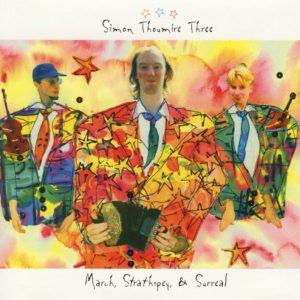
Simon Thoumire internationally acclaimed concertina virtuoso, has a gift for both traditional Irish and jazz. The founder of Foot Stompin’ Records, Scottish Traditional Music Trust, and Hands Up for Trad, Thoumire established himself as a world-class performer by the age of 26.
Winner of the prestigious BBC Radio 2 Young Tradition Award in 1989, Thoumire joined the Boy’s Brigade (65th Edinburgh) as a highland piper at the age of 9, and when he was 12, he received his first concertina, after conceding to the fact that no one around could teach him his desired instrument: the mandolin. By the time he was a teenager, Thoumire was performing in accordion clubs across Scotland, before joining a locally gigging band, with whom he cut his first record.
Then, one day while Thoumire was practicing in his house, the promoter for the Scottish supergroup Silly Wizard walked by and heard him. She immediately introduced him to Alistair Anderson, and the Radio 2 Young Tradition Award, which the 19-year-old Thoumire won in 1989.
In the 1990s, Thoumire recorded several times with Ian Car, and Kevin Mackenzie and Simon Thorpe as the the Simon Thoumire Three which recorded the album Waltzes For Playboys, for Green Linnet in 1994.
In 1997, Thoumire toured the Netherlands with the free-imrov combo Drones in the Bones, and in 1997, he composed the Celtic Connection’s Suite for Glasgow’s Celtic Connection’s festival. 1999 brought a composition, Music for a New Scottish Parliament, and in 2000, The Scottish Requiem premiered.
The Big Day In, Thoumire’s first album with pianist David Milligan, was recorded in 2001. The duo traveled throughout Europe and Australia before he cut Experiments in Culture, a modern record featuring real-life recordings of “existence” accompanied by musicians improvising freely over the top.

In the rich and fertile world of Celtic music, three names stand out at the very pinnacle of the genre. Playing under the name Trian, fiddler Liz Carroll, accordionist Billy McComiskey, and guitarist/singer Dáithí Sproule already established their legendary status with their first album. Trian 11 is their Green Linnet debut. It is captivating, intricately played, and uplifting. Sproule (also a member of Altan) is at the top of his form, delivering four great songs (one in Irish) and accompanying his bandmates on guitar with all the subtleties and shadings for which he is known and imitated. Carroll and McComiskey, both as soloists and together, are without equal as players and tunesmiths. Special guest Tríona Ní Dhomhnaill joins them on keyboards and bodhrán. There is no better trio in Celtic music than Trian.

Reeltime is a charismatic Irish quartet that combines stellar instrumental skills with a genius for arranging. Their music has that incredible energy and lift found only in the very best Irish music, but goes even further, with percussive jazz guitar and complementary instrumentation more often found in jazz than trad groups.
Centered around the virtuoso duet and unison playing of accordion and fiddle, Reeltime infuses their music with unquenchable energy and humor. Moving easily between Irish traditional, Texas swing, and ragtime, Galway fiddler/vocalist Mairin Fahy and guitarist Chris Kelly debuted their self-titled album with Green Linnet in 1994, followed by Live It Up, (Green Linnet, 1998).
The group’s debut earned “Best New Group” and “Best Female Vocalist” by the Irish American News. Their follow-up featured the artistry of Eilis Egan and Luke Daniels on accordions, John Flatley on keyboards, Yvonne Fahy and Jimmy Higgins on percussion, Brendan Power on harmonica, and additional production by Johnny Cunningham.
Multi All-Ireland winner Máirín Fahy was playing and dancing by the age of three, and in 1996, Fahy was asked to join the world-touring Irish music and dance phenomenon Riverdance. For the next decade, Fahy was hailed by critics as, “an athlete of the bow,” and “a joy to watch…simply breathtaking,” as she played for princes and kings around the world.
Featured in the major motion picture “Devil’s Own”, Empire magazine described her performance as as “haunting with a wicked fiddle solo.” In 2004, Fahy joined with her family to create the musical “Tara”, which premiered to a sold-out Luxor Theter. A regular guest with the Chieftains, Fahy has performed with them across North America, Europe, and Australia. Her own show, “Trad on the Prom”, was hugely successful, and she joined once again with the Chieftans for their 2007 tour before returning to her show.
Guitarist, vocalist, keyboardist, percussionist, producer, engineer, and photographer Chris Kelly has lent his talents to several Celtic collections and Irish musicians as well as acts such as Sister Machine Gun, Charlie Hunter, Josie Kuhn, All Chrome, and Rare Bird. In the band Reeltime, Kelly specialized in percussive guitar accompaniment, using rock and jazz chords to accentuate the Irish trad, though his finger-style picking on the band’s slow airs is equally compelling.
-->

