
Celtic folk-rock band, Rare Air (formerly named Na Cabarfeidh) was founded by in the late 70s by Canadian bagpipers Pat O’Gorman and Grier Coppins.
When still called Na Cabarfeidh, the band’s music incorporated a funk bass and Polynesian percussion with the traditional Celtic music of Brittany, North America, and Ireland. Utilizing traditional Celtic instrumentation of flutes and whistles, alongside bombardes, keyboards, and a funk bass guitar, the pipe-heavy band created a unique sound that took them around the world. Rare Air released six albums total, including Green Linnet titles Hard to Beat(1987), Primeval (1989), and Space Piper (1991).

John Williams has been hailed by the Irish Times as “a musician of remarkable sophistication.” Born in Chicago to Irish parents, he carries three generations of traditional County Clare music within him, from both his father Brendan and his grandfather, Johnny Williams. John is an award-winning accordion and concertina player with five All-Ireland titles to his credit, and is the first American-born competitor to take first place in the Senior Concertina category. His additional talents on flute, whistles, bodhran, and piano distinguish his as a much sought after multi-instrumentalist in the national session scene.
John’s latest album is Steam (GLCD1215), a powerhouse of ensemble playing that invigorates the traditional artform. A founding member of the acclaimed Irish group Solas, John re-unites with his former bandmates Séamus Egan and John Doyle on Steam, as well as with Chicago fiddler extraordinaire Liz Carroll, guitarists Dennis Cahill and Dean Magraw, bassist Larry Gray (Ramsey Lewis) and percussionist Paul Wertico (Pat Metheny Group). Amazon.com says of the album, “John Williams is a button accordion and concertina player of rare ability, ably demonstrated on Steam. To play with the feeling that Williams does, you need a profound understanding of the music that transcends technique.”
John recently served as Traditional Music Director in the upcoming Dreamworks feature film The Road to Perdition, a story of the Chicago Irish mafia in the 1930s starring Paul Newman, Tom Hanks, Jude Law and Jennifer Jason Leigh and directed by Sam Mendes (American Beauty). The film is scheduled for a late 2002 release.
John has appeared on numerous recording and soundtracks, including the PBS special Out of Ireland, The Brothers McMullen, and Traveller. His solo debut release on Green Linnet Records was included in the Irish Echo’s Top Ten traditional releases for 1995. In Solas, Williams received wide recognition playing to sold-out audiences internationally and earning both a NAIRD award and a Grammy nomination for the ensemble’s self-titled 1996 release on Shanachie Records. Most recently, John has been touring and recorded as a member of Tim O’Brien’s acclaimed Appalachian-Celtic ensemble, The Crossing.
Some of John’s dynamic solo performances have been captured on two award winning compilation discs, Dear Ol’ Erin’s Isle (Nimbus) and The Twentieth Anniversary Collection (Green Linnet). The first received the Library of Congress honorary distinction as an outstanding folk recording in 1992; and the second, a double CD of the finest Green Linnet recordings, occupied the top 15 of the Billboard World Music Charts for an unprecedented 17 weeks in 1996. John has also collaborated with friends Martin Hayes, Seamus Egan, and Joannie Madden on their individual albums.
Williams has performed at the Barns of Wolftrap in the Folkmasters Concert Series, as well as The World Accordion Festival in Montmagny, Quebec. Other festivals include the Telluride Bluegrass Festival, the Montreaux Jazz Festival, and the National Folk Festival in Chattanooga, Tennessee. He has played concerts in New York, London, Paris, Brittany, Zurich, Dublin, Belfast, and Lisdoonvarna, Co. Clare, Ireland. National Public Radio performances include Mountain Stage, A Prairie Home Companion, and the 1997 broadcast of the July 4th Concert on the Mall in Washington, D.C. He has been the subject of the Irish radio program The Long Note and television program The Pure Drop. John has also been interviewed and recorded on BBC and CBC radio.
Williams performed at taught at the prestigious Willie Clancy Summer School in Co. Clare, Ireland, the Augusta Heritage Workshops in Elkins, West Virginia, and the Swannanoa Gathering at the Warren Wilson College in Asheville, NC. At home in Chicago, John has taught for seven years at the Irish American Heritage Center and performed to thousands of Chicago area school children in Urban Gateways, the country’s leading arts and education agency. John was a guest soloist with Chicago’s Symphony of the Shores and served as music consultant and principal recording artist for the Goodman Theatre’s production of Brian Friel’s Dancing at Lughnasa in 1994.
John has been highlighted in Chicago Magazine’s Best of Chicago issue as “Best Squeezeboxer for 2003,” with a full-page photo of John and his concertina at the local pub.
For more information on John Williams, visit www.johnwilliamsmusic.com.
Quotes From the Press
“There is no denying that John Williams is a fine musician…Williams shows great versatility, playing button accordion Anglo concertina, flute and whistle, all adding up to a very well made and superbly recorded CD.” – The Living Tradition
“Multi-instrumentalist John Williams’ Steam is a lively, spirited rendition of some of the best Irish traditional music.” – New Age Voice

London-born multi-instrumentalist, film composer, producer, and songwriter John Faulkner grew up with the sounds of the Rock Revolution, and was greatly inspired by the likes of Elvis, Little Richard, and Gerry Lee Lewis.
After exhausting modern rock, Faulkner looked to the roots, discovering the great blues and folk musicians. During the English Folk Revival of the 1960s, Faulkner met and developed a professional relationship with singer/songwriter/folklorist Ewan McColl and his wife Peggy Seeger, who in turn introduced Faulkner to the world of British and Irish folk music.
When Faulkner was living in Britian in the late 60s and early 70s, he became close and began to play with many of the best London-based traditional Irish musicians, including West Clare fiddler Bobby Casey, piper Tom McCarthy, and Sligo flautist Rodger Sherlock.
In the 70s, Faulkner wrote the music for the BBC children’s television show “Bagpuss.” Then, in 1977, he met and married Co. Galway singer and De Dannan founder Dolores Keane. The couple worked on several more film scores for the BBC as well as formed the successful Trad bands “The Reel Union” and “Kinvara,” recorded three duet albums, toured extensively throughout the US, Canada, Australia, and Europe, and collaborated on several musical projects.
Faulkner has worked with the best in Irish traditional music, and has appeared on over fifteen albums (four of which he either produced or co-produced). In the new millennium, Faulkner joined forces with accordion great Jackie Daly to create a highly-acclaimed duet tour.

Relativity, a Scotch-Irish band, successfully united two families, two countries, and two styles of music to create two albums, Relativity, (1986) and Gathering Pace (1987).
The four members of Relativity were brothers Phil and John Cunningham (fiddle and accordion/keyboard/whistle/bodhrán) from the band Silly Wizard and the Bothy Band’s brother-sister duo Triona Ni Dhomhnaill and Micheal O’Domhnail (vocals/clavinet and vocals/guitar/keyboard respectively)
Relativity’s strength comes from the extraordinary marriage of the earnest vocals of the Domhnails and the Cunningham brothers’ virtuosic instrumental abilities.

Tommy Sands was born, reared and still lives by the foothills of the Mourne Mountains in the North of Ireland. As a child he heard the lively fiddle and accordion, and the traditional songs and stories of his mother and father welcoming neighbours into the small farmhouse kitchen. Later with his brothers and sister, The Sands Family, he would travel the world bringing these same songs and stories to stages as far apart as Moscow’s Olympic Stadium and New York’s Carnegie Hall.
After the tragic death of his youngest brother Eugene in a car accident while on tour in Germany, The Sands Family toured less together. Tommy eventually set off in a more solo direction, writing new songs, recording albums of his own material and producing a weekly programme on Downtown Radio. Twenty years on, “Country Ceili” is still as popular as ever.
His first solo album, Singing of the Times (GLCD3044), released in 1985, is now regarded as a classic. Two songs from this collection, There Were Roses and Daughters and Sons have already passed into the Irish tradition and are currently included in the English Language syllabus in schools in Germany. Ireland’s Nobel winning poet Seamus Heaney spoke of “the airiness and heartsomeness” of Sands’ work. “You feel you can trust the singer as well as the song”, he says, “his voice is at ease, it is not drawing attention to itself and yet, for that very reason it demands attention naturally.”
Down By Bendy’s Lane (GLCD1085) came next, a charming collection of songs and stories. It consolidated Tommy’s wit and charm with children of all ages. In 1992 he released Beyond the Shadows (GLCD3068), a collection that reflected the changes in Tommy’s life as well as in the world. This included the remarkable Dresden and The Shadow of O’Casey, the title song from a stage musical written by Sands and playwright Sean O’Casey’s daughter, Shivaun.
Autumn 1995 brought the release of The Heart’s A Wonder (GLCD1158), a look at the tremendous changes that have occurred in Tommy’s homeland and around the world. It includes the song The Music of Healing co-written and performed with his good friend Pete Seeger and described by John Hume MEP as “a new anthem for our times”. The album also features the accompaniment of the famous Sarajevo cellist Vedran Smailovic.
In August 1996 he organized the historical “Citizens Assembly” in Belfast where, in a climate of “neighbourliness and humanity” created by Ulster’s finest artists and literary figures, all warring political parties sat down together for the first time this century. The Music of Healing was the anthem sung by all.
In January 1997 he recorded the title track for the tribute to Pete Seeger album with Dolores Keane, Liam O’Flynn and Co. The blockbuster album, entitled Where Have All the Flowers Gone? also features Bruce Springsteen, Jackson Browne, Nanci Griffith and many others. Kathy Matthea from Nashville has also recorded a great version of the Sands classic There Were Roses on the American Narada Label.
In September 1997 he was invited to address a special study of UNESCO in Paris on the subject of the culture of peace.
March 1998 he completed the new Sarajevo to Belfast album with cellist Vedran Smailovic. Also in March he was asked by Irish Republic President Mary McAleese to organize and take part in a special North-South TV cultural concert programme in Aras an Uachtarain, Dublin.
In 2000 Tommy recorded To Shorten the Winter (GLCD1212), an album of original songs based on the winter season and Christmas, with Dolores Keane, Liam O Flynn, Steve Cooney, Arty McGlynn and others.
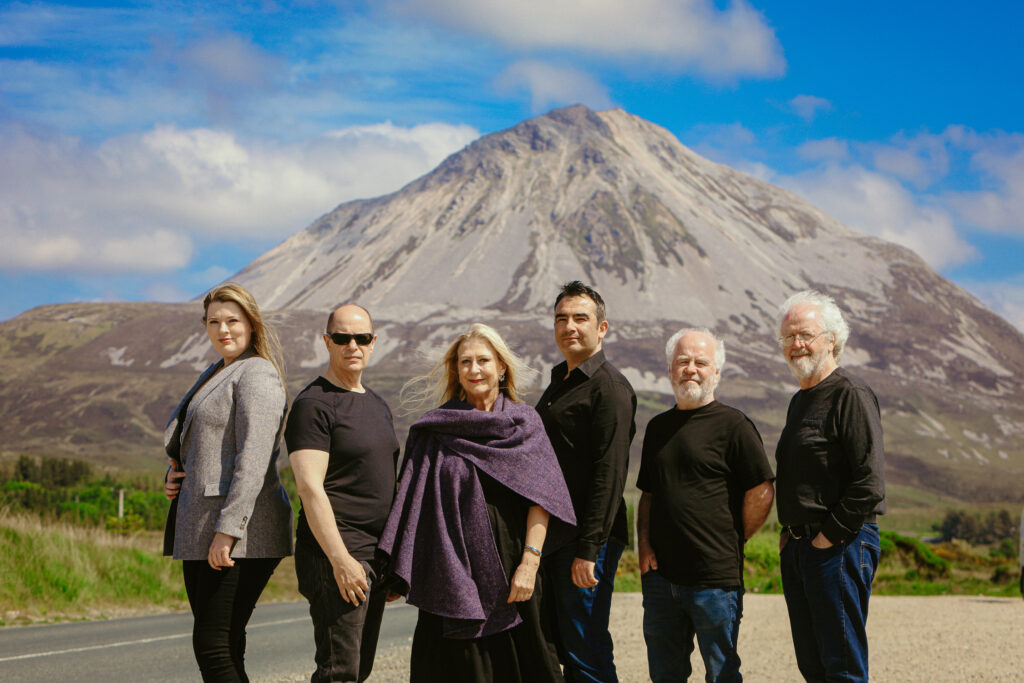
Altan is one of the most iconic bands in Irish music. The band delivers on their reputation as among Ireland’s most important cultural ambassadors with their new release DONEGAL. Irish-language songs and dynamic twin-fiddling, both hallmarks of Altan’s sound, framework the new album which tributes Altan’s native County Donegal and its rich musical heritage, breathtaking landscapes and vibrant culture.
Bandleader, lead vocalist and fiddler Mairéad Ní Mhaonaigh is in fine form thoughout, lending her angelic voice to “Liostáil mé le Sáirsint” and “The Barley and the Rye” and contributing “Port Árainn Mhór/Port Kitty Rua Mooney”, an outstanding set of jigs, to the project. Altan’s newest member, Clare Friel, shares vocal duties with Ní Mhaonaigh, most notably on the track “Faoiseamh a Gheobhadsa” and adds her fiery twin fiddle playing to great effect. Accordionist Martin Tourish brings his formidable chops and compositional sense to the medley “The House of Baoithín” which pays homage to the mid 6th century Saint Baoithín. Dáithí Sproule (guitar), Mark Kelly (guitar, harmony vocals) and Ciarán Curran (bouzouki, mandolin) round out the band which is augmented by special guests Jim Higgins (percussion), Steve Cooney (bass) and Graham Henderson (keyboards) on select tracks. Taken as a whole, the music transports listeners to a bygone time in rural Ireland while simultaneously forging a connection between the past and modern times.
Recorded by Manus Lunny at Stiúidió na Mara (“Seafront Studio”) in County Donegal, DONEGAL captures the essence of the region which has inspired Altan since the band’s inception and further cements Altan’s legacy as one of the great cultural treasures of Ireland.
No Irish traditional band in the last thirty years has had a wider impact on audiences throughout the world than Altan. Formed in County Donegal in 1987 by lead vocalist Mairéad Ní Mhaonaigh and her late husband Frankie Kennedy, the group’s music is influenced by traditional Irish language songs and tunes from Donegal. Over the course of their career, Altan has sold over a million records.

“If it’s music you want,” Christy Moore sang, “then go to Clare.” In 1989, flute, tin whistle, low whistle, and bodhrán player Kevin Crawford heeded those words. He left his hometown of Birmingham, a bustling industrial city in west central England, for rural West Clare. “One reason I moved was to up my game musically and get a bigger exposure to the tradition where it originated,” he explained. “I never intended tomake it a permanent move, but I’ve been living here ever since.”
What made Kevin’s decision to stay easier was the welcome he received from other musicians. “I knew I had been accepted into the traditional world of music,” he recalled, “when Conor Tully phoned me up and asked me to play in a session with him.” Kevin performed regularly with him at the Hill Bar in Kylebrack, East Galway.
Conor isn’t the only fiddler on Kevin’s new CD, the aptly titled In Good Company (GLCD1211) , who valued Kevin’s participation in sessions. For a couple of years, he played with Tony Linnane throughout Clare. Kevin also performed with James Cullinan in sessions in Lissycasey and Doolin. And for nearly five years, Kevin played beside Tommy Peoples in a Sunday morning session at Cruise’s Pub in Ennis.
“When I first moved to Clare,” Kevin said, “Tommy was doing a regular Tuesday night session at Brogan’s Pub in Ennis. I used to go in and listen, not play. At that time I was living in O’Callaghan’s Mills, East Clare, and I felt I needed to move into Ennis. I wound up staying in Tommy’s house. He actually gave me my first car, a Ford Cortina that hehad. ’You’ll need it for the sessions you’ll be playing,’ he told me. In every respect, Tommy is the most generous musician I’ve ever come across.”
Such musical friendships formed for Kevin almost from the moment he showed a singular talent for playing in Birmingham, where he was born on December 6, 1967. Both his parents had immigrated from Miltown Malbay, Clare, bringing with them an ardent love of traditional music. Kevin’s father, Patrick, often sang songs and whistled tunes around the house, while Kevin’s mother, Mary, would whisk him, his two brothers, and his sister back to Miltown Malbay for music-filled summers. There he heardsuch masters as P. J. Crotty on flute, Seán Talty on pipes, and Eamonn McGivney on fiddle.
While on holiday in West Clare, Kevin also heard a duo that profoundly shaped his outlook on Irish music and, not coincidentally, this album. “The first memory I have of Irish traditional music being played live featured a flute player and a fiddle player: Josie Hayes and Junior Crehan. It was a sound I always associated with Irish music, and Ithought it was the perfect instrumental combination.”
Josie Hayes came from Coore, not far from the home of Kevin’s mother, while Martin “Junior” Crehan hailed from Bonavella, near the Crosses of Annagh. Both had played together in the famed Laictin Naofa Céilí Band, who included legendary piper Willie Clancy. The inspiration of this Miltown Malbay-based céilí band can be heard in Kevin and Martin Hayes’s rendition of The Bag of Spuds, a reel Kevin learned from the Laictin Naofa’s 1960 LP, Come to an Irish Dance Party.
Back in Birmingham, Kevin was additionally influenced by the harmonica playing of his uncle Michael, the fiddling of Pat Molloy from Connemara and Tony Neylon from Clare, the accordion playing of Brendan Boyle from Fermanagh, and the flute playing of Patsy Moloney from Limerick. Later on, Kevin played Irish music with Joe and Enda Molloy, Pat Molloy’s sons, and with Mick Conneely, a fiddler born in Bedford, north of London. Kevin, Mick Conneely, Brendan Boyle, banjoist Joe Molloy, Cork-born vocalist Bernadette Davis, and transplanted Parisian guitar and bouzouki player Ivan Miletitch eventually founded a group together, Long Acre. They performed at folk clubs throughout England and also cut an album. The band grew out of the many marathon music sessions organized by Miletitch. “He had this old van we’d all pile into, and asmany as twelve of us would get in,” Kevin remembered. “We never knew where we’d wind up: Newcastle, Scotland, Belfast. The sessions would often last for days on end.”
The music itself was of a high standard. “When you’re born and living in England, you sometimes feel your music may be a bit inferior to what’s coming out of Ireland, and you may not think you’re as good as the musicians there. But, funny enough, one of the reasons the music is so strong in England and in the U.S. is that you work twice as hard atit because you feel you have to.”
After relocating to West Clare, Kevin’s musical work ethic remained just as strong. At one point, he played seven nights a week and twice on Sunday in sessions. In Clare, he formed the group Grianán with button accordionist P. J. King, fiddler Siobhán Peoples (Tommy’s daughter), bouzouki player Pat Marsh, bodhrán player John Moloney, guitarist Paul McSherry, and singer Niamh De Burca. Subsequently, Kevin, P. J., and guitarist-singer Martin O’Malley formed the trio Raise the Rafters. Each band recorded an album: Maid of Erin in 1991 and Raise the Rafters in 1995.
Kevin also appeared on such albums as Maiden Voyage (1991), recorded at Pepper’s Bar in Feakle, Clare; The Sound of Stone: Artists for Mullaghmore (1993); The Sanctuary Sessions (1994), recorded at Cruise’s Pub; Seán Tyrrell’s Cry of a Dreamer (1994); and Musical Travel Ireland (1994) on the French label Silex. More recently, he’s guested on Joe Derrane’s The Tie That Binds (1998).
In 1993 and 1998, Kevin joined, respectively, two of Ireland’s most celebrated instrumental bands, Moving Cloud and Lúnasa. With the former, he made two exceptional albums for Green Linnet: 1995’s Moving Cloud (GLCD1150), named best recording of the year by New York City’s Irish Echo newspaper, and 1998’s Foxglove (GLCD1186). With Lúnasa, he made another superb Green Linnet release, 1999’s Otherworld (GLCD1200) , also singled out by the Irish Echo as that year’s most outstanding album; plus the Lúnasa recording The Merry Sisters of Fate (GLCD1213). His involvement with each group has brought him the wider international recognition he richly deserves.
Following his acclaimed solo debut in 1994, ’D’ Flute Album (GLCD1162) , also available on Green Linnet, Kevin has now made his most personal, heartfelt recording to date, In Good Company. “I wanted to reintroduce myself to the musicians I played with when I first came over to Clare and to the tunes we used to play,” he said, describing the album’sgenesis. “When I’m away from home, these are the musicians I miss the most, the ones I sit on the tour bus or the plane wishing I was back in Clare playing tunes with.”
To satisfy his longing, Kevin recorded some old CDs, LPs, and session tapes onto mini-discs and brought them on tour. “I’d be sitting in the back of the tour bus playing along with the mini-discs,” he said, “but I knew there couldn’t be any integration or sparks flying compared to actually being in a session. That’s when the notion of this album really took root. I thought the only way to get the job done was to find some of the old material I used to play, draw on some of the new tunes I liked, and try to get together some of the musicians I’ve always loved playing with. In many ways, this is an album of heroes of mine.”
Those heroes represent the cream of Irish traditional fiddling: Tommy Peoples, Tony Linnane, Frankie Gavin, Martin Hayes (playing viola here), Conor Tully, James Cullinan, Mick Conneely, and two band colleagues, Seán Smyth of Lúnasa and Manus McGuire of Moving Cloud. With these nine string virtuosos Kevin plays D concert, E-flat, or B-flat flute, adding low whistle to one track. He also delivers two impressive solos, expertly backed by Moving Cloud pianist Carl Hession and a chamber orchestra consisting of four violins, two violas, and one cello. The impeccable rhythm supplied by Carl Hession on keyboards, Arty McGlynn on guitars, Jim Higgins on bodhrán, and Mick Conneely on bouzouki elicits the best from the melody players. (Mick actually pulls double duty on John Carty’s/The Stolen Reel/Feeding the Birds, playing both fiddle and bouzouki.)

The Tannahill Weavers are one of Scotland’s premier traditional bands. Their diverse repertoire spans the centuries with fire-driven instrumentals, topical songs, and original ballads and lullabies. Their music demonstrates to old and young alike the rich and varied musical heritage of the Celtic people. These versatile musicians have received worldwide accolades consistently over the years for their exuberant performances and outstanding recording efforts that seemingly can’t get better…yet continue to do just that.
The Tannahills have turned their acoustic excitement loose on audiences with an electrifying effect. They have that unique combination of traditional melodies, driving rhythmic accompaniment, and rich vocals that make their performances unforgettable. As the Winnipeg Free Press noted, “The Tannahill Weavers – properly harnessed – could probably power an entire city for a year on the strength of last night’s concert alone. The music may be old time Celtic, but the drive and enthusiasm are akin to straight ahead rock and roll.”
Born of a session in Paisley, Scotland and named for the town’s historic weaving industry and local poet laureate Robert Tannahill, the group has made an international name for its special brand of Scottish music, blending the beauty of traditional melodies with the power of modern rhythms. The Tannahill Weavers began to attract attention when founding members Roy Gullane and Phil Smillie added the full-sized highland bagpipes to the on-stage presentations, the first professional Scottish folk group to successfully do so. The combination of the powerful pipe solos, Roy’s driving guitar backing and lead vocals, and Phil’s ethereal flute playing breathed new life into Scotland’s vast repertoire of traditional melodies and songs.
Three years and a dozen countries later, the Tannahills were the toast of Europe, having won the Scotstar Award for Folk Record of the Year with their third album, The Tannahill Weavers. Canada came the next summer, with thousands at the national festivals in Vancouver, Winnipeg and Toronto screaming an approval that echoed throughout the Canadian media. The Regina Leader-Post wrote, “The Tannahill Weavers personify Celtic music, and if you are given to superlatives, you have to call their talent ’awesome’.”
Since their first visit to the United States in 1981, the Tannahills’ unique combination of traditional melodies on pipes, flute and fiddle, driving rhythms on guitar and bouzouki, and powerful three and four part vocal harmonies have taken the musical community by storm. As Garrison Keillor, the host of “Prairie Home Companion”, remarked, “These guys are a bunch of heroes every time they go on tour in the States”.
Over the years the Tannies have been trailblazers for Scottish music, and their tight harmonies and powerful, inventive arrangements have won them fans from beyond the folk and Celtic music scenes. The Ithaca Journal writes, “Traveling overseas to perform always thrusts the artist into the role of cultural ambassador. If that is the case, the Tannahill Weavers make Scotland out to be a country to desire, one with an appreciation of the old, an acceptance of the new and a quick and playful wit.”
1994 saw the release to critical acclaim of Capernaum, which won the Indie Award in the USA for Celtic Album of the Year from the National Association of Independent Record Distributors and Manufacturers. Now with their 15th album, Alchemy (2000), the Tannahill Weavers are firmly established as one of the world’s premier Celtic artists. From reflective ballads to footstomping reels and jigs, the variety and range of the material they perform is matched only by their enthusiasm and lively Scottish spirit.
Quotes From the Press
“These guys are a bunch of heroes every time they go on tour in the States” – Garrison Keillor, Prairie Home Companion
“…world class musicians with passion and a healthy sense of fun, keeping alive and making accessible the very heart of the tradition itself.” – Mojo Magazine
“…as close to perfect as it gets in an imperfect world…there is no Celtic group which can match the enigmatic Tannahill Weavers for pure excitement.” – R. Weir, Sing Out
“…no band of their ilk has performed with more energy or authority than the Tannies, who blend guitar, mandolin, bouzouki, fiddle, whistles, bodhran and pipes into a lilting product as fine and enduring as the textiles woven by namesake weavers of their Scottish hometown, Paisley.” – Westword, Denver, Colorado
“…the Weavers’ unpretentious manner and superlative playing set them apart from most other Celtic groups. In a world where good taste has become a scarce commodity, the Tannahill Weavers are a wealthy bunch.” – Michael Lipton, The Charleston Gazette
“Versatility is their strong suit, backed up by instrumental brilliance and on-stage high spirit.” – Vancouver Press
“Past meets present for a heckuva future!” – St. Paul Pioneer Press
“If you haven’t yet discovered the emotional power and beauty of Celtic music, then you owe it to yourself to see firsthand one of the best traditional Celtic folk bands in the world – The Tannahill Weavers. No other group comes close to matching their musical style and breathtaking harmony. Whether they’re performing an a cappella ballad with beauty and precision, or a hard-driving Gaelic battle tune, this band is one of a kind, featuring stunning vocals, as well as the best guitar, pipes, fiddle, bodhran, and tin whistle players anywhere.” – Miami Valley Guide to Musical Diversity
-->


