At a time when hope and forgiveness seem in short supply, roots singer-songwriter Amy Ray gives us all a shot in the arm with her ninth solo album, Holler, due September 28 from Daemon Records.
Still thriving as one half of GRAMMY-winning folk duo Indigo Girls, Ray has also produced a vital body of solo work over five studio albums and three live records (beginning with 2001’s Stag) that explores more deeply her roots in punk and classic country music.
2014’s Goodnight Tender delved into the rich sonic tradition of old-style country music-making that had long-captured Ray’s imagination, but never fully made it into her work—equal-parts Appalachian gospel and late-night honky tonk.
That song cycle navigated themes of darkness and heartbreak, calling to mind the words of Southern greats like Hank Williams and Eudora Welty. American Songwriter called it “beautifully well-done” and PopMatters called it “wise” and “vulnerable.”
But, while many of those reviews rightly focused on Ray’s ability to embody her songwriting, few focused on the impressive work of her backing musicians. Finding their spark on Goodnight Tender, Ray’s firecracker backing band has evolved into a tight unit over four years of on and off touring.
Critics are unlikely to miss them on Holler.
Led by shape-shifting multi-instrumentalist Jeff Fielder on guitars, dobro, bass, and mandolin; Ray’s band—Matt Smith on pedal steel, dobro, and guitar; Adrian Carter on fiddle and guitar; Kerry Brooks on upright bass and mandolin; Jim Brock on drums and percussion; Alison Brown on banjo, and Kofi Burbridge of Tedeschi Trucks Band on keys—has long since fused into a level of cohesion more typical of a family band.
With the group’s intuitive chops serving as a foundation, Ray, together with producer Brian Speiser, takes things further with Holler.
She was partially inspired by Jim Ford’s 1969 cult-classic country album Harlan County, “I had that in my mind, musically. I knew I wanted horns and strings to bump it up to that level, to get that swagger into it.”
To boot, she’s called upon the masterful slide guitar of Derek Trucks (Tedeschi Trucks Band, the Allman Brothers), and vocal harmonies from Vince Gill, Brandi Carlile, the Wood Brothers, Lucy Wainwright-Roche, Phil Cook, and Justin Vernon.
The bulk of Holler was tracked live over an intensive nine-day period at Asheville, North Carolina’s Echo Mountain Recording studio. Ray turned once again to Goodnight Tender producer Brian Speiser, who has also worked with Indigo Girls and Tedeschi Trucks Band. Alongside Speiser behind the board was engineer, (Tedeschi Trucks Band). Working mostly fourteen and eighteen-hour days with the band, a full string and horn section, and reels upon reels of analog tape, the team beautifully captured what is indisputably Ray’s most sonically ambitious solo record to date.
Indeed, all of her musical interests blend beautifully on Holler, from the emotionally gripping title track, which she finished writing during the week of recording in Asheville, to the punk frenzy and brass-section blast of “Sparrow’s Boogie,” and beyond.
Fans of Goodnight Tender will love Brown’s banjo on “Dadgum Down,” the pep talk to indie artists on “Tonight I’m Paying the Rent,” and the Elizabeth Cotten-influenced “Fine with the Dark.”
But Ray’s greatest skill has always been her knack for straddling the line between the personal and the political. Ray tackles Southern identity and racism in “Sure Feels Good Anyway,” and “Didn’t Know a Damn Thing,” while in “Bondsman (Evening in Missouri)” she paints a scene of poverty and hardship in the Ozark mountain region.
So does “Jesus Was a Walking Man.” Though she wrote it well before the crisis of family separations at the Southern U.S. border, the song bears a timely message for the listener: “Jesus would’ve let ‘em in.” To cap off the track, she called on the oratory prowess of former SNCC Freedom Singer Rutha Mae Harris, driving several hours to Albany, Georgia, just to capture Harris’s voice, field recording-style.
Indeed, it’s that kind of artistic commitment that has made Ray’s career so full of unforgettable songs, and Holler feels like a culmination. We can only hope for more.
Fronted by acclaimed violinist Jeremy Kittel (formerly of the GRAMMY award-winning Turtle Island Quartet), contemporary string quintet Kittel & Co. has announced their ethos-centric debut album Whorls, out June 29 on Compass Records. Inhabiting the space between classical and acoustic roots, Celtic and bluegrass aesthetics, folk and jazz sensibilities, Whorls is an 11-track compilation of visceral, yet precise musicianship—accompanied on one track by the ghostly harmonies of Sarah Jarosz.
Kittel demonstrated a similar scope as a composer-arranger-collaborator for such diverse artists as My Morning Jacket, Yo-Yo Ma & the Silk Road Ensemble, and Béla Fleck & Abigail Washburn. Now, the Brooklyn-based artist has built his own repertoire of music for a wholly original new group.
Comprised of Kittel, mandolin phenom Josh Pinkham (named “the future of the mandolin” by Mandolin Magazine), genre-bending guitarist Quinn Bachand (a presidential scholar at Berklee College of Music), transcendent cellist Nathaniel Smith (as heard with Sarah Jarosz and Kacey Musgraves), and hammer-dulcimer wizard Simon Chrisman (acclaimed for bringing a new tonal flexibility to the instrument), Kittel & Co. captures a sonic landscape that is equally as unpredictable as it is captivating.
The group’s debut record Whorls refers to patterns of spirals, an apt metaphor for the undulation between the outsize skills and free-spirited instincts that drive its sound. The album’s first single “Pando” was originally written for the Detroit Symphony, and it was driven by a compelling violin melody that evolves from its timid entrance to urgent plight. The record’s scope ranges from buoyant rhythmic undercurrent of tracks like “The Boxing Reels” to the longingly bittersweet “Home in the World”—a song named in honor of the late journalist Daniel Pearl and a collection of his writings.
The concept of bringing people together underlies much of Whorls. “These instruments have a rich tradition of playing dance music; they were the way everyone got down, say, 150 years ago. Acoustic string bands in a room,” says Kittel. “Locking this in rhythmically and sonically, finding the balance of intensity—that’s been really exciting.”
During his years as lead singer and main songwriter of Toad the Wet Sprocket, Glen Phillips helped to create the band’s elegant folk/pop sound with honest, introspective lyrics that forged a close bond with their fans. When Toad went on hiatus, he launched a solo career with Abulum, and stayed busy collaborating with other artists on various projects including Mutual Admiration Society, with members of Nickel Creek and Remote Tree Children, an experimental outing with John Morgan Askew.
“Until recently, I’ve seldom allowed myself to stay in one place for very long,” Phillips says, explaining the genesis of his new album, THERE IS SO MUCH HERE. “I was lucky during the COVID lockdown to move in with my girlfriend, now fiancée, and to stay home for the longest stretch I’ve had since the birth of my daughter, 20 years ago. I began noticing the little things. After a life of travel and seeking out peak experiences, I began to appreciate the subtle beauty of sitting still.
“I’ve been playing a songwriting game with Texas folksinger Matt The Electrician, for about ten years. Every Friday, he sends out a title. We have a week to write a song that includes it. The process allows me to write songs I wouldn’t write on my own. When my friend John [Morgan Askew] asked me to come up to his studio and make music, I said, ‘Yes!’ I collected a bunch of the new songs and headed up to Bocce Studios, in Vancouver, WA. John invited drummer Ji Tanzer and bass player – / – multi-instrumentalist Dave Depper along. When we started playing, I wasn’t sure we were making an album, but as the process unfolded, the songs began to make sense to me.
Phillips’ previous solo record, SWALLOWED BY THE NEW, was about grief, a post-divorce outing while THERE IS SO MUCH HERE finds Phillips writing love songs again focusing on gratitude, beauty and staying present. “With this batch of songs, I was suddenly hopeful again, knowing you can never know what the outcome of any action, or inaction, is going to be. There’s no pure happy ending – the world is a mess, the future is uncertain – but I find found truth in the poet Mary Oliver’s words: ‘Attention is the beginning of devotion.’ I was suddenly in a state of being that wasn’t about my loss. I woke up and things felt doable again.”
The 11 tracks on the album move between quiet love songs and outright rockers that consider the multi-faceted meanings hidden in our everyday lives. “Stone Throat” is a midtempo rocker that looks at a couple in a new relationship, trying to find the balance between desire and responsibility, or as Phillips sings, “trying to find the balance, between the sacred and the street.” There’s a hint of new wave ska in the rhythm of “I Was a Riot,” a song that casts a compassionate eye on the end of a relationship. “The arrangement nods to Joe Jackson’s Look Sharp,” Phillips says. “Graham Mabey is one of the greatest bass players of all time, so we had him in mind when laying down the bass part.”
The COVID lockdown-inspired “The Sound of Drinking,” is an appreciation of the familiar things in life, like drinking a glass of water on your back porch. Phillips plays soft acoustic guitar and sighs a lyric of gratitude for simple pleasures.
“Call The Moondust” is the most metaphysical song in the set. There’s a dash of secular gospel in Depper’s piano, and ambient effects that suggest the vastness of the cosmos. Phillips delivers an emotional performance over a tense arrangement that hints at the wonders of the universe. “The beauty of life is in its mystery,” Phillips states. “If we think we have an answer, we’re deluding ourselves. Everything in creation produces a vibration. The universe itself is a song. The subset of human songwriting is a tiny portion of all the harmony in the universe.
“As I sat still during the lockdown, I realized how much is always here – in the space around me, in the sensations of my body, in the sounds and smells and tastes and thoughts that emerge and drift away. It’s not a novel concept, but it is a novel experience when you’ve spent your life running from one thing to another.”
Ultimately, as Phillips reflects on the album, he shares: “This is an album about showing up for what is and letting it be enough.”
A San Franciscan now calling Tennessee home, Nicki Bluhm possesses a modern, clear-eyed perspective that grabs the heart and keeps you holding on to every word.
Bluhm’s music career began in the Cow Hollow area of San Francisco, where she recorded two solo albums and co-founded Nicki Bluhm and The Gramblers. The band wrote and performed their own music and recorded covers nostalgic to their childhoods, including the Hall and Oates classic“I Can’t Go For That.” After gaining widespread attention for their “Van Sessions” on YouTube, they toured internationally and recorded two albums as a band.
The band’s meteoric ascent into the public eye had its obvious blessings, but it came with challenges as well, particularly for Bluhm’s creative process. Says Bluhm, “It’s been confusing learning how to move away from defining success in an algorithmic way; how many clicks and likes and views you can get. These past few years have been a process of trying to articulate my authentic voice, which has taken a lot of self-reflection, vulnerability, and to be honest, therapy.” In 2017 Bluhm made the decision to leave California to forge a career as a solo artist in Nashville. Her ensuing solo album, To Rise You Gotta Fall(2018), plumbed the depths of hard goodbyes and hopeful beginnings. Produced by Matt Ross-Spang (Jason Isbell, Margo Price, Calexico) and recorded in the legendary Sam Phillips Recording Services in Memphis, the album exhibited a natural blending of Tennessee sound and Bluhm’s West Coast roots, which she jokes as being her ‘CaliMemphis’ sound.
In 2020, Bluhm embarked on creating her new album with Los Angeles producer Jesse Noah Wilson. Releasing in June of 2022,Avondale Drive is a masterful exploration of what it means to be fully yourself, rather than a vessel for the expectations of others. “This album is a lot about building trust back in myself. Finding my own inner compass and aligning it to my authentic self,” she says. “When you go through a lot of trauma, divorce, estrangement… you learn that you don’t have to repeat the patterns of the past or continue to identify with the old story.”
Recorded in Bluhm’s home in East Nashville, and featuring the talents of luminaries like Oliver Wood, James Pennebaker, Jay Bellerose, Jen Condos, Erik Slick, Erin Rae, Karl Denson, A.J. Croce and more, Avondale Drive combines nostalgic country-rock with distinctly modern, sharp lyricism—an apt contrast for the process of studying one’s past in order to make a better future. Opening the album is “Learn to Love Myself,” about the self-reflection that comes when you don’t have a person around to distract you from your own flaws. “A friend and I joked about how when you revert to living alone you realize that a lot of your frustrations weren’t really about the other person, they were merely projections of our own insecurities.” The song’s 60s country-pop naiveté is perfectly tongue-in-cheek as Bluhm sings: “I guess I’ve perfected the art of placing the blame / it’s just so easy cursing your name.” A rousing chorus of “If I don’t have you/ I guess I’ll have to learn to love myself” has all the perfect happy-sad contradiction of Leslie Gore insisting on crying at her own party.
Bluhm’s deft self-awareness is all the more apparent in “Love to Spare” which Bluhm co-wrote with songwriter A.J. Croce. “We came up with the line ‘I’ve got love to share but none to spare’ out of the sheer confusion of middle-aged dating and the idea that it’s OK to share love without giving it away.” The song’s easygoing manner and the friendly back-and-forth between Bluhm and Croce convey the comfort and sometimes humor in knowing your personal boundaries.
The heat is kicked up a notch for “Feel,” a juxtaposition of sentiments and time signatures. When Bluhm developed the song with producer Jesse Noah Wilson, Wilson said: “it was like two different songs…I thought they sounded cool as two totally different things working together.” That tension between the blues and funk, between frustration and knowing that ‘this too shall pass,’is followed by the satisfying exhale of “Sweet Surrender” which aptly defines a crucial lesson in the human experience – ‘It takes a lifetime to learn who we are and you gotta earn every scar.”
“Writing songs is often a way for me to talk myself down when my ruminating mind won’t stop,” Bluhm says, “I have to remind myself that it’s important to sit with hard feelings, to know what I’m in control of and more importantly of what I’m not. To learn how to be comfortable within the discomfort. The songs I tend to write are typically what become the mantras I need to hear most.” Eric Slick plays the drums on this track, and the Wurlitzer piano adds to the song’s sepia-toned, lean-back-and-let-go sensibility.
Bluhm’s folk influences shine in “Juniper Woodsmoke,” where she looks back at her 10-year marriage to musician Tim Bluhm. The song begins as a 6/8 ballad as Bluhm recalls good memories. “Who says it’s a failure?” she sings, shifting into a sentimental waltz signature. A gorgeous fiddle solo played by James Pennebaker evokes a heartfelt goodbye. “Though we may never ever settle the score,” Bluhm sings, “It don’t matter / ‘Cause it won’t be what it was before.”
The second half of the album shifts more to the present day, bringing in texture and fresh energy. “Friends (How To Do It),”a duet with Oliver Wood (The Wood Brothers), is an amusing shake of the head at the follies of dating in the modern world, while “Mother’s Daughter” is a rallying cry for survivors of harassment and sexual assault. “How long till you believe her?” Bluhm wonders. “She is a woman / She is her mother’s daughter / only getting stronger.” “Fool’s Gold” is a stylistic nod to the theatrical sonic landscape of Ennio Morricone as it laments the many false promises and ulterior motives women navigate through in the male-dominated recording industry.
The final two tracks of Avondale Drive are reminiscent of the beginnings and endings in Bluhm’s previous album, but there is a distinctly new, mature perspective. “Leaving Me (Is the Loving Thing to Do)”is a heart-wrenching ballad about the moment of realization that a relationship is over. “Speaking the truth and hearing the truth isn’t easy, but it’s better than prolonging the inevitable,” Bluhm says. “At the end of a relationship, sometimes the truth is the only scrap of kindness we have left to offer.” Finally, Bluhm looks ahead with high hopes in “Wheels Rolling,” a windows-down, hit-the-gas banger. “This song really goes back to the overarching theme of trusting yourself, trusting the universe and trusting it’ll all work out as it should. Calling off the war with what IS.”
Following appearances and collaborations with artists such as Phil Lesh, Dawes, The Band of Heathens, Little Feat, and The Infamous Stringdusters, Bluhm’s creative confidence is well-won, and her authentic voice and songwriting is all the more apparent on Avondale Drive.
Usher’s Island brings together two generations of the finest and most influential Irish traditional musicians, stretching back to the acclaimed 1970’s era of Planxty, through Andy Irvine and Dónal Lunny, and the Bothy Band, through fiddler Paddy Glackin and Lunny. This next chapter brings in renowned players from the 1990’s generation, with Mike McGoldrick (Capercaillie, Flook and Lúnasa) on flute, whistle and uileann pipes and John Doyle (Solas) on guitar and vocal.
The resultant self-titled album is imbued with musical history, both of the place where it was recorded and of the five celebrated members of Usher’s Island. Their debut exceeds the expectations that inevitably accompany musicians of this calibre joining forces. The music combines the excitement of the 1970’s traditional Irish groups with a modern sensibility informed by a range of influences. There are lively sets of traditional tunes, including tunes from the Goodman Collection, from Donegal fiddle playing brothers John and Mickey Doherty, and from Chieftain’s fiddler Sean Keane. The songs range from fresh takes on the traditional “Molly Bán”, “The Wild Roving” and “Bean Pháidín”—which Dónal Lunny revisits 44 years after recording it with Planxty—to captivating originals by Andy Irvine and by John Doyle.
Compass Records is proud to announce an extraordinary new album from award-winning songwriter-guitarist Molly Tuttle. …but i’d rather be with you arrives everywhere on Friday, August 28. A collection of 10 striking covers recorded during quarantine, …but i’d rather be with you—bit about the radio track
In March 2020, the Nashville-based Tuttle experienced the devastating tornado that tore through much of East Nashville, followed by the global pandemic. While sheltering at home, she found solace by revisiting favorite songs in an attempt to “remind myself why I love music.” An idea for an album emerged, to be recorded with Los Angeles-based producer Tony Berg (Phoebe Bridgers, Andrew Bird), despite being over two thousand miles apart.
Tuttle taught herself how to use Pro Tools and then recorded and engineered all of her parts alone at home before sending them to Berg in Los Angeles. The renowned producer enlisted a number of legendary session musicians—including drummer Matt Chamberlain and keyboardist Patrick Warren—to add instrumentation from their respective home studios, with guest vocals contributed by Dawes’ Taylor Goldsmith and Old Crow Medicine Show’s Ketch Secor. “This is how the astronauts do it!” Tuttle recalls Berg saying as they sent the files back and forth.
The result is a surprising and inventive collection of songs that cross the musical spectrum and the decades, from iconic artists spanning FKA Twigs to Cat Stevens, Rancid to Karen Dalton, all united by Tuttle’s clear, true voice, astonishing range, and incredible musicianship. With its remarkable scope and adventurous creativity, …but i’d rather be with you presents a further progression of Tuttle’s distinctive talent and musical ambition while hinting towards what is yet to come.
“I have been working on writing for another original album and am still planning to record that this year,” Tuttle says, “but in the meantime I wanted to share these covers that have lifted my spirits, in hopes that you’ll find some much-needed joy as well.”
A virtuosic, award-winning guitarist with a gift for insightful songwriting, Molly Tuttle has garnered worldwide applause for her amazing flat-picking guitar technique and confessional songwriting. Since moving to Nashville in 2015, the native Californian has been welcomed into folk music, bluegrass, Americana, and traditional country communities – even as her own music pushes against the limits of those genres. A series of awards and accolades followed, including two consecutive International Bluegrass Music Awards as “Guitar Player of the Year”—the first female artist to achieve that historic honor.
Crowned “Instrumentalist of the Year” at the 2018 Americana Music Awards on the strength of her acclaimed RISE EP, Tuttle affirmed her signature sound with last year’s boundary-breaking debut album, WHEN YOU’RE READY. Produced by Ryan Hewitt (The Avett Brothers, The Lumineers), the album was hailed by NPR for its “handsomely crafted melodies that gently insinuate themselves into the memory,” noting, “Tuttle applies remarkable precision to her pursuit of clarity. That’s even a central theme of her lyrics: consciously reckoning with indecision or intuition, honestly acknowledging incompatibility, cultivating intimacy based on people seeing each other for who they are.” “The bluegrass virtuoso’s first solo album blends emotional preparedness and long-demonstrated knowhow,” wrote the Wall Street Journal, while American Songwriter raved, “The production, playing and songwriting coalesce into a striking statement that shows an already developed artist well on her way to the next level of her still nascent career.”
Laura Cortese and the Dance Cards have a vision for their band’s sound: bold and elegant, schooled in the lyrical rituals of folk music and backed by grooves that alternately inspire Cajun two-stepping and rock-n-roll hip swagger. Cellist Valerie Thompson (cello/vox), fiddler Jenna Moynihan (fiddle/vox), and bassist Natalie Bohrn (bass/vox) pair their sophisticated string arrangements and rich vocal harmonies to band leader Laura Cortese’s poignant and powerful singing. For their forthcoming album, the band is exploring their special and less common instrumentation with the support of Sam Kassirer, album producer of folk-pop favorites like Lake Street Dive and Joy Kills Sorrow.
The new record has a wide emotional and sonic scope. The four voices are just as much instruments as they are providers for lyric and harmony. At times its rowdy, delicate and cinematic. The result is a sound that can start as a string band, and morph into a string quartet, female acappella group, or indie band; all while staying honest and true to their identity as folk instrumentalists. Watching them on the main stage at a summer folk festival, or tearing it up late-night at a club, you get the sense that they might snap some fiddle strings or punch a hole in the bass drum. This is post-folk that seriously rocks.
Cortese grew up in San Francisco and moved to Boston to study violin at Berklee College of Music. She has since immersed herself in the city’s vibrant indie music scene and enjoyed a busy sideman career, which has included appearances with Band of Horses at Carnegie Hall, Pete Seeger at Newport Folk Festival, and Patterson Hood and Michael Franti for Seeger’s ninetieth birthday celebration at Madison Square Garden. Her vocals and fiddle have been featured prominently on numerous albums including Rose Cousin’s Juno award winning album “We have Made a Spark”, Arc Iris fronted by Jocie Adams (Formerly of the Low Anthem) and on “Wild Flowers” the newest release by Belgium based Bony King.
Jenna Moynihan is an acclaimed fiddler at the forefront of a new generation of acoustic musicians and is a graduate of Berklee College of Music. Her unique style is rooted in the Scottish tradition, with influences from the sounds of Appalachia. Jenna’s love of the music has taken her across the U.S., Canada, France & Scotland, performing with various groups including Darol Anger, The Folk Arts Quartet, Atlantic Seaway, Matt Glaser, Våsen, Hamish Napier (Back of the Moon), Maeve Gilchrist, Bruce Molsky, Fletcher Bright, Courtney Hartman (Della Mae), at Festival InterCeltique (Brittany, France), Grey Fox Bluegrass Festival, and as a soloist with Hayley Westenra (Celtic Woman) at Symphony Hall in Boston.
Cellist-songwriter-composer, Valerie Thompson, grew up a classical cellist in a household filled with the music of Bach, The Beatles, The Chieftains and the blues. Entranced by dance music in her teens, she supplemented her formal cello studies by attending summer folk camps and studying Irish step-dance and American clogging. She graduated with honors from the Berklee College of Music and holds a Masters of Music in Contemporary Improvisation from New England Conservatory with honors. She has shared the stage with acclaimed jazz pianist, Fred Hersch; indie-rock icon, Amanda Palmer; multimedia artist, Christopher Janney; and CMH Records’, Vitamin String Quartet (including a guest appearance on CW’s TV show, Gossip Girl.) In addition to performing with the Dance Cards, Valerie has toured nationally and internationally with musical projects Fluttr Effect (world music-infused progressive rock,) Long Time Courting (neo-traditional Irish/ American quartet) and Goli (songdriven chamber duo).
Natalie Bohrn is a 2014 graduate of Brandon University’s School of Music. In 2012 Natalie was included among the Women of Distinction at Brandon University, selected by her teachers for her outstanding contribution as a musician to the school and to the province of Manitoba. Before obtaining her degree in 2014, Natalie Bohrn toured professionally across Canada, including points as disparate as the Gulf Islands in British Columbia, Yellowknife in the Northwest Territories and St. John’s, Newfoundland. Supporting Canadian post-folk band Fish & Bird, she has played in California, Boston and New York. Graduating from Brandon University “With Great Distinction” in May, 2014 and moving to Winnipeg, Manitoba, Natalie now fronts her own project, records as a session bassist, and plays electric and upright bass for a host of Winnipeg-based bands, including internationally touring folk-blues outfit, The Crooked Brothers.
Responsible Friend is an album about the ways in which we show up for one another. What does it mean to be a responsible friend — to be there for someone you love without trying to save them?
“The first lesson I learned about caregiving,” says songwriter Elizabeth Ziman, “is that I need to put on my own oxygen mask before I can help anyone else. The next lesson (and the one you won’t find in an airline seat-back) was that no matter how much I wanted to, I couldn’t take away anyone’s pain. I wasn’t there to fix anyone. I just had to accept them on their own terms.”
That philosophy runs throughout the LP, with songs about a family member’s passing, a friend living with long COVID, and the shared burden of a society steeped in conflict and injustice. “I realized that everyone I knew, including myself, was being asked to process an enormous amount of grief at an alarming pace,” she says. “Writing these songs became my way to surrender to those experiences and slow down enough to be fully present for the people in my life.”
The title track describes a flirtation between two friends who should probably know better. The song lives in a moment of restraint — trying not to let an impulsive decision unravel a long, meaningful friendship. It was a song Elizabeth didn’t necessarily want to write or share, yet somehow it became central to the album. “I also realized after writing the song that the title “responsible friend” was an unconscious theme running throughout
the album. Being responsible to others, to myself, and to the world at large”.
“I Love You Still” was written after Elizabeth spent time in and out of the hospital with a loved one. “It took me a while to realize that the best gift I could give was to accept them exactly as they were, pain and all.” The song captures the practice of letting go of control.
“Learning to Drive” uses Elizabeth’s New York City upbringing (i.e., that she still doesn’t know how to drive) as a metaphor for an adulthood that keeps restarting. It’s about growing up over and over, making the same mistakes, setting boundaries too late, and learning skills you feel you should already have. There’s humor here, but also gentleness: an acknowledgment that progress isn’t linear, and that trusting yourself is something you have to relearn with every turn (and turn signal).
With “50/50,” Elizabeth grapples with the cosmic unfairness of the world. It moves rapidly through contradictions: someone getting high while someone else gets sober; someone winning the lottery while someone else is evicted; someone goes to college while someone else is sent to war. She says, “It took me three years to write the lyrics because there was so much happening in real time that I wanted to include.”
“Bored of Myself,” originally written for Elizabeth’s pandemic-era record Sincerely, E, explores loneliness and the isolation of being an artist. Creation often happens alone, and when you spend too much time talking only to yourself, inspiration can fade. The song reflects on the challenge of embracing the mundane using RAM-era McCartney as a sonic keystone, or millstone, depending on which Beatles you roll with.
“Lost Time” was written for a close friend living with long COVID. After a sleepless night, Elizabeth’s friend said, “It feels like I’ve lived a lifetime in the blink of an eye.” That moment became the heart of the song. “I wanted to capture the mystery and frustration of living with a chronic illness,” she says. “I struggled with an autoimmune disorder in my 20’s, and I remember that feeling of hopelessness. This song is an homage to my friend Emily’s endurance — and to anyone living with chronic illness.”
“Cellophane” is a quiet elegy for things we hold precious and for what happens when they disappear. Dedicated to animals losing their homes in the wild, the song widens the album’s emotional scope beyond the personal. It’s about environmental loss, fragility, and responsibility, and about showing up for lives we may never know directly.
“90 Years Young” is a love song to Elizabeth’s great-aunt Arline, who passed away at 95. “She was the family matriarch. Strong, brilliant, funny,” Elizabeth says. “She kept us together. I hope she appreciates this song.”
Some of the songs on Responsible Friend are joyful dedications; others feel more like letters Elizabeth wasn’t sure she wanted to send. Taken together, it’s a record about slowing down in a world that keeps accelerating. It’s a commitment to friends, family, and self, at a time when everyone seems to be carrying more than they can reasonably hold.
Elizabeth Ziman is the singer, songwriter, and creative force behind Elizabeth and The Catapult. Known for her piano-driven compositions, sharp emotional insight, and disarming honesty, she has built a career on songs that balance wit and vulnerability with striking precision. With Responsible Friend, she delivers a record that feels both intimate and expansive, an unflinching reflection on care, grief, and the stuff it takes to keep showing up.
OLD SALT UNION is no road show but they are a band born, grown and cultivated on the road. The band has made a habit of playing 200+ shows a year since forming in 2012 from club dates and theatres to festivals and special events like Bluegrass Underground, Music City Roots, John Hartford Memorial Festival, ROMP, Stagecoach, Freshgrass, and Yonder Mountain String Band’s Harvest Festival. In the process, they have shared the stage with the best in bluegrass and string band music like Del McCoury, Sam Bush, Leftover Salmon, Greensky Bluegrass, Travelin’ McCourys, Jeff Austin Band, and Ricky Skaggs. Inclusion on key Spotify playlists for their single “Madam Plum” has further fueled the band’s rapid trajectory. A pivotal moment emerged when the band won the 2015 Freshgrass band contest and was introduced to Compass Records co-founder, banjo virtuoso and GRAMMY winning composer, Alison Brown, who went on to produce several tracks for the band and eventually sign them to the label in 2017. With a songwriting style and magnetic stage personas that derive as much from the Great American Songbook as from Americana, their self-titled Compass debut represents a true step forward for a band with seemingly limitless possibilities.
“Old Salt Union has the groove and the chops of a great string band, balanced with infectious rock and roll energy. Their music occupies that sweet space between Old Crow folk and Yonder Mountain jam — not a bad place to be for a band about to break.” — No Depression
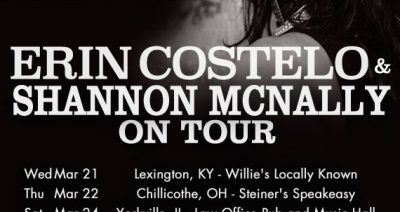
With her new album, The Waylon Sessions, the prolific and wide-ranging Shannon McNally set out to revisit the songs and spirit of Waylon Jennings, a legend with whom she’s always had an ongoing fascination. “I have always loved his defiantly existential but immediately accessible common man’s music and how it boogies,” says McNally. But her collection of tunes ended up being not so much a tribute as it is a recontextualization; a nuanced, feminine rendering of a catalog long considered a bastion of hetero-masculinity.
That’s not to say McNally has a softer, gentler take on Jennings’ songs—in fact, just the opposite. Over and over again, she manages to locate a smoldering intensity, a searing hurt buried deep within the music’s deceptively simple poetry, and she hones in on it with surgical precision on this new album, which features special guests like Jessi Colter, Buddy Miller, Rodney Crowell, and Lukas Nelson. “The world has changed a lot since these songs were first recorded,” says McNally. “I have never heard a woman sing any of them, but these tunes are poignant and relevant to me and to women in general right now. As a songwriter, bringing a song to its full potential so that a larger or different audience can connect is all I’ve ever cared about.”
When Blue Rose’s founder, Joe Poletto, asked McNally the question every artist wishes they could hear when it comes to making a record, “What would you do if you could do anything?” McNally didn’t even need to think before she answered. “An Album of Waylon.” “What Waylon Jennings brought to country music is what country music needs right now, and that unapologetic and vulnerable sense of self are what women are tapping into artistically right now as the industry evolves,” says McNally. “Because of the nature of this business, I’ve spent most of my life moving through a man’s world. I love men and I accept them for the complex critters they are, but when #MeToo started unfolding, I was hearing all these powerful stories and remembering all my own experiences, and I realized just how much of myself I’d been suppressing to get by. The system and the ways I’d learned to survive in it were cracking wide open, and suddenly I felt this freedom I’d never felt before.”
McNally knew that assembling the right band would be essential to capturing Jennings’ mix of laid back charm and swaggering bravado, so she called AMA-winning guitarist Kenny Vaughan (Marty Stuart, Lucinda Williams) to help her assemble a team that included drummer Derek Mixon (Chris Stapleton), pedal steel legend and longtime Jennings bandmate Fred Newell, Texas keyboard mainstay Bukka Allen (Robert Earl Keen, Jerry Jeff Walker), and bassist Chris Scruggs (Marty Stuart, Charlie Louvin). Working live and raw, they tracked sixteen songs in just five days, relying on instinct and intuition to guide their decisions at every turn. As brilliant as the band’s performances are, it’s McNally that breathes new life into the music here, tackling the tunes with an honesty and a maturity that transcends genre and gender. She doesn’t swap pronouns or couch her delivery with a wink; she simply plays it straight, singing her truth as a divorced single mother in her 40’s in all its beauty, pain, and power.
“My goal wasn’t to force anything onto the music that wasn’t there already,” explains McNally. “There’s a feminine perspective hidden somewhere inside each of these songs. My job was to find a way to tap into that and draw it out.” The result is that rare covers record that furthers our understanding of the originals; an album of classics that challenges our perceptions and assumptions about just what made them classics in the first place.
Born and raised on Long Island, McNally has, at various points, called New Orleans, Nashville, and Holly Springs, Mississippi, home, but it was in Los Angeles that she first came to national attention in the early 2000s with her Capitol Records debut, ‘Jukebox Sparrows.’ Recorded with a Murderer’s Row of studio legends including Greg Leisz, Benmont Tench, and Jim Keltner, the collection garnered high profile spotlights everywhere from NPR to Rolling Stone, earned McNally slots on Letterman, Leno, and Conan, and led to dates with Stevie Nicks, Robert Randolph, and John Mellencamp among others. She followed it up in 2005 with ‘Geronimo,’ a critically acclaimed sophomore effort that prompted the New York Times to call her “irresistible” and the Washington Post to hail her as “a fine lyricist who often calls to mind Lucinda Williams.”
A restless creative spirit with a magnetic personality, McNally would go on to release a wide range of similarly lauded albums, EPs, and collaborations over the next 15 years, performing on stage and in the studio with the likes of Willie Nelson, Dr. John, Bonnie Raitt, Levon Helm, Charlie Sexton, Derek Trucks, Terry Allen, and many more along the way. In 2018, she partnered with Joe Poletto at Blue Rose to develop her new album, The Waylon Sessions—a collection of songs from Waylon Jennings and his outlaw cohorts. The album will be released on Compass Records on May 28, 2021.
I Draw Slow is one of the most unique bands on the Americana scene. Fronted by brother/sister songwriting team Dave Holden (guitar/vocals) and Louise Holden (vocals), this Dublin, Ireland-based group sits squarely at the crossroads of Irish and Appalachian music and has received critical praise for an original sound that bridges the gap between traditional Irish and American roots music.
But as the pandemic closed in and touring came to a halt in 2020, the group was forced to put their burgeoning career on hold. It was a time of tremendous personal upheaval, with the loss of loved ones to COVID and subsequent months of grief for the Holdens. The dark days were made even more challenging by their isolation from each other and from their band mates Konrad Liddy (upright bass), Colin Derham (banjo), and Adrian Hart (fiddle). Without the panacea of music and the joy of creating and playing together to help them heal, they were left in their separate worlds to ride out the pandemic alone.
The trauma wrought by the pandemic is ultimately what defines I DRAW SLOW, the band’s new self-titled release. The process of writing and recording the album was completely unlike any of the band’s previous albums. They each wrote and rehearsed separately and, by the time they finally convened in a farmyard studio in the Dublin mountains to record, they found they had undergone a fundamental shift in their outlook on music and on life. Sonically, the traditional Irish and Appalachian influences that inform I Draw Slow’s prior releases were augmented by a much wider range of influences, including sixties pop, cinematic soundscapes and the funereal jazz of New Orleans. Lyrically, the new tracks pulled storytelling and tradition apart. As Louise says: “The new music represents tradition in the mixed up way that people live now, with the stories we tell to stop ourselves from going crazy and the false memories we build ourselves upon.”
I DRAW SLOW starts with the arresting opener “Bring out Your Dead”, a track that would not be out of place on Fleetwood Mac’s album TUSK (if the Mac played trad Irish music), with vocal echos of The Mamas & The Papas thrown in for good measure. The band then channels New Orleans trad jazz on the track “Trouble”, replete with rudimental snare and mournful brass. And on the duet “Queen of the Wasteland”, adorned by clawhammer banjo, fiddle and acoustic guitar lines, IDS draws upon Ireland’s long folk song and storytelling tradition to create a neo-folk classic that is both timely and timeless.
But it is perhaps the track “Dearly,” with its evocative lyric: “Sunburnt sienna, oxidised copper, the colours discovered by harm” that best describes the culmination of this project. Ultimately, this album captures a pivotal moment in a shared human tragedy and offers a stunning portrait of the beauty that I Draw Slow salvaged from their collective pain.
With the release of their new album, I Draw Slow further cements their reputation as one of the most interesting groups on the Americana/roots scene. Coaxing the past into the present, they have created a very personal sonic tapestry that has drawn fans on both sides of the pond and earned them slots on some of the most important festival stages across North America including MerleFest, Edmonton Folk Festival, Rocky Grass and Wintergrass. With the expansive musical platform of their newest release as a launching point, the possibilities for where I Draw Slow’s musical journey will take them next is limitless.
Bobby Osborne is one of bluegrass music’s true innovators. His trailblazing work with The Osborne Brothers, who charted 13 Billboard Country top 100 hits in the 1960s and 70s, took the sounds of the banjo, mandolin and Bobby’s one of a kind tenor voice to a mainstream audience. Blurring the boundaries between bluegrass and country music with the addition of electric bass, drums and cutting edge instrumental performances, the Osborne Brothers are, in a sense, the connective tissue between the first generation creators of bluegrass and newgrass which has in turn paved the way for the diversity and innovation that characterizes contemporary bluegrass music.
Even at 89 years old, when Bobby Osborne could be resting on his many laurels, he is still driven by a desire to push the musical envelope. His current single, a creative reworking of Merle Haggard’s 1960’s classic “White Line Fever” is the latest collaboration between producer/banjoist/Compass co-founder Alison Brown and Osborne since the 2017 release of his GRAMMY-nominated album Original. Feeling that the song needed an additional verse, Brown and co-producer Garry West reached out to Jeff Tweedy (Wilco). Tweedy contributed the perfect handful of lines, telling Osborne’s story with nods to his time in Kentucky and Ohio as well as his 60+ year career on the road. The track features Tim O’Brien and Trey Hensley on harmony vocals and a crack band consisting of Sierra Hull (mandolin), Stuart Duncan (fiddle), Trey Hensley (guitar), Todd Phillips (bass) and Brown on banjo.
The new single is a fitting musical follow up to 2017’s Original which earned Osborne extensive press acclaim including a feature on NPR, an IBMA Award for Recorded Event of the Year and his first ever music video for his cover of the Bee Gees’ “I’ve Gotta Get a Message to You.” Other highpoints of the album included the never before recorded Darrell Scott song “Kentucky Morning,” and a cover of “Make the World Go Away” featuring Vince Gill, Molly Tuttle and the lush twin fiddles of Buddy Spicher and Matt Combs evoking Music Row circa 1962. About the album Bobby had this to say: “We [The Osborne Brothers] didn’t want to sound like nobody else. And that’s the way I want to be on this CD, too.”